Women entered the workforce, but household responsibilities were not redistributed accordingly. They still take on most of the care of children and older people, at a cost to their work, income and time. The diaNEOsis study, “Between the Genders: Paths, Gaps and Policies Towards Equality”, by Antigoni Lyberaki, Katerina Glyniadaki and Thomas Georgiadis, examines the past 50 years. Women’s greater economic independence has not been matched by a corresponding redistribution of unpaid work.
“Women embrace egalitarian behaviour wholeheartedly, while men resist both because they feel threatened and because their mother was different,” says Antigoni Lyberaki, professor of economics at Panteion University and one of the study’s authors.
The second shift is still women’s work
The figures are clear. According to the data cited in the study, women aged 25 and over spend four times as long on housework as men. Among couples without children, 76% of women regularly do housework, compared with just 7% of men. Inequality, then, exists before motherhood. When children arrive, demands increase: in families with children, 86% of women and 46% of men provide daily care. In the EU, the corresponding figure for men is 67%. Care is still treated as the woman’s primary responsibility, even when both partners work.
Home life shapes careers, too
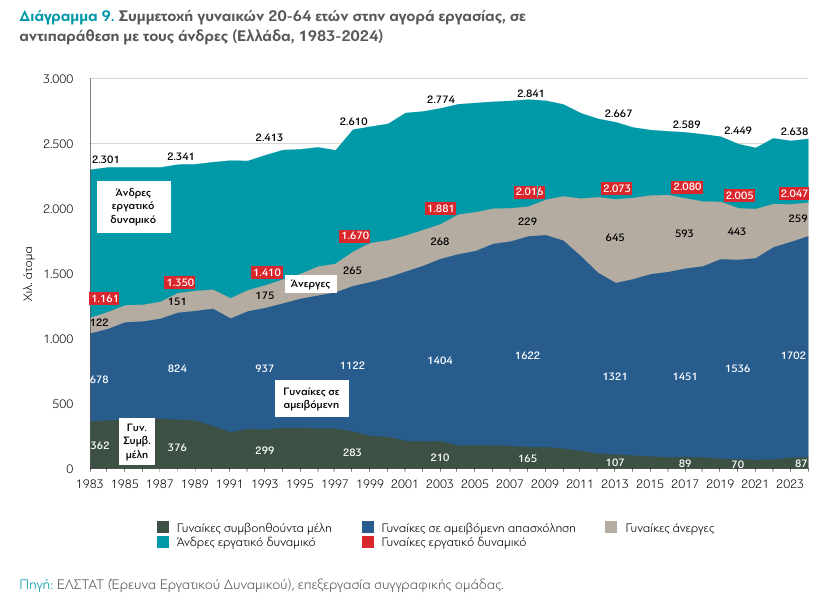
This division has measurable consequences. In 2023, nearly one in four economically inactive women aged 20 to 64 said they were neither working nor looking for work because they were caring for children or older people. A lack of adequate care services limits their choices. For those who remain in work, family responsibilities can mean fewer working hours, interruptions to their careers and fewer opportunities for progression. In 2024, 59.9% of women aged 20 to 64 were in work, compared with 78.7% of men. Greece had the EU’s second-lowest female employment rate. The gap between men and women stood at 18.8 percentage points, almost twice the EU average.
Economic independence comes with conditions
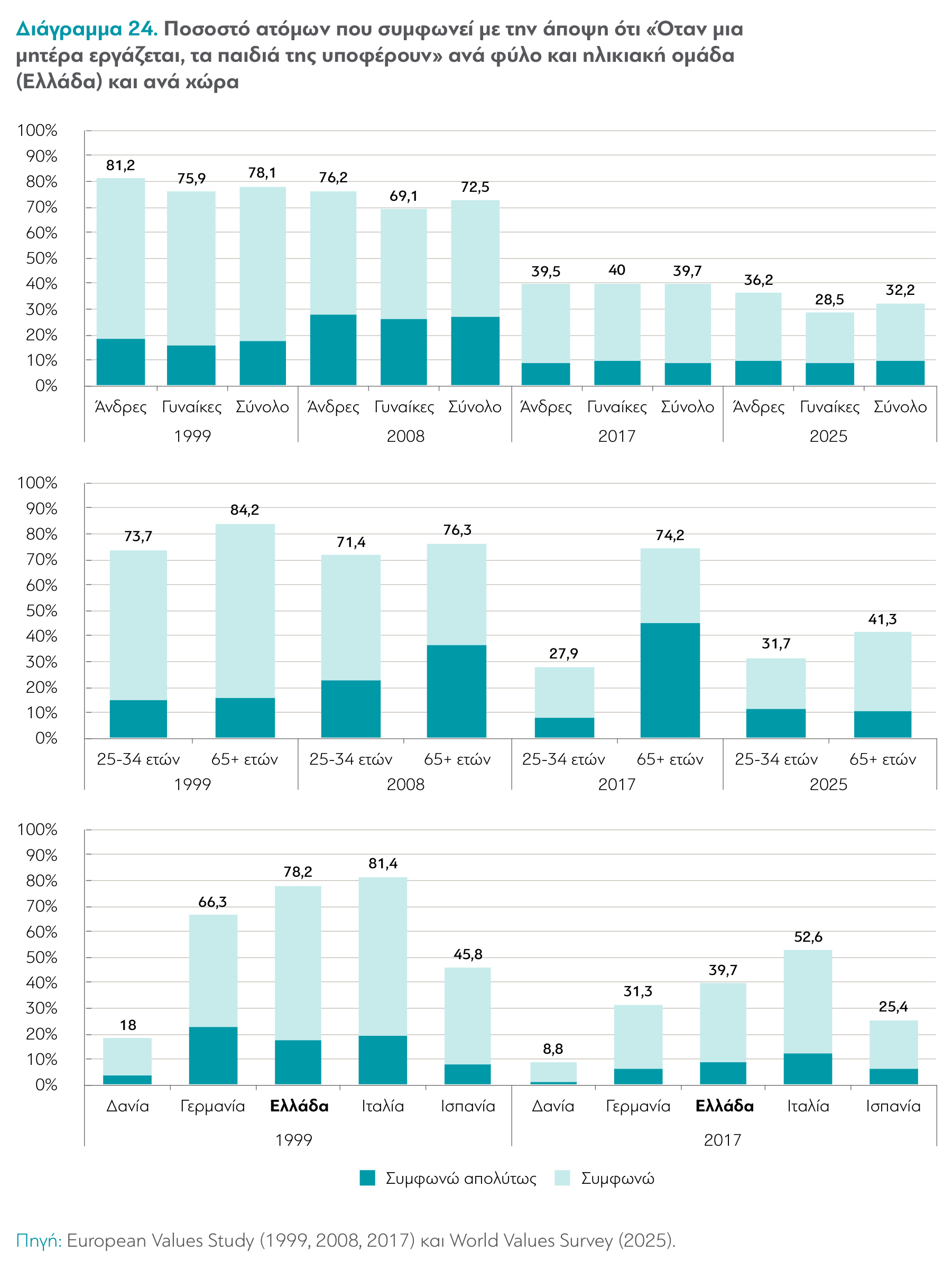
The contradiction is reflected in Greeks’ own responses. According to the 2024 Eurobarometer cited in the study, 95% agree that economic independence is equally important for men and women. At the same time, 70% believe family life suffers when the mother works. The researchers link the coexistence of these conflicting views to “cognitive polyphasia”: the same person may support equality while also accepting traditional roles that constrain it. Women’s independence is recognised as a value, but responsibility for the family is still assigned to the mother.
The gender pay gap
Greece’s gender pay gap, which had narrowed to 10.4% in 2018, widened again to 13.4% in 2024. The study finds that the main mechanism widening pay inequalities is the so-called “motherhood penalty”. Having a child very often acts as a professional and financial “punishment” for the mother, as many employers assume that mothers are not committed to their work.
It is no coincidence that, despite significant progress in recent decades, Greek women’s participation in the labour market remains among the lowest in Europe. In 2024, the female employment rate reached 59.9%, the highest ever recorded in the country, but still the second-lowest in the European Union. The employment gap between men and women remains almost twice the EU average: 18.8 percentage points, compared with 10.
Young people are not always more progressive
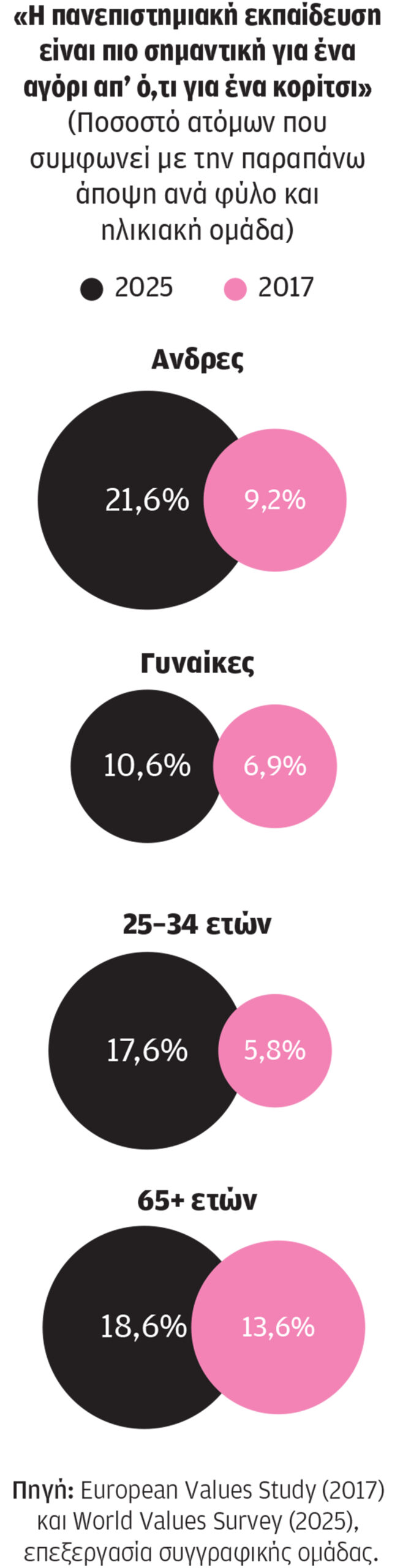
Changes in attitudes towards education are even more worrying. The proportion of men who consider university studies more important for a boy than a girl rose from 9.2% in 2017 to 21.6% in 2025. Among women, it increased from 6.9% to 10.6%. Among people aged 25 to 34, regardless of gender, the proportion nearly tripled, from 5.8% to 17.6%. Among those aged 65 and over, it rose from 13.6% to 18.6%. The reversal affects both genders, but is more pronounced among men and younger people. A change of generation does not in itself guarantee a change in attitudes.
The cost continues after work
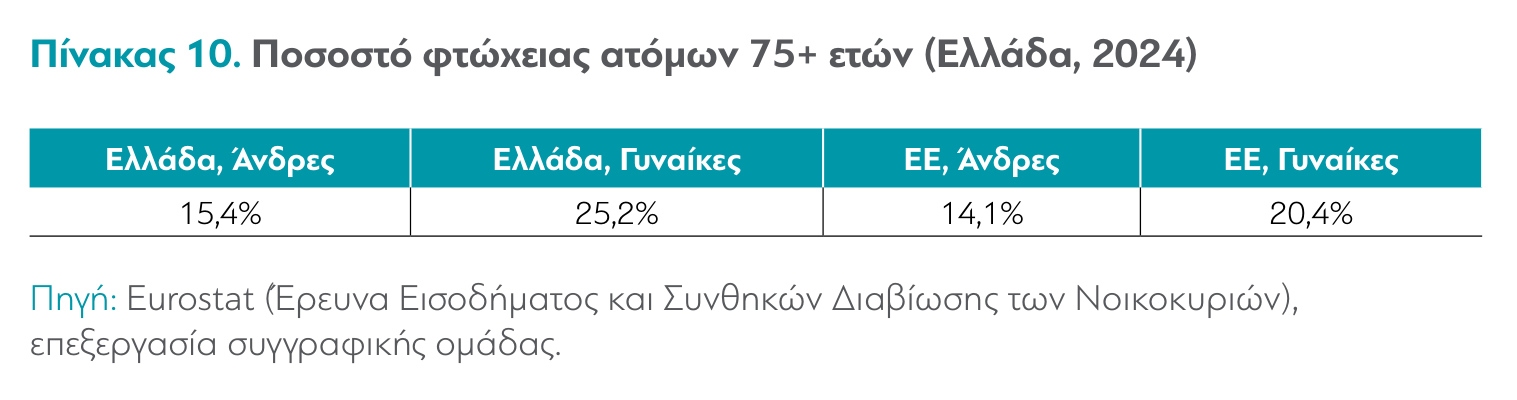
Inequalities over an entire working life also affect people in old age. In 2024, the poverty rate among women aged 75 and over was 25.2%, compared with 15.4% among men. Career breaks and lower earnings limit financial security. Women also remain under-represented in decision-making: in 2025, they held about 27% of board seats at listed companies, compared with 35% in the EU.
Change requires sharing responsibility
The study proposes accessible care services, incentives for fathers to take parental leave, pay transparency and action to address stereotypes in education. The burden of adjustment cannot continue to fall on women. Employers, the state and men within the family all have a role in the discussion. When care is routinely assigned to the mother or daughter, her career choices and economic independence are constrained. Who cares for a child or an older person is, ultimately, a question of equality with consequences for an entire life.
Source: The diaNEOsis study