Some international media outlets have published articles arguing that France could become the new Greece because of its political and fiscal impasse, despite advantages such as its productive base, large domestic deposits and so on.The European ratings agency Scope downgraded France to A+ from AA-, with a stable outlook, while upgrading Greece.
Many expected Moody’s to downgrade France’s credit rating, triggering a fresh wave of selling in French securities, but it did not. As a result, some praised it for going against the market grain, while others argued that the ratings agency had backed down, accusing it of applying double standards depending on the country.
It is worth recalling that at the start of Greece’s debt crisis, Moody’s did not follow the other ratings agencies, which downgraded the Hellenic Republic early. Instead, it chose to wait, on the recommendation of the French analyst (coincidentally) responsible for Greece. The analyst was eventually dismissed, and Moody’s aggressively downgraded Greece by several notches in 2010. The episode does not appear to have faded from the foreign ratings agency’s memory, as it seems to take the toughest line on Greece.
Today, markets charge France more to borrow than Greece — something unthinkable just a few years ago — while the major ratings agencies continue to assign Greek debt a substantially lower rating than French debt. Clearly, those who “vote” with their money believe their chances of getting their loans back are higher if they lend to Greece rather than France.
A look at the trend in Greece’s and France’s macroeconomic indicators over the past five years, and at forecasts for 2026-2027 from the European Commission, the IMF and other organisations, helps explain why markets demand a higher yield from France.
According to the IMF, France is the eurozone’s weak spot, with growth forecast at 0.4% this year and 0.7% in 2027, compared with 1.8% and 1.7% for Greece, respectively. France will continue to run large budget deficits and its debt will rise, while Greece is expected to post a primary surplus of 3.6% of GDP and see public debt fall to 136.6% of GDP.
A look at the two countries’ performance over the past five years shows that Greece’s average growth rate was 4.2%, compared with 2% for France. In addition, France’s public debt rose to 119% of GDP from about 110% in 2023, while Greece’s fell to 146% of GDP in 2025 from 209.4% in 2020. Greece posted a fiscal surplus of 2% of GDP last year, compared with a deficit of 5.1% of GDP in France.
Where Greece lagged behind France was in its comparatively higher inflation and larger current-account balance.
The chart shows that Greece has the lowest S&P rating, at “BBB”, yet markets lend to it more cheaply than to countries such as Italy, rated “BBB+”, Lithuania and France.
Who is right: the markets or the international ratings agencies? The answer will be clear a year or two from now.
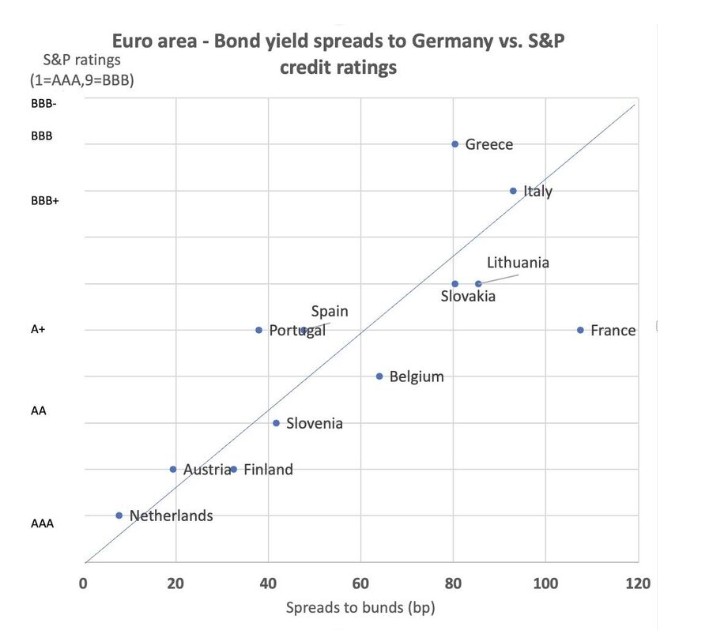
Source: Amauri Goguel