The deterioration in the key factors driving electricity costs underscores how critical the situation is ahead of winter, with the market fearing a fresh, prolonged power-price shock in November and the government continuing to insist on keeping subsidies off the table.
For now, the measure does not appear to be under consideration, as relevant officials reiterated yesterday, continuing to present switching from green tariffs to fixed-price blue tariffs as consumers’ main “defence”.
In reality, despite the government banking heavily on PPC’s aggressive strategy, it is clearly playing defence ahead of winter.
The economic team is also mindful that the crisis could drag on well into 2027, so it is holding resources in reserve for next year — all the more so given that it is an election year.
Caught in the grip of this “polycrisis”, Europe is preparing to face winter with nuclear generation down 13% on last year, hydro generation down 13% and wind generation down 3% — a shortfall that is forcing it to meet its needs with more coal.
The figures show that coal generation has risen by 18% (October 2025-October 2026). Coal is clearly cheaper than natural gas, which is why gas consumption remains at the same level as last year, despite its price having surged by 200% year on year.
The toxic mix driving electricity prices is even more evident in our region, as the map has remained firmly in the red in recent weeks. Expensive natural gas is combining with a prolonged drought — and, in turn, lower nuclear output — pushing up electricity prices across southeastern Europe, including Greece.
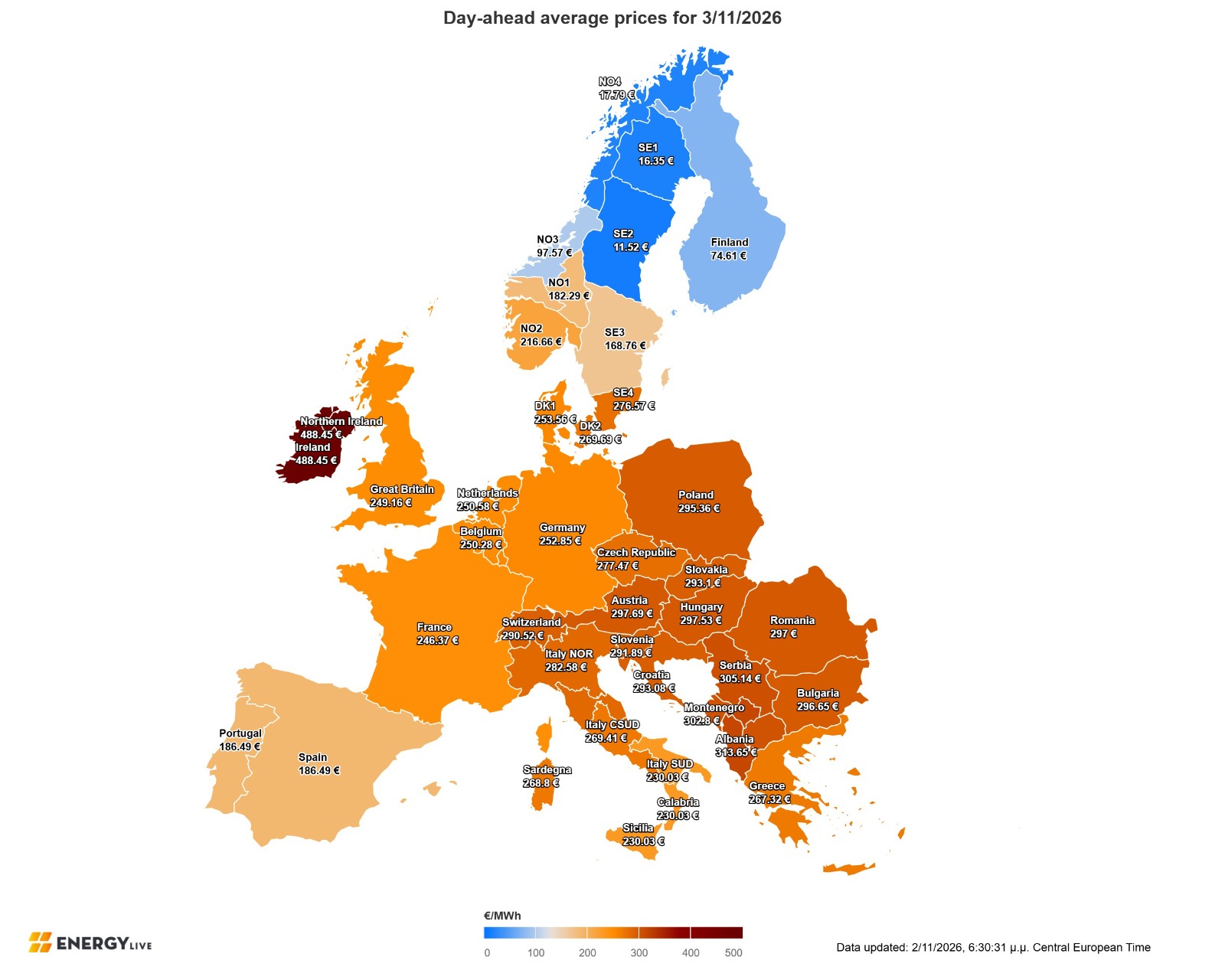
No one in Greece’s electricity market expects prices to ease, and an experienced industry executive’s forecast is telling: November’s average wholesale price will reach €240/MWh, up from €197 in October — another increase of more than 20%. Futures contracts closed yesterday at even higher prices for November (€264.75) and December (€256.79/MWh).
The base case
Solar generation in the EU may be up 28% year on year, but that is not enough to hold prices down. The 27-member bloc is facing a shortfall of 11 terawatt-hours in nuclear and hydro generation and is having to rely heavily on coal, as natural gas is prohibitively expensive, as the table below shows.
EU energy production (October 2025-October 2026)
- Solar: + 4.7 TWh
- Coal: +3.5 TWh
- Natural gas: -0.1 TWh (consumption)
- Wind: -1.6 TWh
- Hydro: -4.4 TWh
- Nuclear: -6.6 TWh
This is also the worst-case scenario for electricity prices this winter, with direct implications for Greece: the situation described above persists; the winter brings little rain — reservoir levels at Greek hydroelectric plants are low, at 1,350 GWh compared with 1,200 GWh on the same date last year — operational problems continue to affect nuclear fleets in France, Romania and Hungary, and gas prices keep climbing above €100/MWh.
“The outlook for natural gas remains strongly bullish, and we still have to see what emerges from the political developments (namely, today’s crucial US elections) and whether the bombing resumes,” Brendan A’ Hearn, a well-known analyst at ICIS, said in a post yesterday, alluding to scenarios of US escalation in the Persian Gulf in the event of a heavy defeat for D. Trump.
The least bad scenario
Asked whether there is a… least bad scenario, experts point to the exact opposite of the one above. As winter sets in, rainfall increases, raising water levels in Europe’s hydroelectric reservoirs; nuclear reactors that are currently offline return to service; and, most importantly, diplomacy in the Gulf delivers results, bringing gas prices well below €100.
The fact that European gas storage levels are not so poor relative to consumption could also help. They stand at 24%, above levels in previous years and enough to get through even a cold winter without additional imports, according to the German government.
Germany’s low gas stocks sparked a verbal spat between Rome and Berlin in recent days. Italy accused Germany of delaying efforts to secure adequate reserves, even as the rest of Europe spends hundreds of millions to do so, and of prioritising the privatisation of energy groups Uniper and SEFE, which play a central role in gas supply and storage. Berlin rejected the accusations.