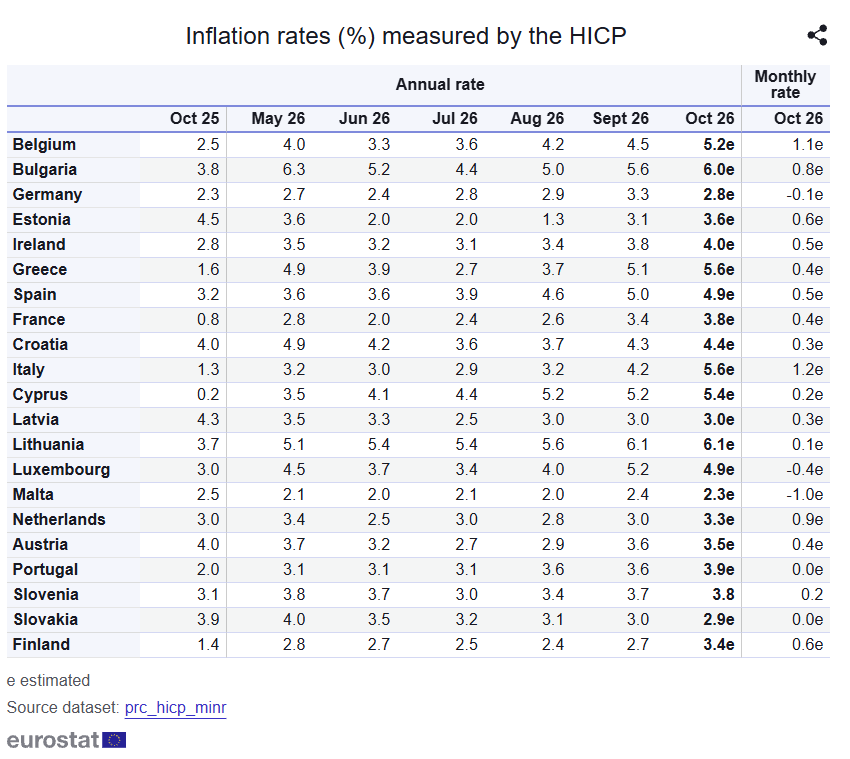
Inflation in Greece was at 5.6% in October, having risen further year on year, according to preliminary Eurostat data. A month earlier, the annual rate was 5.1%.
Annual inflation in the euro zone is estimated at 4.0%, up from 3.8% in September.
Among the main components of inflation in the euro zone, energy is expected to post the highest annual rate in October, at 20.8%, up from 18.9% in September.
This is followed by services, with inflation at 3.3%, up from 3.2% in September; food, alcohol and tobacco, at 1.6%, up from 1.3%; and non-energy industrial goods, at 1.2%, up from 1.1% in September.
Germany’s inflation cools to 2.8%
Annual inflation in Germany is estimated at 2.8% in October at national level, down from the near three-year high of 3.3% reached in September.
This is also below market expectations of 3.0%, according to preliminary estimates from the Federal Statistical Office (Destatis).
Based on the results available so far, Destatis also reports that consumer prices fell by 0.2% month on month.
Inflation, harmonised to allow comparison with other EU countries, also stood at 2.8% year on year, while harmonised consumer prices fell by 0.1% month on month.
Core inflation, which excludes food and energy prices, is estimated at 2.1% year on year in October.
Energy prices rose by 12.2% compared with the same month last year.The rise in energy prices slowed slightly in October, after reaching 14.9% year on year in September.
ECB takes a “measured” approach to inflation
The European Central Bank (ECB) is taking a measured approach to inflation, as most prices remain stable and pressures stem mainly from imported factors rather than the domestic economy, said Emmanuel Moulin, a member of its Governing Council.
As Bloomberg notes, at its meeting on Thursday, the central bank avoided a third interest rate rise since the war with Iran drove up energy prices.
However, officials discussed the possibility of a rate rise, while ECB President Christine Lagarde said that the direction of future monetary policy is “clear” and officials are ready to raise rates in December, if the inflation outlook does not improve, according to people familiar with the discussions.
“Excluding energy and fresh produce, prices remain relatively stable. Likewise, at this stage we are not seeing second-round effects on wages,” Moulin told the French newspaper La Montagne.
“In the current climate, with inflation stemming mainly from imported factors, the ECB is taking a measured approach,” he added.
Moulin, who is also governor of the Bank of France, said the ECB would continue to monitor inflation “very closely” and make decisions at its upcoming meetings based on the data available.
Warnings from ECB officials
In a separate interview with Lithuanian radio, ECB Governing Council member Gediminas Šimkus appeared open to the possibility of further rate rises.
“The fact that there is no rate rise at the moment does not mean there will not be one in the future,” he said, adding that although the likelihood of energy pressures feeding through to other prices had increased, “we are not seeing secondary effects or second-round effects.”
His Estonian counterpart, Ülo Kaasik, said policymakers should respond if inflation spreads beyond energy and expectations of future price rises increase.
“It is no secret that I am quite concerned, because inflation has accelerated and I believe price risks are high,” he said.
“If energy prices remain at their current level and do not start to fall more quickly, we could easily see inflation of 4% in the euro zone in the coming months,” he added.
Primož Dolenc of Slovenia also expressed concern about the outlook for consumer prices, noting that still-elevated energy costs increase the risk of more persistent inflationary pressures.
“Market expectations for inflation suggest that inflation in the euro zone could remain above 2% in the coming years,” he said in a statement.