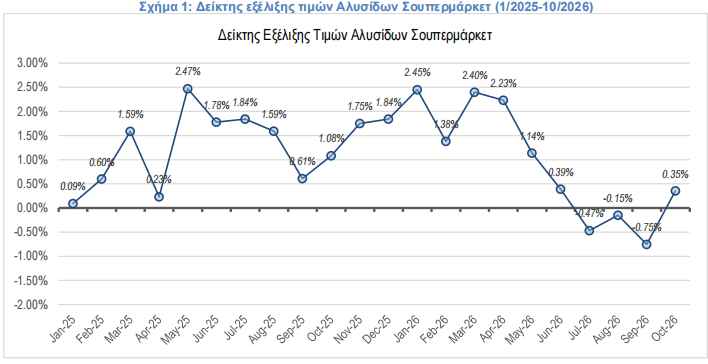
A survey by the Institute of Retail Consumer Goods Research (IELKA) points to stable supermarket prices, with a change of +0.35% in October 2026.
As noted in a related statement, supermarket inflation stood at +0.35% in October 2026 compared with October 2025.
Overall, prices fell by -0.18% over the latest three-month period, from August to October. In the first 10 months of 2026, prices were up 0.90% year on year.
Meanwhile, individual categories showed very small fluctuations compared with the first months of the year.
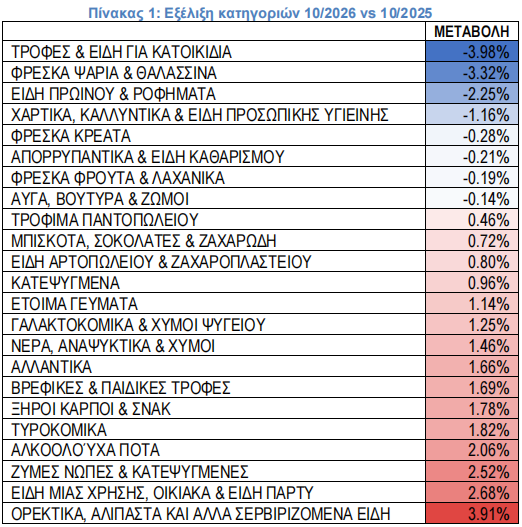
Of the 23 categories surveyed, 15 recorded increases and 8 decreases.
Biggest price falls in October 2026 compared with October 2025
- Pet food and supplies: -3.98%
- Fresh fish and seafood: -3.32%
- Breakfast products and beverages: -2.25%
- Paper products, cosmetics and personal care items: -1.16%
- Fresh meat: -0.28%
The decreases recorded are linked both to the normalisation of the market and to lower producer prices for some products. According to IELKA, the stabilisation seen in fresh products is particularly significant. Producer and import prices for fresh meat are returning to normal. For packaged products, the price-reduction initiative is also considered to have had some effect.
Biggest price rises in October 2026 compared with October 2025
- Appetisers, cured products and other ready-to-serve items: +3.91%
- Disposable products, household goods & party supplies: +2.68%
- Fresh and frozen dough: +2.52%
- Alcoholic beverages: +2.06%
- Dairy products: +1.82%
Factors behind the broader trend of price restraint for supermarket products over the past two years
The price restraint recorded in organised food retail over the past two years is linked to a combination of factors relating both to the way large chains operate and to consumer choices:
- Economies of scale and high sales volumes. Large chains handle significant volumes of products, enabling them to benefit from economies of scale in operations, purchasing and distribution.
- High inventory turnover. Faster stock replenishment allows changes in purchase prices to be reflected more quickly in retail prices. This is particularly important when costs are easing.
- The contribution of private-label products. Private-label products have a significant presence in large supermarket chains, offering more choices at different price points.
- Intense competition between chains. Competition in organised food retail, both on price and through promotional activity, puts pressure on businesses to keep final prices in check.
- Operational and technological efficiency. The use of inventory management, logistics, data and demand-forecasting systems enables more efficient operations and helps limit certain operating costs.
- Changes in consumer behaviour. Greater consumer price sensitivity, the search for special offers and a shift towards cheaper alternatives increase competitive pressure on businesses to update their product listings and refresh their ranges.