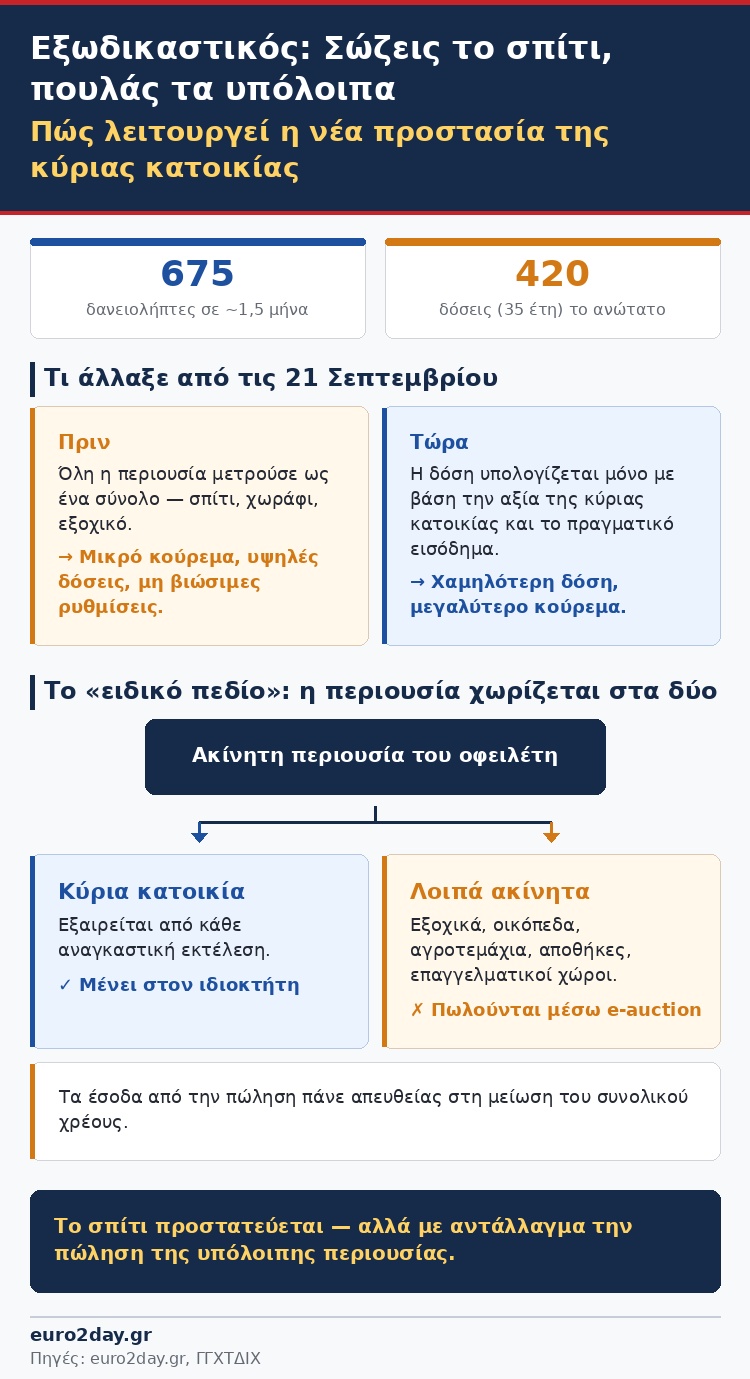
The first tangible results of changes to the Out-of-Court Debt Settlement Mechanism, particularly the provisions for protecting the primary residence, are now clear: 675 borrowers have agreed to the liquidation of other assets to avoid foreclosure of their main home.
According to data from the General Secretariat for the Financial Sector and Private Debt Management (GSFSPDM), in the roughly six weeks since the new measure came into force on 21 September, 675 over-indebted borrowers have opted for the new safeguard under the out-of-court mechanism to save their homes.
Under the previous framework, the out-of-court mechanism’s algorithm treated a borrower’s assets as a single pool. If someone with a non-performing loan and a low income owned, in addition to the flat they lived in, an inherited field or an old holiday home in the village, the system calculated monthly instalments based on the total value of their assets, offering a smaller debt write-off and leaving a larger amount to be repaid in higher instalments.
The result? Unsustainable repayment plans that were either rejected by the borrower or ultimately failed when the debtor could not keep up with payments to the end.
A dedicated field
Under the new procedure, in force since September, submitting an application through the GSFSPDM’s online platform activates a dedicated field for primary residence protection.
If the debtor selects it, the system automatically separates the property they live in and divides their real estate into two categories:
- The primary residence, which is exempt from all enforcement proceedings, and:
- Other properties (holiday homes, plots of land, agricultural land, storage units or business premises), which are made available voluntarily for the benefit of creditors.
Lower instalments
Separating the properties also produces a different repayment plan: the monthly instalment is no longer based on the combined value of all the properties, but is calculated strictly on the basis of the market value of the primary residence and the household’s actual disposable income.
With the value of other properties excluded from the calculation of repayment capacity, the proposal from servicers and banks results in:
- Lower monthly instalments, tailored to the family’s actual means.
- A higher percentage of the debt written off from the outstanding loan balance, particularly when total debt exceeds the value of the main home, and:
- A longer repayment term of up to 420 instalments (35 years) for debts owed to financial institutions.
The price
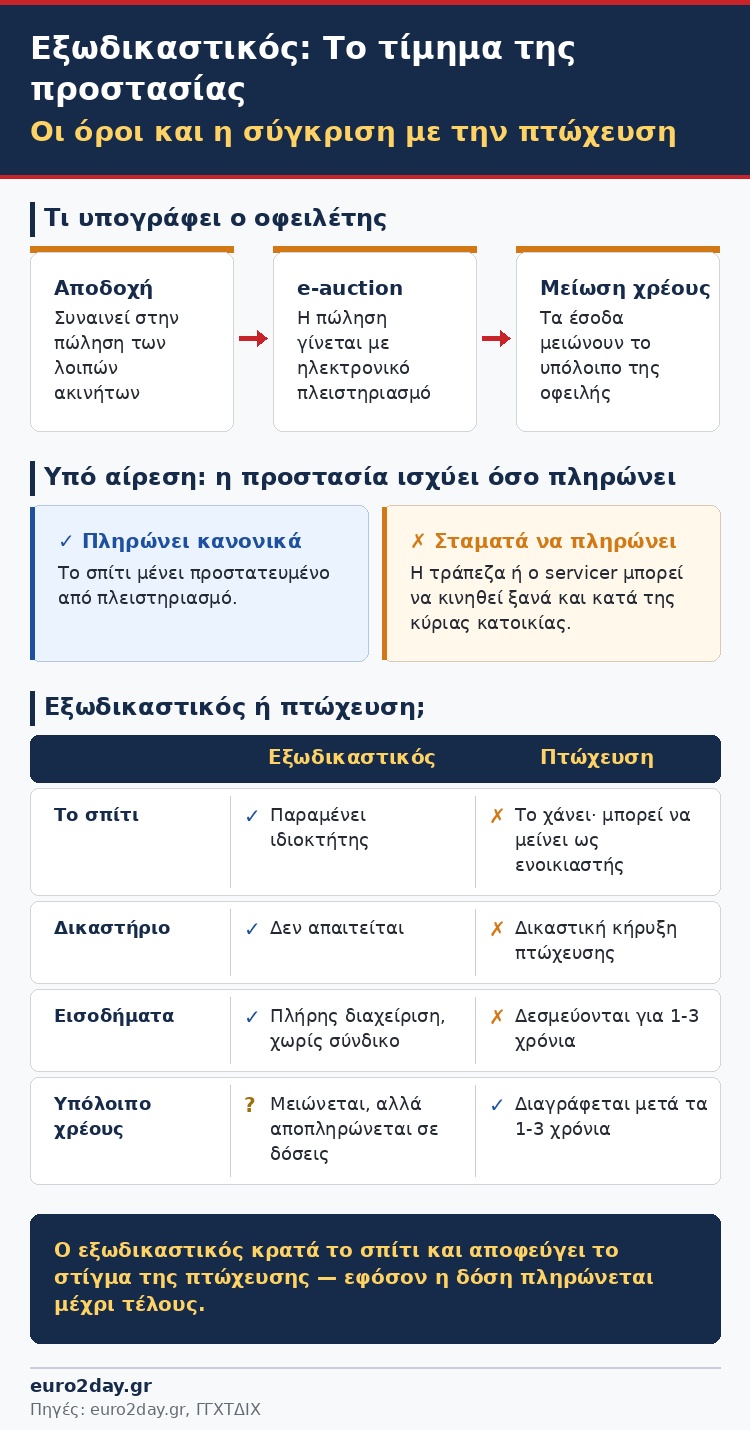
Protecting the primary residence comes at a price, however: the debtor is required to agree to the sale of their other properties, with the proceeds further reducing their debt. By accepting the proposed repayment plan, the borrower also agrees to a clause providing for the voluntary liquidation of those assets.
The sale process is initiated through the electronic auction mechanism (e-auction). The proceeds from the sale of a holiday home or plot of land go directly towards reducing the outstanding debt, correspondingly lowering the amount left to be repaid.
Conditional protection
Compliance with the repayment plan is crucial to protecting the primary residence. In other words, that protection is subject to a “resolutory condition” if payments are not maintained.
As long as the debtor pays the final, reduced instalment they secured, all is well. If the borrower stops paying and defaults on the arrangement, the bank or servicer regains the right to enforce against the primary residence as well.
The stigma of bankruptcy
The main advantage for debtors who choose to protect their primary residence is that they avoid bankruptcy and the stigma it entails.
In personal bankruptcy, the individual loses all their assets, including their home. As they are left with no assets, the remaining debt is written off, unlike in the past, when the balance remained and the debtor continued to owe money.
Despite having lost everything, their income was committed to repaying the debt indefinitely, until it was paid in full. Under the new regime, income can be committed for 1-3 years, after which any remaining debts are permanently written off.
In the event of bankruptcy, the debtor may also continue living in their home under a leaseback arrangement as a tenant.
For vulnerable debtors, however, joining the Special Acquisition and Re-leasing Entity gives them the option to buy back their homes—if their financial circumstances improve—after 12 years.
By contrast, under the upgraded out-of-court mechanism, the borrower:
- Remains the owner of their home, retaining the right to use it and benefit from it over the long term.
- Avoids the court proceedings to declare bankruptcy and their short-term impact on their professional and financial dealings, and:
- Retains full control of their income, without the involvement of a bankruptcy trustee, as long as they comply with the agreement.