International waters, from east of Karpathos to Cyprus, will be the testing ground for the resumption of work on the GSI, the significance of the French-Turkish agreement and how Ankara has assessed Rubio’s messages from Athens — above all, the shift in the balance of power in Washington.
In the wake of the “battle” between NAVTEX notices issued by Greece and Turkey, which began yesterday over the cable to Cyprus, and with the Abeille Marengo warming up its engines for the boundary of Greek territorial waters off Karpathos, the picture remains unclear as to the stance Ankara will ultimately take and the level of its response on the ground.
The coming days will show whether the behind-the-scenes French-Turkish consultations have borne fruit and to what extent there has been an understanding with Paris. They will also show whether Turkey will ultimately be satisfied with being informed or notified, or will insist that its consent be sought for the surveys, part of which, according to the Turkish counter-NAVTEX, lies within the Turkish continental shelf.
The Turkish foreign ministry’s position
In its statement yesterday, the Turkish Ministry of Foreign Affairs said it had not given its consent, that the NAVTEX notices issued by Athens and Nicosia were unauthorised, and that the French vessel was preparing to engage in illegal activity. It also, naturally, referred to the unilateral submission of coordinates to the UN on 18 March 2020.
It also argued that “the process for obtaining the necessary consent from our country has not yet been completed — as required under the established provisions of the international law of the sea for any activity planned within the limits of our continental shelf”, according to the Turkish foreign ministry.
Greek diplomatic sources joined the verbal war, responding to the Turkish foreign ministry’s statement by saying that “the international law of the sea is clear and admits of no different interpretations”, and “that the work of the French research vessel VB Abeille Marengo will proceed according to the company’s operational schedule, in Greek and Cypriot territorial waters and in areas of the Greek and Cypriot continental shelves”.
Set to sail for Karpathos shortly
On the operational front, weather permitting, the vessel is due to set sail from Heraklion over the weekend, heading for international waters east of Karpathos and extending to Cyprus, as the map of its planned route also shows.
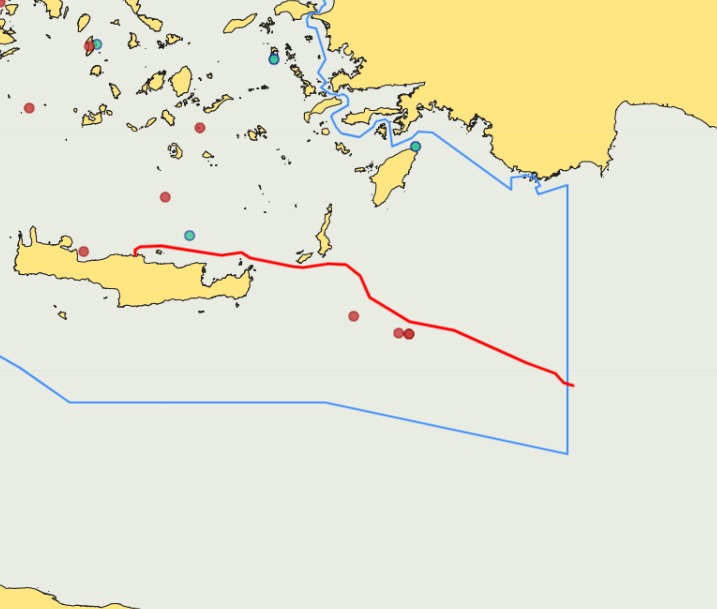
According to reports, in its first few days the Abeille Marengo will calibrate its instruments, checking its sonar systems (sonar) to ensure the accuracy of measurements of sea depth and the seabed, its GPS positioning systems and its seismic equipment (hydrophones, etc.), and generally synchronising its equipment.
For now, the picture remains fluid, with analysts believing that in the coming hours Ankara will seek to obtain written notification that it can use to argue that the vessel ultimately requested and received permission from Turkey to conduct the surveys. This has been, and remains, the Turkish side’s aim: to portray notification as a request for permission.
The best-case scenario
Others argue that, following the blue wave in the US Congress that limits President Donald Trump’s room for manoeuvre in meeting Turkish demands — foremost among them Turkey’s return to the F-35 programme — the neighbouring country will choose to avoid a serious escalation over the Greece-Cyprus cable.
Under this reading, an escalation would put Turkey on the radar of the Democrats, who will take control of both chambers — the Senate and the House of Representatives — in early 2027. Those we have spoken to ask whether, in the current circumstances, Turkey is willing to spend so much political capital on the Greece-Cyprus electricity interconnector, especially given that under international law, surveys for laying a cable are linked to the freedoms of the high seas.
Government sources believe that, following the understanding reached between the French and Turkish sides, the response may be limited to the now customary practice — as it has evolved in recent years — of harassing the vessel conducting surveys over the radio (hailing).
Under this scenario, the Turkish side will insist that it must grant permission, since all surveys in the area must be coordinated with the competent Turkish authorities, as the counter-NAVTEX issued by the Antalya station argues. The Greek side disputes this, as diplomatic sources said yesterday: “the international law of the sea is clear and admits of no different interpretations”.
According to this reading, each side will stick to its position, claiming that it has authorised the surveys, which means that they will go ahead despite the legal dispute.