“The issue with the NAVTEX for work on the electricity interconnector cable has been resolved,” Turkey’s foreign minister, Hakan Fidan, told Kathimerini in response to a related question, adding that “everything is normal, everything is fine”.
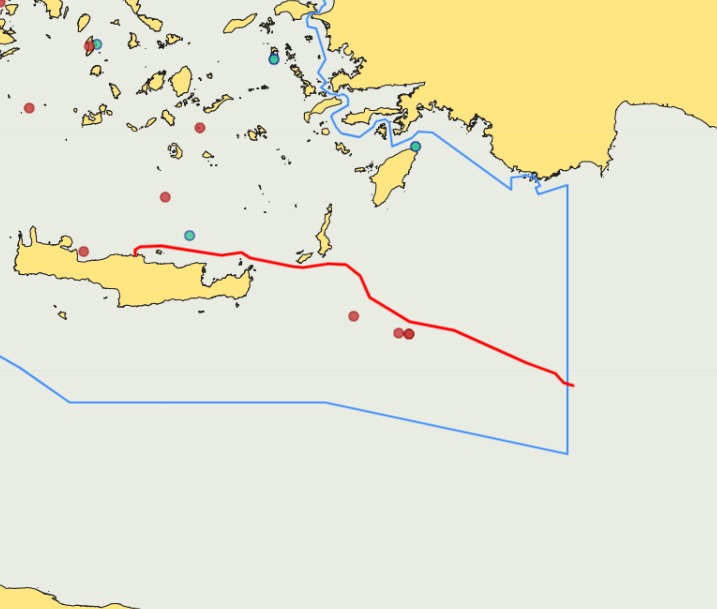
The Turkish foreign minister’s comments come at a critical point for the resumption of surveys for the Great Sea Interconnector (GSI). Meanwhile, the French research vessel Abeille Marengo is preparing to sail from Heraklion towards the area east of Karpathos and as far as Cyprus.
Fidan’s statement adds a new element to the diplomatic dimension of the issue. However, it does not in itself answer the central question: whether Turkey will in practice allow the surveys to proceed unhindered, or seek to impose its own interpretation of the required notification and permitting procedures.
Greek diplomatic sources, referring to Hakan Fidan’s statement on the NAVTEX, said: “Turkey’s domestic handling is not our concern. Greece is the only country with authority to issue permits. It has done what it was required to do under international law and will continue to do so”.
The test on the ground
As Euro2day.gr reported earlier, international waters stretching from east of Karpathos to Cyprus will test not only the resumption of work on the cable, but also the outcome of behind-the-scenes talks between Paris and Ankara.
In the wake of the exchange of NAVTEX between Greece and Turkey, the situation had until recently remained fluid. Turkey’s counter-NAVTEX challenged the legality of the notices issued by Athens and Nicosia, arguing that the process for obtaining the necessary Turkish consent had not been completed.
This position was also set out in a statement by the Turkish foreign ministry, which argued that activities in areas Ankara considers part of its continental shelf require its approval. In this context, it cited the unilateral submission of coordinates to the UN on 18 March 2020.
Greek diplomatic sources responded that the Law of the Sea is clear and admits of no other interpretation. They stressed that the French research vessel’s work would proceed according to the company’s operational schedule, in Greek and Cypriot territorial waters.
Fidan’s statement that the NAVTEX issue has been resolved carries particular weight. The question is whether it reflects a substantive understanding that will also be borne out operationally, or whether Ankara will continue to assert its longstanding positions.
Abeille Marengo sets sail
On the operational front, weather permitting, the Abeille Marengo is expected to sail from Heraklion shortly. It is bound for international waters east of Karpathos and the area extending to Cyprus.
According to the information available, the vessel will spend the first few days calibrating its equipment. This involves checking and adjusting its sonar systems, GPS positioning systems and seismic equipment, including hydrophones.
This phase will also be the first practical test of the surveys’ resumption. The conduct of the Turkish side, any radio communications and the presence of Turkish units will show whether the wording also signals a change at the operational level.
Turkish consent
Until recently, analysts had estimated that Ankara might seek written notification of the surveys and then present this as a request for, and subsequent granting of, its own authorisation. That is, after all, the key difference between the two approaches.
Greece believes the surveys can proceed under the existing framework of the Law of the Sea. Turkey, by contrast, insists that activities in areas it claims as part of its continental shelf must be coordinated with its competent authorities.
The Turkish foreign minister’s statement leaves open the possibility that some form of diplomatic arrangement has been reached, without clarifying its terms. Whether this concerns only the notification process or also acceptance that the surveys can go ahead will become clear in practice.
Messages from Washington
The wider geopolitical context is also a factor. One assessment was that Turkey would avoid a serious escalation over the cable, as this could further strain its relations with Washington.
The new political landscape in the US Congress, with Democrats strengthening their position and set to take control of both chambers in early 2027, limits Donald Trump’s room for manoeuvre in meeting Turkish requests, most notably for F-35s.
Meanwhile, behind-the-scenes contacts with France are in focus. The French presence through the Abeille Marengo gives the issue a European dimension.
One scenario under consideration had been that Turkey would limit its response to radio calls (hailing), with both sides maintaining their differing legal positions but the surveys ultimately proceeding.
After Fidan’s statement, attention is shifting from diplomatic confrontation to events on the ground. The Abeille Marengo’s movements and Ankara’s stance over the coming days will show whether the wording translates into genuine de-escalation around the Greece-Cyprus electricity interconnector.