Low purchasing power among workers and limited growth in social benefits paint a bleak picture of the financial situation facing Greek households, according to Eurostat data for 2025.
The two indicators reflect different aspects of the same reality: the limited ability of income from work to cover living costs, and the role of social protection as a supplementary support mechanism — one that has shown weaker momentum in Greece than in the rest of the European Union.
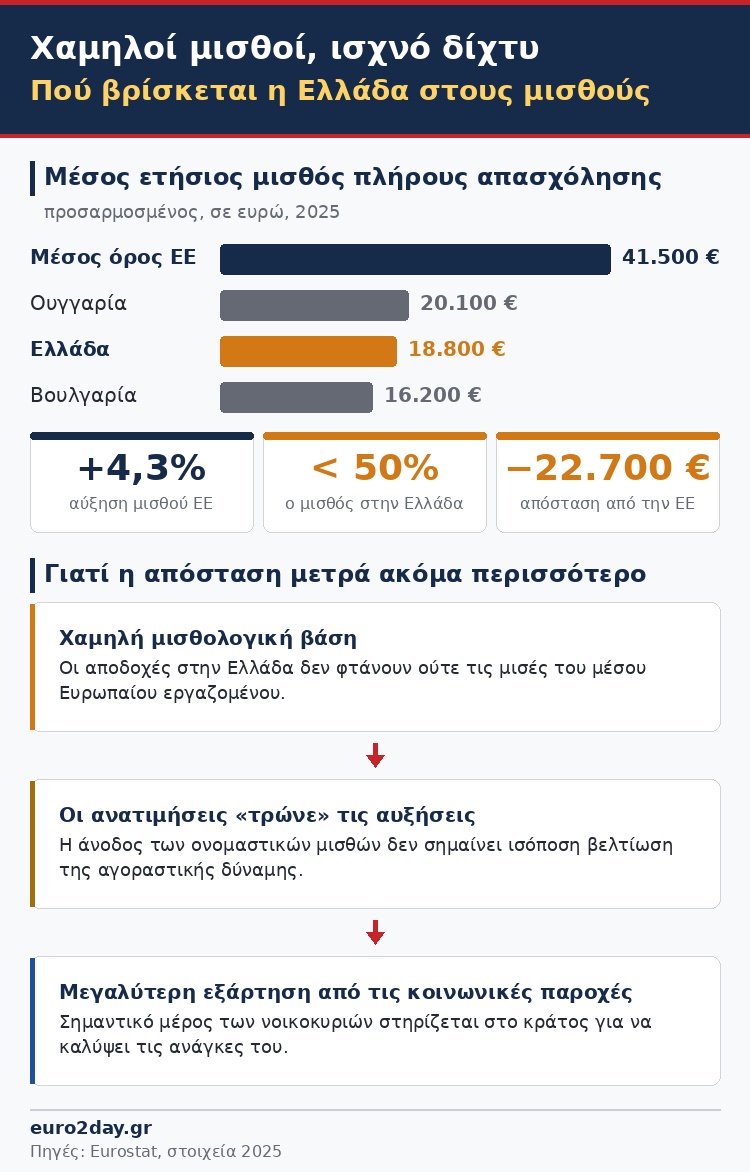
Specifically, the EU’s average annual full-time adjusted salary stood at €41,500 in 2025, up 4.3% from €39,800 in 2024. In Greece, the equivalent figure was just €18,800, placing the country near the bottom of the European rankings, above only Bulgaria (€16,200) and below Hungary (€20,100). Greek salaries amount to less than 50% of the EU average.
The gap takes on greater significance when the cost of living is taken into account. Higher nominal salaries do not automatically translate into a corresponding improvement in purchasing power, as rising prices for essential goods and services erode the real benefit to workers. As a result, the low wage base increases the dependence of a significant proportion of households on social benefits.
Social protection
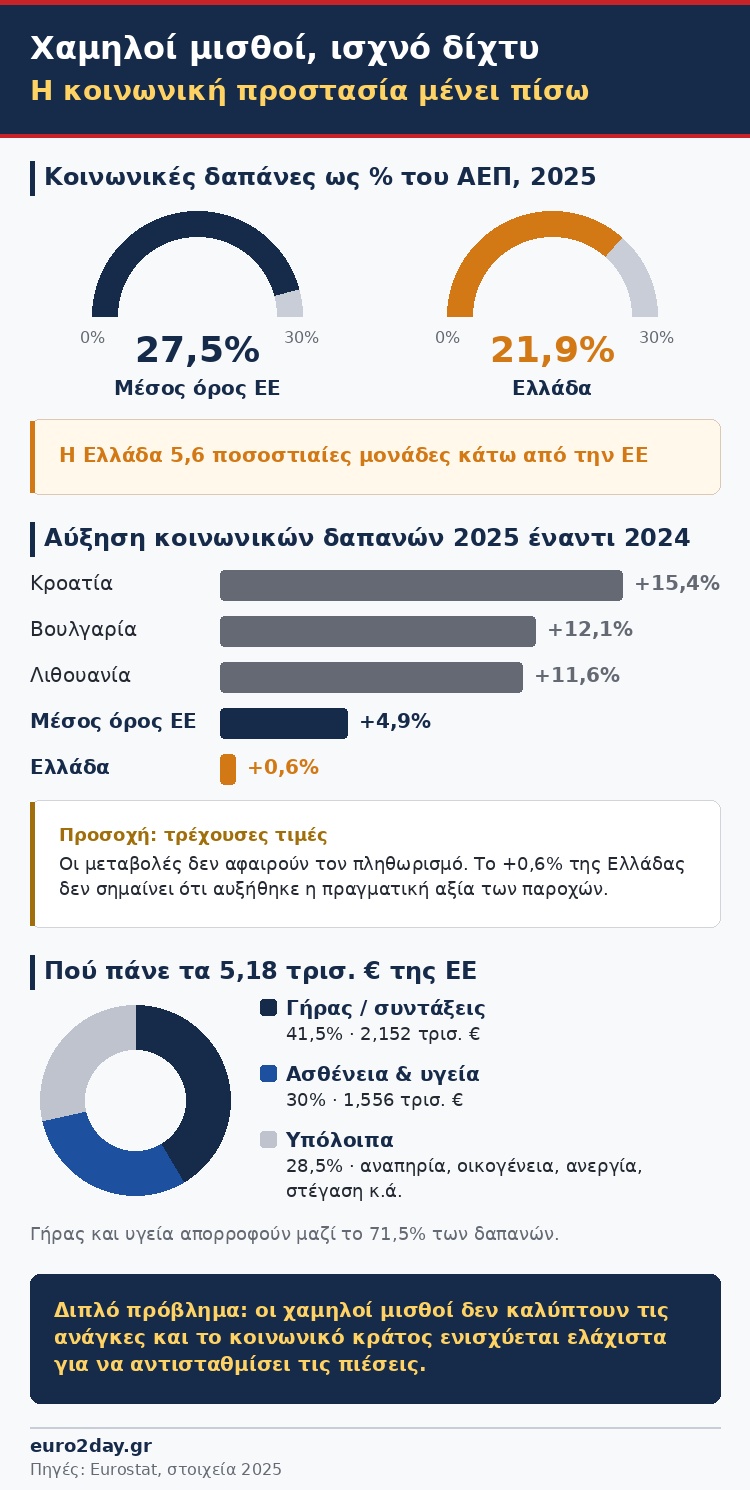
Social protection, however, has also shown little momentum in Greece. Across the EU, total social benefits expenditure reached €5.18 trillion in 2025, up 4.9% from 2024. As a share of GDP, it fell to 27.5% from 27.7% the previous year.
In Greece, the corresponding expenditure rose by just 0.6%, one of the weakest performances in the EU, and amounted to around 21.9% of GDP — 5.6 percentage points below the EU average. The 4.3-percentage-point gap between the increase in Greek and EU spending reflects the limited strengthening of the social safety net.
The contrast is even sharper when Greece is compared with countries in Central and Eastern Europe, where spending rose at double-digit rates, including Croatia (15.4%), Bulgaria (12.1%) and Lithuania (11.6%).
It is worth noting that these changes are in current prices and do not represent real increases after inflation. The marginal 0.6% rise in Greece therefore does not mean that the real value of benefits increased by the same amount.
At EU level, the largest share of social spending goes to old-age benefits, which amounted to €2.152 trillion (41.5% of the total), and sickness and healthcare benefits, at €1.556 trillion (30%). Together, the two categories account for 71.5% of spending, with the remainder covering disability, survivors, family and children, unemployment, housing and social exclusion.
The data highlight the Greek economy’s twofold problem: low salaries limit workers’ ability to meet their needs on their own, while weak growth in social spending constrains the state’s capacity to offset pressure on incomes.