TITAN: Several issues came together at the group (pictured: Dimitris Papalexopoulos) over a single quarter. But even allowing for the exceptional circumstances, the market was puzzled by the group’s… accordion-style approach to its full-year guidance.
In the third quarter, the group’s cement grinding plant in Virginia was unexpectedly taken out of operation, while delays continued to hamper Titan America’s cement supplies from Egypt because of disruption caused by the closure of the Strait of Hormuz.
As a result, it had to buy cement from third parties to fulfil its orders. The Virginia plant shutdown alone cost €6 million in third-quarter EBITDA, according to management, which said the problem was resolved in September.
At the same time, heavy rainfall in Florida during September further dampened already weak demand amid a slowdown in residential construction. However, the problem of delays in unloading at ports had begun in the second quarter.
In this context, continued difficulties in cement supplies could have been anticipated, as could the slowdown in residential construction resulting from higher borrowing costs.
TITAN II: The difficulties were evidently underestimated, leaving the group… short of its target in the updated guidance for organic earnings it provided at the end of July, and prompting it to scale back that guidance.
It now expects EBITDA to rise by a mid-single-digit percentage. This year’s benefit from its cost-saving programme, Project Prime, is expected to reach €60 million (of which €40 million was achieved in the first nine months), while acquisitions are expected to contribute €36 million to EBITDA (€25 million from Tracim and €11 million from Keystone).
It will be recalled that on 30 July Titan management updated its guidance for this year’s EBITDA to a low double-digit percentage.
Next year will begin with cement price increases for Titan America (of $12 per tonne), while prices for other materials will also be raised. Management expects margins in the US to widen as a result of these price increases, €30 million in synergies from the addition of Keystone and further productivity improvements.
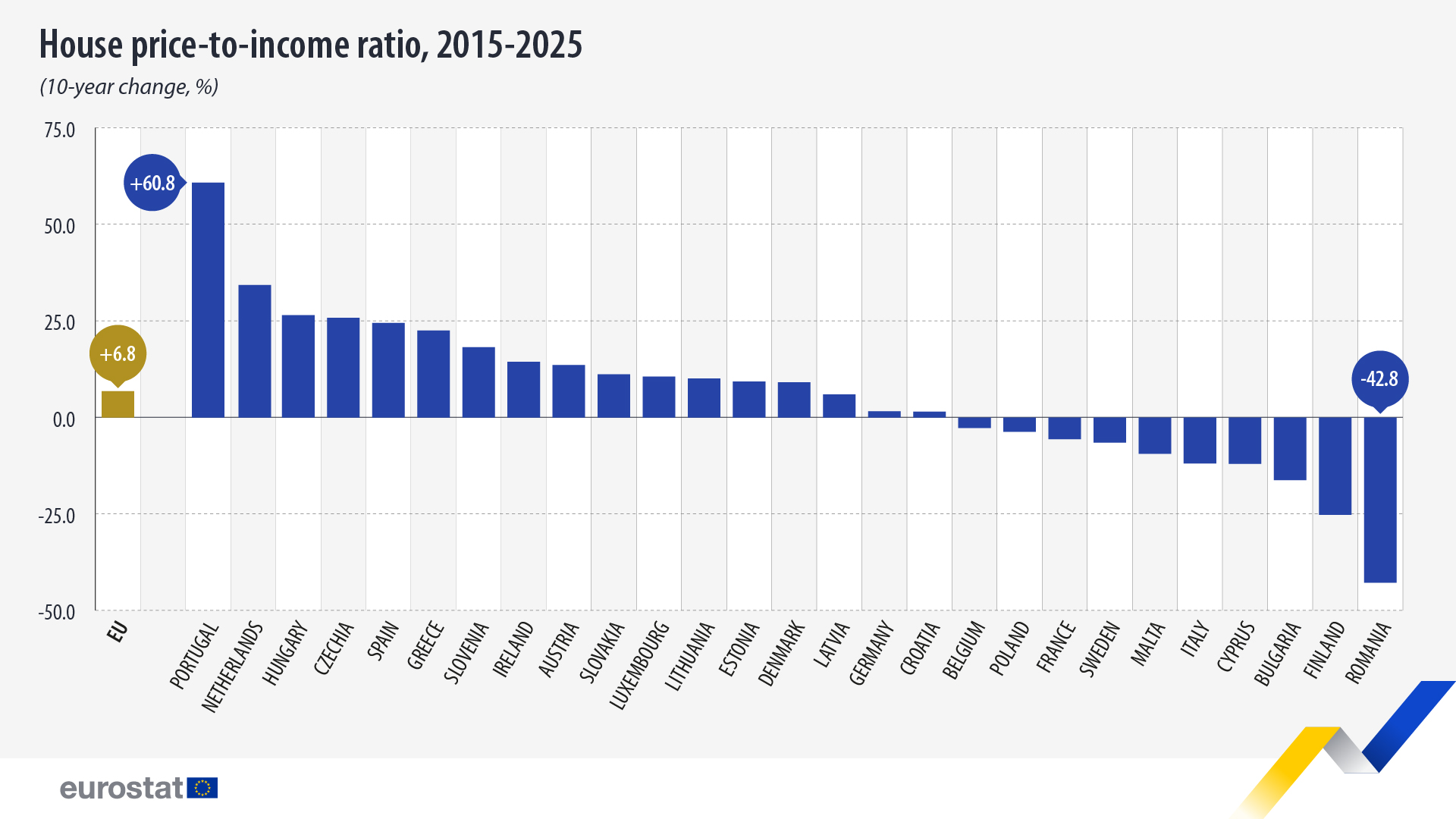
HOUSING: We know that Greece is facing a serious housing crisis. But yesterday’s figures from Eurostat add a dimension worth noting.
From 2015 to 2025, Greece’s house-price-to-disposable-income ratio rose by about 22.5%, compared with just... 6.8% on average across the EU.
We rank sixth among the 27, with only Portugal, the Netherlands, Hungary, the Czech Republic and Spain faring worse on this measure.
So far, you might say, this is just another confirmation of a familiar problem. But something else is particularly significant.
The year the trend began!
In 2015, the country was at the depths of the crisis, with capital controls, a third bailout programme, battered incomes and a property market devastated by recession.
One might therefore have expected a decade of economic recovery to make housing more affordable. The opposite happened. The property market heated up, driven by foreign and domestic investors, real estate development and short-term rentals.
Another Eurostat indicator captures the social cost: in 2025, 26.4% of the country’s residents lived in households spending more than 40% of their disposable income on housing, three times the EU average of 7.7%.
HOUSING II: The other end of the table is also interesting. In Romania, the same indicator fell by 42.8% over the decade. In Bulgaria, it dropped by 16.2%.
That was not because homes became cheaper; prices rose significantly in those countries too. The difference is that incomes grew much faster.
In Romania, median disposable income in 2024 was... 162% higher in real terms than in 2010, according to Eurostat. That was the largest increase in the EU, where the average was 20%. In neighbouring Bulgaria, incomes rose by more than 50%.
The relationship between disposable income and housing costs also improved in Finland (down 25.2%), though subdued demand and falling prices in recent years played a role there.
TSIPRAS: “Integrity” remains a central theme in Alexis Tsipras’s public statements, whether he explicitly contrasts it with “corruption” or hints at the state of affairs today, continually infuriating the prime minister’s office.
Yesterday, during a two-day tour of Epirus, he spoke of “a shift towards production and a shift towards integrity”.
After pointing out that it is the poorest region in the entire EU, the president of ELAS said, among other things, that a policy was needed to support those engaged in production. “And not,” he added pointedly, “one that tolerates or supports those who steal the sweat and toil of these people — the privileged few who, sadly, are favoured both by today’s production model and by Mr Mitsotakis’s New Democracy government”.
During the two-day tour, Mr Tsipras also enjoyed… “a little tsipouro”, as the distillation stills are operating at this time of year to make the traditional spirit, in Epirus and elsewhere.
SYRIZA: SYRIZA is expected to …gain its 14th MP very soon, following the announcement by Andreas Panagiotopoulos, who was elected with the party but is now independent and on his way to ELAS.
Speaking in parliament yesterday, he said that this was “probably” his last speech, signalling that he would resign as an MP and hand back his seat.
The next candidate in Achaea is George Kyriakopoulos, whom party headquarters in Koumoundourou are confident will remain with SYRIZA. They also believe the parliamentary group could number “as many as 20 members”, with indications that some MPs may return (such as Kyriaki Malama) or that newly elected MPs may stay with the party after other would-be ELAS members — currently independents — give up their seats before the holidays.
On the face of it, SYRIZA and PASOK are the only parties increasing their number of MPs without an election having taken place.
The point, of course, is that SYRIZA elected 47 MPs in 2023, then fell to 10 after three splits, and is only now beginning to add members.
PASOK, meanwhile, entered parliament with 32 MPs, lost two along the way through expulsions and now has 36 — gaining five MPs who left the party during the first bailout crisis and ended up in SYRIZA, plus one who was elected with Course of Freedom.
P.S. One more “green” return remains: Nina Kasimati in Piraeus B, which is expected to be completed within the month…
PANATHINAIKOS: Delivery of Panathinaikos’s new stadium in Votanikos is expected to be delayed by at least eight months beyond the contractual deadline of April 2027, according to reports.
If that estimate is confirmed, the target of moving in at the start of the 2027-28 season will be missed. The football club’s management is reportedly already informed the OAKA management that it expects to remain there for the whole of next season.
Behind the scenes, however, the discussion has shifted from dates to cost. The City of Athens’ budget provisions are reportedly insufficient to cover the additional specifications requested by the club. According to the same reports, Panathinaikos wants the shortfall to be covered by municipal or state funds.
That raises the question for the city and the government: which of the additional expenses are necessary to deliver the stadium, and which stem from requests by the club?
And, ultimately, who will pay the difference?
SHIPPING: The market puts the likelihood of a US-Iran agreement to fully reopen the Strait of Hormuz by the end of the year at just 36%, according to forecasts on the Polymarket platform.
The low figure reflects how difficult the equation remains, even with a draft temporary agreement circulating.
The proposal envisages the lifting of the US blockade of Iranian ports and the release of frozen funds in exchange for access for IAEA inspectors to Iran’s nuclear facilities. Tehran would then reopen the Strait through a temporary corridor agreed with Oman.
The problem, analysts point out, is which side will give up its negotiating leverage first. Even an agreement, however, would not automatically restore normality to shipping.
Clarksons Securities estimates that tanker company shares have fallen more sharply than the expected correction in freight rates would warrant. The bank’s shipping share index lost 8% last week, while crude tanker stocks fell 15%, creating a potential buying opportunity, analysts say.
The caution is evident in futures for VLCCs loading in the Persian Gulf, which price in daily rates of around $310,000 for 2027.
EFTHYMIADIS: Leon Shipping & Trading, owned by Panos Efthymiadis, is entering a new phase, having now ordered a total of five newbuildings from Chinese shipyards. As TradeWinds reports, the programme comprises four tankers and one kamsarmax bulk carrier, marking the Greek shipowner’s entry into dry bulk shipping.
Specifically, the company has ordered two 50,000 dwt MR product tankers from Cosco Shipping Heavy Industry (Guangdong), for delivery in March and August 2029. Two LR1 tankers have also been ordered from Jiangsu Yangzijiang Shipbuilding, for delivery in November 2029 and January 2030.
The fifth vessel is a kamsarmax under construction at Hengli Heavy Industries, with delivery scheduled for March 2029.
The total cost of the orders has not been disclosed. Based on current market prices, however, an MR could cost up to $53 million, an LR1 up to $61 million and a kamsarmax around $38 million.
At the same time, Leon Shipping sold two MR tankers it had acquired from International Seaways at the start of the year for $16 million each. The Leon Wisdom, built in 2008, was reportedly sold for $26.5 million, while its sister ship, Leon Grace, fetched $23.5 million.
The two transactions translate into a total gain of around $17.5 million compared with the original purchase cost.
Leon Shipping & Trading was founded in 2010 by Panos Efthymiadis, who had previously served for 22 years as general manager of the family-owned Lotus Shipping. According to Clarksons, the company also controls two panamax crude carriers built in 2006.
THANASIS MARTINOS: Thanasis Martinos has secured an impressive deal in the second-hand tanker market, with Eastern Mediterranean Maritime (Eastmed) selling the 105,700 dwt aframax Hydra, built in 1999, for $52 million, according to TradeWinds.
The price is around six times the vessel’s estimated scrap value, according to Clarksons data. More strikingly, the Greek shipowner acquired Hydra in 2013 for $20 million, equivalent to around $29 million in today’s prices.
Delivery was agreed to take place in Dubai, and the vessel has already reached the area. With its sale, none of Eastmed’s 25 tankers was built before 2000.
The transaction is part of a wave of purchases by Middle Eastern oil interests, as limited available tonnage, geopolitical risks and sanctions have driven up vessel values. For example, Adnoc Logistics & Services is reportedly spending nearly $300 million to acquire two tankers.
NIKOLAS MARTINOS: Thenamaris, owned by Nikolas Martinos (son of Dinos Martinos, brother of Thanasis), is returning to the LNG carrier market after eight years, with an order for two new vessels worth around $488 million in total from South Korean shipbuilder HD Hyundai Heavy Industries.
According to TradeWinds, HD Korea Shipbuilding & Offshore Engineering announced a 662.9 billion won deal on Monday without naming the buyer. However, shipbuilding market sources link the order to the Greek shipping company.
The two LNG carriers will each have a capacity of 174,000 cubic metres and are scheduled for delivery by the second half of 2030.
Thenamaris’s previous LNG carrier order was placed in 2018, also with HD Hyundai shipyards. The Cool Discoverer and Cool Racer were delivered in 2020 and 2021, respectively.
With the new agreement, the company’s newbuilding orders total 19 vessels, representing investment of more than $1.6 billion in 2026. Its fleet currently numbers 87 vessels, including seven LNG carriers and six LPG carriers.
KRI KRI: Shares in the Serres-based dairy company hit a new record, closing above €37 (€37.1, up 2.91%), while trading also accelerated, exceeding €2.25 million.
The move came despite the company saying in September that it considered it likely that full-year operating profit before interest and tax (EBIT) would come in slightly below its initial target of €60 million, at around €57 million-€58 million.
In any case, the shares are up 95% since the start of the year, while the company’s market capitalisation has surged to €1.22 billion.
COCA-COLA: The stock with the largest market capitalisation on the exchange had just suffered a two-day fall of more than 15%, amid fears over its operations in Russia.
Yesterday it staged an initial rebound, rising to €51, or 2.72%, higher. Its market capitalisation climbed back above €19 billion.
On the “hot” Russian front, Peskov’s statement did not clarify the situation regarding the government’s intentions.
It is worth noting that Citi cut its target price for Coca-Cola HBC to £40 (about €48) in response to the developments.
METLEN: News of a reduction in short positions in the shares of Evangelos Mytilineos has become almost a daily occurrence.
It emerged yesterday that the aggregate net short position reported to the FCA had fallen to 5.61%, from 5.74% on 5 November 2026. The reduction represents 186,454 shares.
The shares rebounded on the market, rising to €45.92, or 1.59%, higher, with trading worth €7.67 million.
SARANTIS: Beta Securities estimates that Sarantis will report nine-month sales of €453.3 million, up 1.1% year on year, ahead of the company’s results announcement today.
Beta expects the trends seen in the first half to continue, with a challenging operating environment in south-eastern Europe, particularly in Romania, and low-single-digit growth in the Greek market.
EBITDA is estimated at €68.7 million, up 1%, while EBIT is forecast to fall 1.4% to €51 million. For the third quarter alone, Beta forecasts sales growth of 0.5% and EBITDA growth of 2.6% to €20.2 million, driven by improved production efficiency in Poland and Greece.
The broker maintains its Neutral rating and €14.50 target price, implying 27% upside. For 2026, it forecasts sales of €605 million, EBITDA of €92.2 million and net profit of €52.7 million, and expects management to provide an updated business plan in the first quarter of 2027.
OPTIMA BANK: Optima Bank is expected to deliver strong earnings momentum in the third quarter, with Axia Alpha Finance forecasting net profit of €59.2 million, up 40% year on year and 4% quarter on quarter.
The bank is expected to publish its results tomorrow, Wednesday, before the start of trading.
Credit expansion remains the main driver of growth, with net interest income (NII) forecast to reach €74 million, up 42% year on year. Performing loans are expected to total €5.99 billion, an increase of 37%.
Meanwhile, net fee and commission income is forecast to reach €21.5 million (+46%), while total revenue is estimated at €100.5 million, up 39%.
Operating expenses are expected to rise 23% to €20.4 million, with pre-provision profit reaching €75.1 million (+49%).
On asset quality, the non-performing exposures (NPE) ratio is forecast to fall to 1.5% from 1.6% in the second quarter, while loan-loss provisions are expected to ease to €7 million.
Finally, the CET1 ratio is expected to remain steady at 11.8%, with deposits reaching €7.41 billion (up 31% year on year).