Another contradiction in Greece’s pension system is highlighted by the OECD report, “OECD Pensions Outlook 2026 – Are We Saving Enough for Retirement?”, which finds that employees face high mandatory contributions but records extremely limited participation in voluntary pension schemes.
The report also points to an even bigger problem: while contribution levels ensure relatively adequate future pensions for employees, the same does not hold for the self-employed.
Choosing low contributions also results in lower pension entitlements for the self-employed. Combined with low retirement saving, this makes the problem worse.
So, despite the rapid growth in funded pension assets, Greece continues to lag significantly in supplementary retirement saving, with the biggest question being what income today’s workers will have when they leave the labour market.
The OECD report’s main conclusion on Greece is that the country is not simply falling behind in building up pension assets, but also has a structural problem in how social security costs are distributed and in ensuring adequate retirement income.
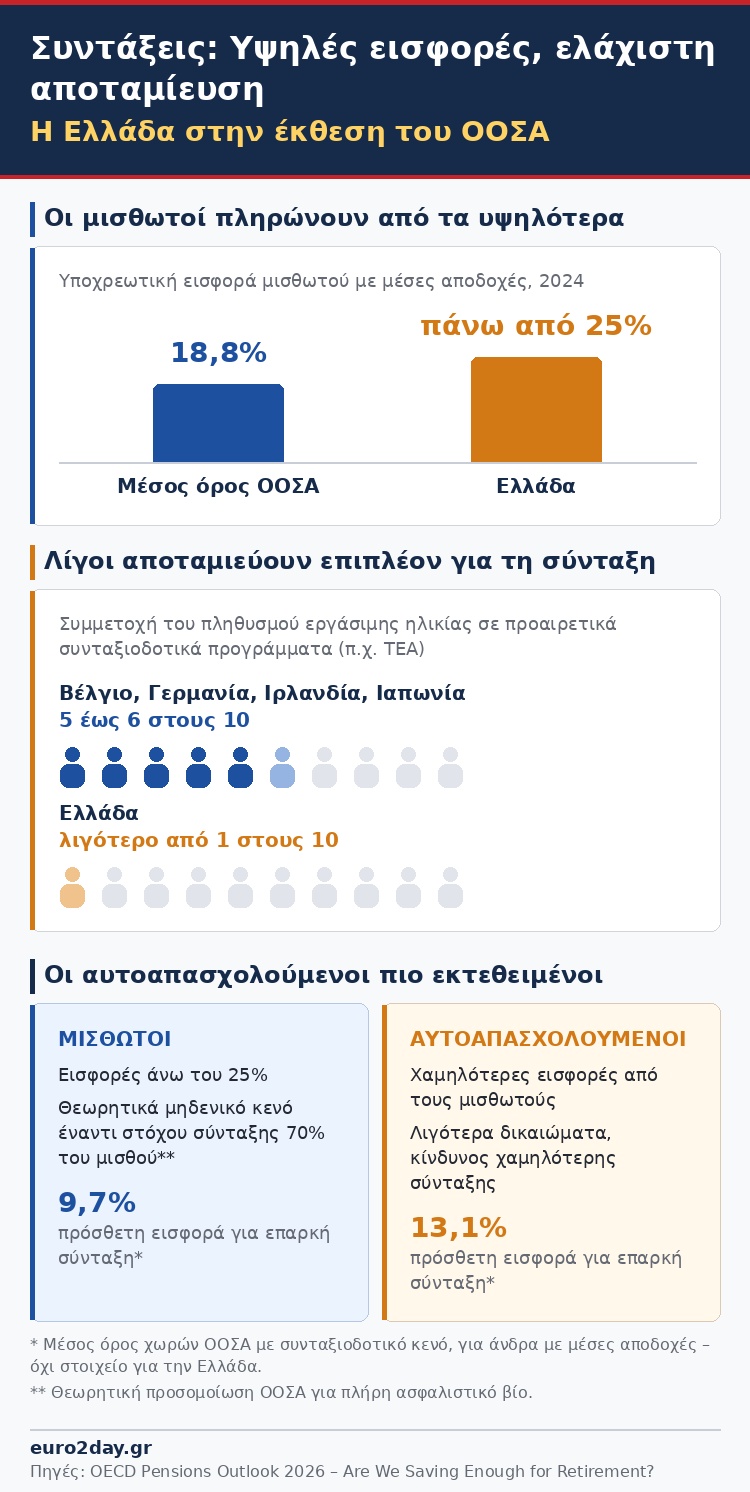
According to OECD data, the average effective contribution rate to mandatory or quasi-mandatory pension schemes for private-sector employees on average earnings was 18.8% across OECD countries in 2024.
In Greece, by contrast, it exceeded 25%, placing the country among those with the highest contribution burdens. This high rate, however, is not accompanied by widespread participation in additional pension schemes: less than 10% of the working-age population participates in voluntary arrangements such as Occupational Pension Funds (TEAs).
Low participation is particularly significant for future retirement income, the report notes. In countries such as Belgium, Germany, Ireland and Japan, participation in voluntary pension schemes is close to 50%-60%, while in Greece it remains in single digits.
Limited saving means that a large proportion of workers are not building up additional assets for retirement, leaving them more dependent on mandatory public pension provision.
The problem is more acute for the self-employed. The OECD notes that Greece is among the countries where self-employed people pay lower contributions than employees. As a result, they accrue fewer pension entitlements, increasing the risk of a lower pension.
Choosing a lower contribution category can provide greater financial flexibility during working life, but comes at a significant cost: a smaller contribution base on which the future pension is calculated. “This choice could prove particularly critical for those who have no savings or other source of income for old age alongside it,” the report notes.
In countries where there is a positive pension gap, the additional contribution required for a self-employed man on average earnings to meet the OECD’s income replacement target averages 13.1%, compared with 9.7% for an employee with the same earnings. These figures do not apply specifically to Greece, but highlight the greater need for supplementary saving among the self-employed.
The OECD’s theoretical estimate for employees is also of interest. Based on the assumptions in its model, an employee with average earnings and a full contribution record in Greece has no pension gap relative to the 70% replacement target. This is, however, a theoretical simulation, not a finding that all current workers or pensioners are assured an adequate income.
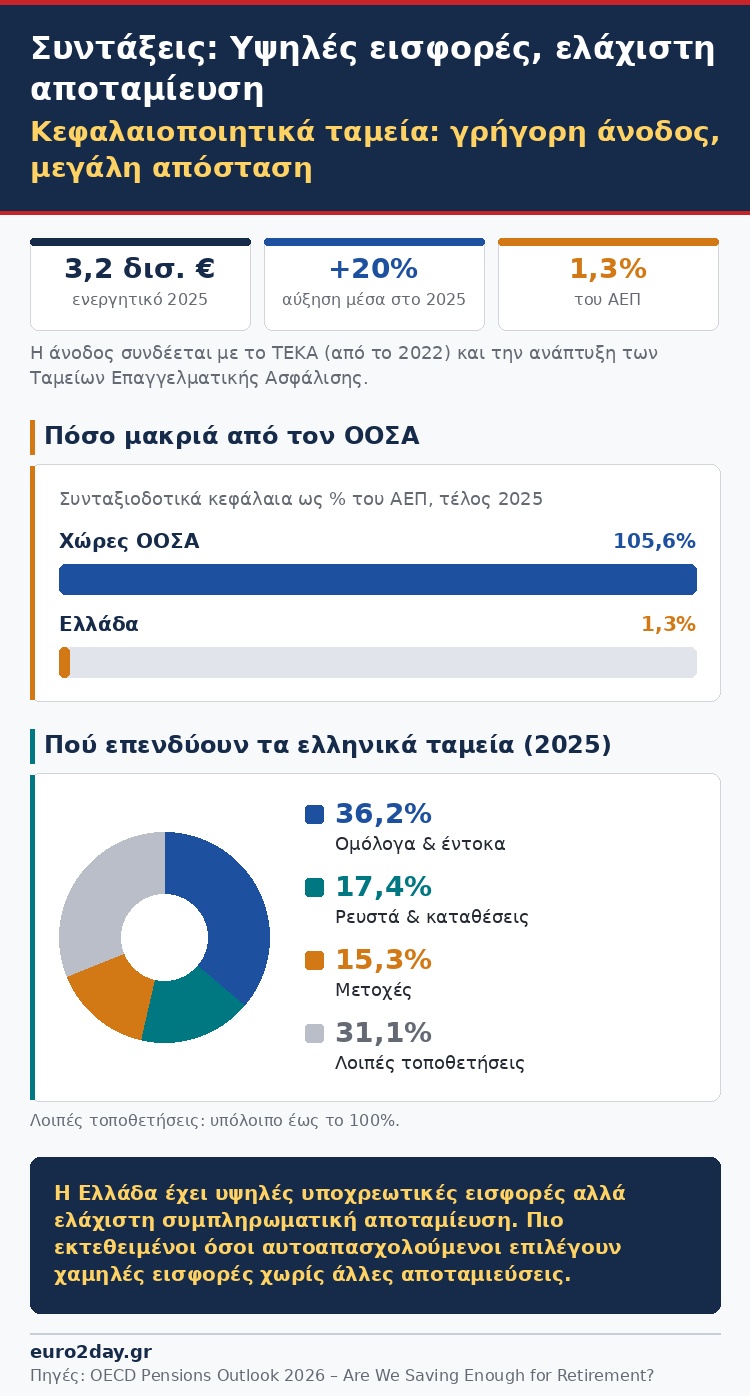
Meanwhile, assets in Greece’s funded pension schemes rose by 20% in 2025 to €3.2bn, or 1.3% of GDP. The increase is linked to the operation of TEKA since 2022 and the growth of Occupational Pension Funds.
Despite the rapid growth, the gap with the OECD average remains wide, with total pension assets in OECD countries equivalent to 105.6% of GDP at the end of 2025.
As for the investment mix of Greece’s funded pension schemes, in 2025 more than half was invested in bonds and Treasury bills (36.2%) and cash and deposits (17.4%), while 15.3% was invested in equities.