UBS remains positive on Greek banks after their third-quarter results, maintaining a “buy” rating on all five listed lenders. Its analysts say the recent decline in valuations “looks excessive”. The firm sees attractive upside potential across all four systemic banks, with little to distinguish them.
Price targets
Based on closing prices on 6 November, UBS has set the following targets:
- Piraeus: €12.50, implying 29.7% upside
- Alpha Bank: €5.60 (+23.6%)
- National Bank: €19.70 (+21%)
- Eurobank: €5.40 (+20.4%)
- Optima: €16 (+14.7%)
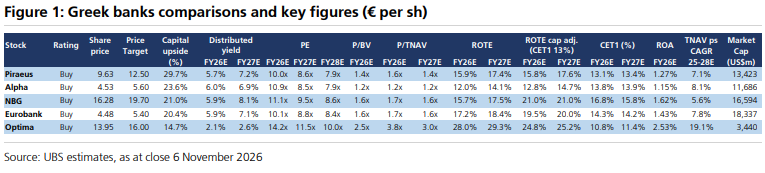
UBS has raised its target price for Alpha Bank by 8% following the bank’s Capital Markets Day (CMD), which pointed to scope for higher distributions and stronger returns on tangible equity (ROTE) over time. The firm has therefore raised its estimates for Alpha’s earnings per share by 4% for 2028 and 7% for 2030.
Rising net interest income
The third quarter marked a turnaround in the momentum of net interest income (NII), according to UBS. The four systemic banks recorded an increase of 5% to 8% quarter on quarter and 11.6% to 17.4% year on year. Alpha posted the fastest annual growth (+17.4%), followed by Piraeus (+15%), Eurobank (+13.8%) and National Bank (+11.6%).
A key driver was the widening of net interest margins (NIM) by 5 to 15 basis points during the quarter. This was supported by higher Euribor rates and the low proportion of rate rises passed on to depositors (deposit betas). Results generally exceeded market expectations. Piraeus was the exception, as several one-off items outside its core business had a significant impact. Analysts note that interest income at European banks was generally close to forecasts, while Greek lenders delivered a positive surprise.
Fee income also grew strongly, particularly at Piraeus (+32.5% year on year) and Alpha (+28.6%).
Loans and deposits
The third quarter is seasonally weaker for lending, but UBS expects growth to accelerate in the fourth quarter. Performing corporate loans in Greece rose by 1.4% quarter on quarter and 13.5% year on year to €116.7bn across the four systemic banks. Total performing loans reached €148.3bn, up 10.2% year on year. Mortgage lending, by contrast, continued to contract, falling 2.5% year on year to €24.2bn.
Deposits rose 12% year on year and 0.6% during the quarter. Their cost remained low, helped by the high share of current-account deposits. National Bank had the lowest deposit costs (0.22%), followed by Piraeus (0.39%), Alpha (0.56%) and Eurobank (0.68%). UBS also notes that bond portfolios are making an increasing contribution to interest income, as banks invest some of their deposit funding in them.
Deploying excess capital is key to higher returns, according to UBS. In particular:
- Alpha Bank: aims to deploy all its excess capital by 2030 through bolt-on acquisitions and higher distributions.
- National Bank: has the highest CET1 ratio in the sector (17.5%). UBS expects it will probably announce a special dividend alongside its fourth-quarter results.
- Eurobank: is striking a good balance between earnings-enhancing acquisitions and distributions. The acquisition of an 80% stake in Eurolife will contribute from the fourth quarter.
- Piraeus: has the least flexibility to increase distributions or pursue new acquisitions (CET1 ratio: 12.9%).
Valuations and preferences
Greek banks are trading at 8.3 times 2028 earnings, based on UBS estimates. This is broadly in line with the European sector (8.5 times) and below Spanish and Portuguese banks (8.8 times). Piraeus and Alpha are trading below eight times earnings (7.9 times).
UBS sees slightly more upside in Piraeus, which has underperformed the market since the start of the year, as 2026 is a year of adjustment for the bank. The firm is also positive on Alpha following the upgrade to its estimates. For National Bank and Eurobank, which have higher valuations, analysts see an attractive entry point. Of the two, they have a slight preference for Eurobank, given its more effective use of capital.
For Optima, which reports results on 11 November, the upside is more limited. At the same time, the bank is expected to post the sector’s highest return on tangible equity (ROTE), at 28% this year and 29.3% in 2027. UBS forecasts total distributions to shareholders, as a proportion of market capitalisation, of 5.7%-6% this year and 6.9%-8.1% in 2027 for the four systemic banks. National Bank is forecast to have the highest ratio in 2027.
Risks
The main risks to UBS’s forecasts are weaker-than-expected growth in business lending and narrower interest margins if rates fall. For Optima, the firm also highlights:
- whether its high rate of loan growth can be sustained,
- the risk that profitability falls more than its model forecasts,
- its relatively limited capital position, with the lowest CET1 ratio in the sector.