The extensive rollout of the Digital Work Card is revealing the true scale of violations related to working time. Data from Labour Inspectorate checks in the nine months from January to September show that violations related to its correct implementation rank first, occurring almost twice as often as those in the next category.
At the same time, however, recorded overtime has risen significantly. Available data suggest that the increase over the nine-month period is close to 2 million hours compared with last year.
The emerging picture reflects the new system’s twofold impact on the labour market: inspection authorities are better able to identify discrepancies between declared and actual working hours, while a greater volume of overtime is being recorded. Until recently, this work went unrecorded, with adverse consequences both for workers’ pockets and for EFKA’s coffers.
In the nine months, the Independent Authority for Labour Inspection carried out a total of 62,619 inspections, identifying 13,679 violations and imposing fines totalling €43.66 million. In the area of employment relations, there were 2,686 violations relating to the Digital Work Card, with fines reaching €11.69 million.
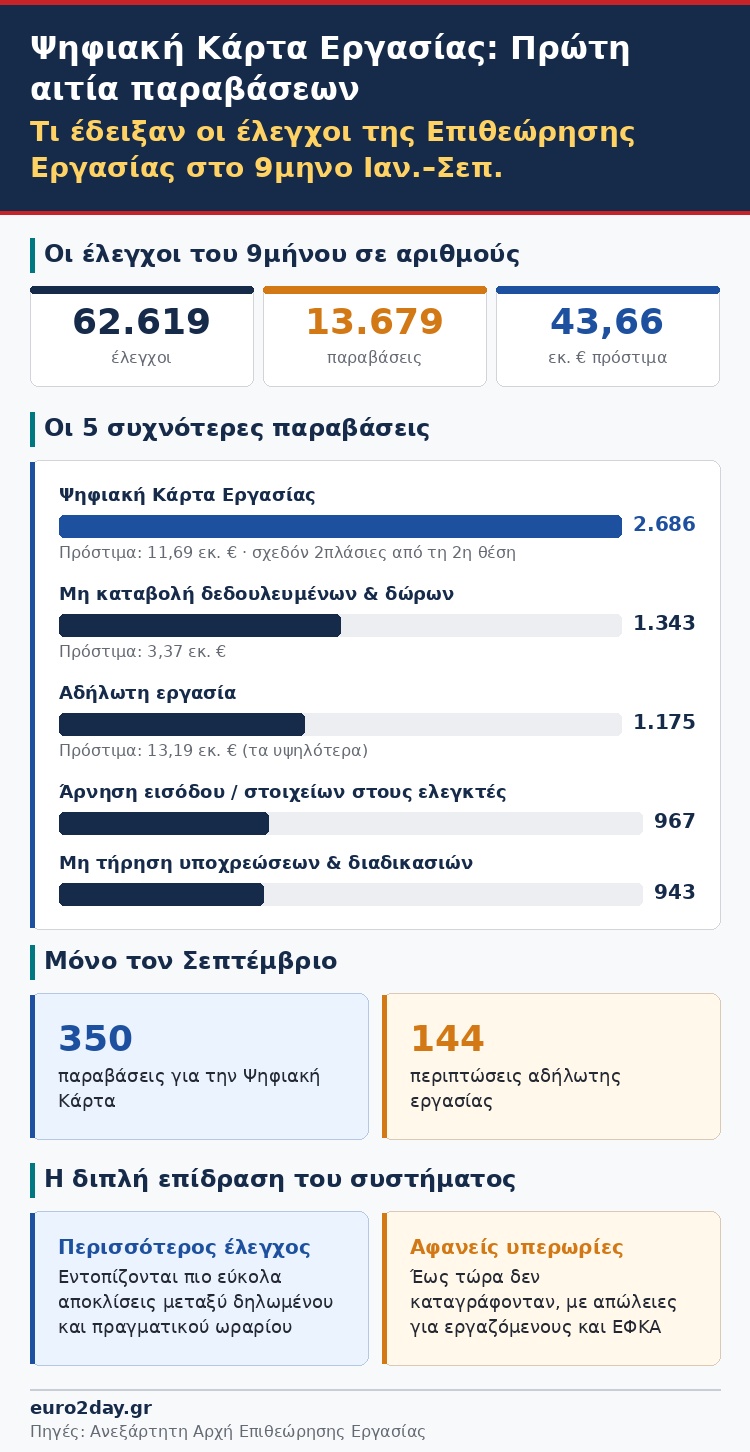
This was almost twice the 1,343 violations involving non-payment of accrued wages, holiday bonuses and other pay, which ranked second, with fines totalling €3.37 million.
Undeclared work ranked third, with 1,175 violations and fines of €13.19 million. The top five also included refusal to admit inspectors or provide them with information, with 967 violations, and failure to comply with obligations and procedures, with 943.
A similar pattern was recorded in September, when there were 350 violations related to the Digital Work Card, compared with 144 cases of undeclared work.
The trend in declared overtime is also noteworthy. In the eight months from January to August, sectors brought into the system during 2026 recorded about 6.8 million overtime hours, compared with 5 million in the same period of 2025. That represents a 35% increase, or about 1.78 million additional hours.
Based on the trend in the figures, the gap is estimated to have approached 2 million hours over the nine-month period, although no final consolidated tally is yet available.
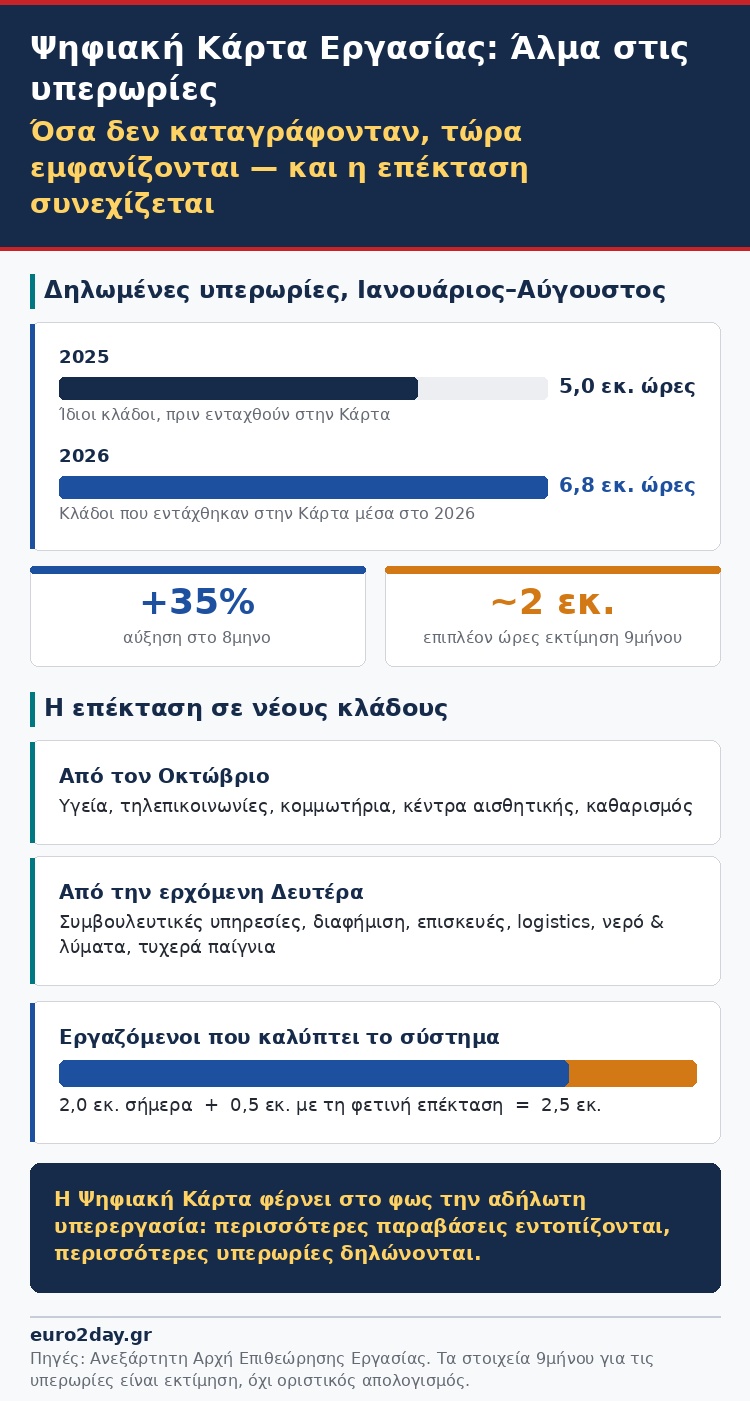
The next period is expected to provide an even fuller picture, as the Digital Work Card was extended in October to new sectors, including health services, telecommunications, hairdressers, beauty salons and cleaning services.
From next Monday, the system will also cover consultancy services, advertising, repairs, logistics, water and wastewater management, and gambling. By the end of this year’s expansion, a further 500,000 workers are expected to be covered, taking the total number of people covered by the system to 2.5 million.