Helleniq Energy will unveil its new strategic plan in London in January, with the focus on the group’s core business of refining and investments well in excess of €5bn. It will present Vision 2035+, its ambitious new business plan for the coming decade, to international investors and analysts.
In this context, the remarks made yesterday by the management team led by Shiamishis on accelerating investment, boosting production of higher value-added products, such as petrol, diesel and aviation fuel, and considering possible new acquisitions in south-east Europe’s fuel market offer a preview of what the group is set to announce.
The focus is increasingly on the areas where the group has a competitive advantage, namely expanding capacity as far as possible and significantly upgrading all three refineries in Thessaloniki, Elefsina and Aspropyrgos, so that it can supply an even larger share of the wider region over the coming decade.
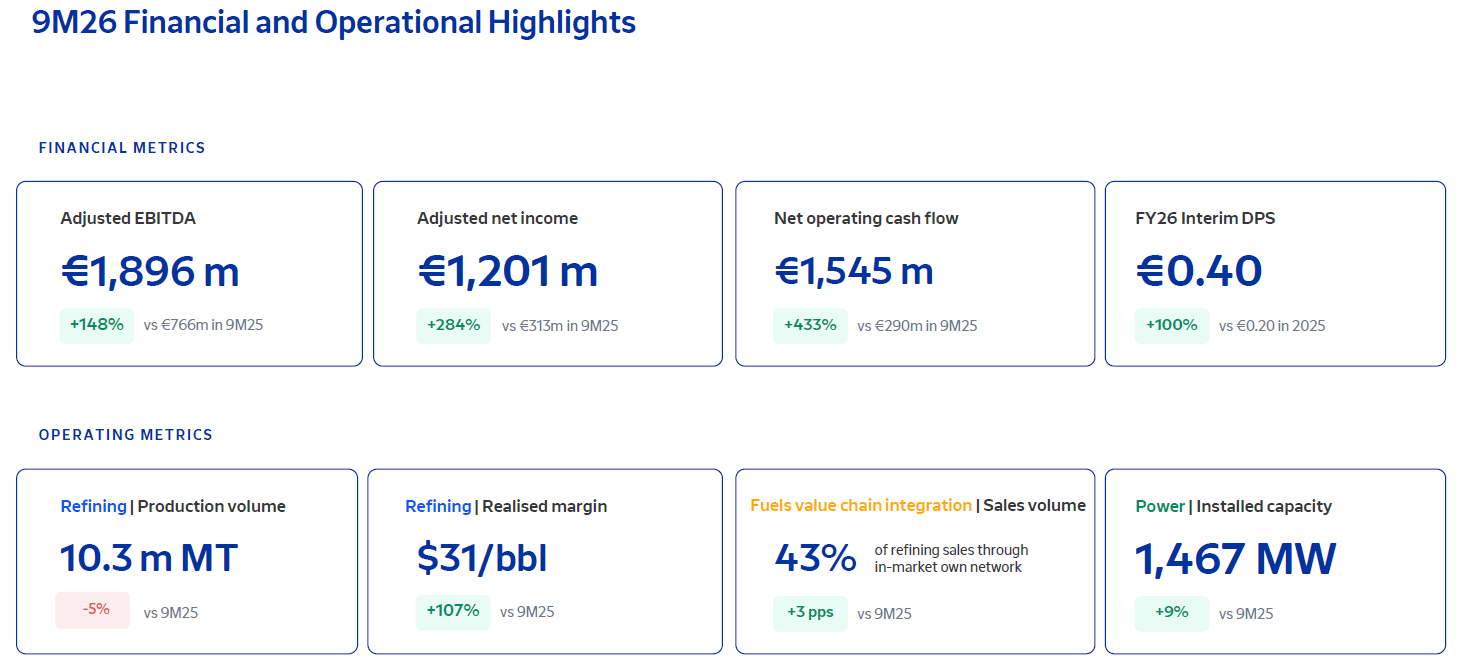
All of this is underpinned by excellent financial results, driven by high international refining margins and, above all, strong exports. Yesterday, the group reported nine-month EBITDA … well above the figure for all of 2025, at €1.896bn, compared with €766m a year earlier.
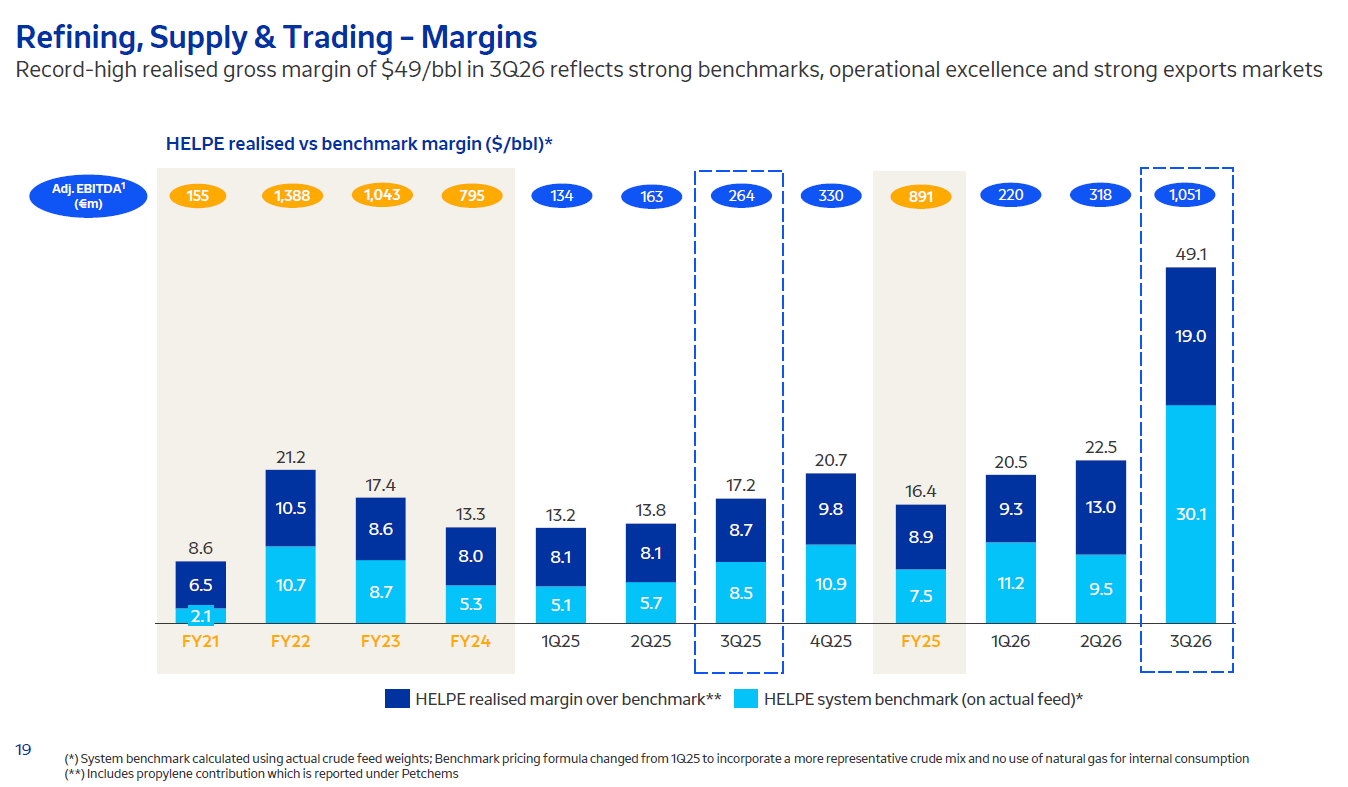
The main driver of all this is the exceptionally strong refining margin, which nearly tripled to $49.1 a barrel in the third quarter, from $17.2 a year earlier.
This allows the group not only to make greater investments in renewables in Greece and abroad, with a focus on Romania (€1.3bn), but also to pay the double dividend announced by management yesterday: €0.40 a share, payable in January 2027.
Asked what it meant that nine-month results had exceeded forecasts for the whole of 2026, which will clearly be well above 2025 levels, CEO Andreas Shiamishis told analysts yesterday: “It doesn’t take any particular wisdom to comment on that.” He began his presentation by saying: “With figures like these, this could easily be an annual results call.”
The impressive nine-month results and performance for 2026 as a whole are already helping the group accelerate its growth plans, not only in renewables but, above all, in refining, where it is considering bringing forward specific investments.
This is partly because the group sees a growing shortfall in oil products across the wider region — hence exports accounted for 46% of the 4.2 million tonnes in total sales during the first nine months — and partly because the sale process for Russian assets in the region, owned by both Lukoil and Gazprom, could create investment opportunities under certain conditions.
The complex dynamics around Russian assets
Answering analysts’ questions, after saying a few days ago in Bucharest that entry into Romania’s fuel market was under consideration, the group’s CEO said it was “monitoring” a number of markets, from Romania to Bulgaria and Serbia. He cautioned, however, that there were many uncertainties about what might happen, precisely because these are Russian-owned assets.
This is a particularly complex environment, given the sanctions, uncertainty over the sale processes and the difficulty of reaching agreement with the current owners. Mr Shiamishis stressed that no decision had yet been taken, as it was extremely difficult to distinguish fact from rumour.
He cited reports of an agreement with US-based Carlyle to acquire Lukoil’s international assets, as well as announcements by the government in Belgrade that Hungary’s MOL was set to acquire Gazprom’s stake in the NIS refinery — although neither of these things has happened yet.
In the first case, the US investment group Carlyle Group formally abandoned its attempt to acquire Lukoil’s assets, despite an initial agreement that failed to secure the necessary approval from US authorities.
In the other case, the Hungarian group MOL has received authorisation from US authorities to carry out preparatory work relating to the possible acquisition of the Russian stake in Serbia’s NIS.
“We are monitoring the situation. We are interested in expanding. We are expanding in the region. Bulgaria, Serbia, Montenegro and North Macedonia are areas where we already operate, and any asset connected with that activity is, by definition, of interest to us. That does not mean we are going to buy everything that is available. The picture remains quite unclear. I would not rush to say that we are moving ahead with the acquisition of any significant asset there,” Mr Shiamishis said.