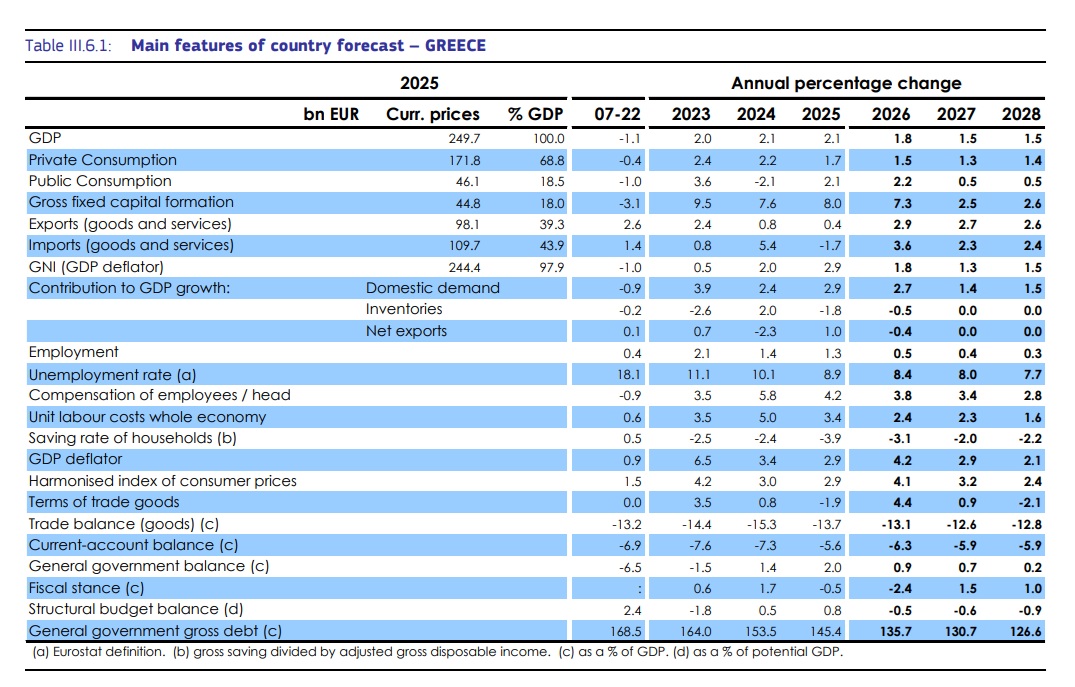
Greece’s economic growth is expected to slow to 1.8% in 2026, as the energy price shock erodes households’ real incomes and restrains consumption growth. Investment, however, is expected to remain strong, supported by the uptake of EU funds. GDP growth is forecast to slow further, to around 1.5% in both 2027 and 2028, as implementation of the Recovery and Resilience Facility (RRF) gradually draws to a close. Amid a sharp rise in energy prices, inflation is expected to increase to 4.1% in 2026 before gradually easing to 2.4% by 2028. Unemployment is forecast to continue falling, albeit more slowly than in the past, reaching 7.7% in 2028. Greece’s fiscal position is expected to continue to be characterised by sizeable primary surpluses, although ongoing expansionary measures are forecast to gradually reduce them over the forecast period. The public debt-to-GDP ratio is expected to continue its downward trend, falling to 126.6% by the end of 2028.
In the first half of 2026, the Greek economy grew at an annual rate of 1.9%, driven by broad-based growth in domestic demand. Investment is expected to remain strong in the second half of 2026, supported by EU funding through the RRF, with inflows forecast to reach a record high. However, rising energy prices are expected to weigh on household consumption, although the impact will be mitigated by recent energy support measures and a cut in the tax burden on labour, introduced in 2026 and scheduled for 2027. Although Greece remains heavily dependent on energy imports, its trade balance is being supported by exports of refined petroleum products and a widening spread between the prices of refined oil products and crude oil (the crack spread). This is improving the terms of trade and boosting the GDP deflator in 2026. Beyond 2026, higher energy costs, tighter financing conditions and the gradual completion of the RRF are expected to slow investment. Overall, GDP growth is forecast to slow to around 1.8% in 2026 and 1.5% in both 2027 and 2028, bringing the Greek economy’s growth rate closer to the euro area average.
Unemployment continues to fall
The labour market continued to expand in early 2026, with the unemployment rate falling to 8.3% in the second quarter. Long-term unemployment also declined, to 4.3%, but remained the highest in the EU. Job vacancy rates remained high, pointing to a tight labour market, particularly in tourism. Employment is expected to increase, albeit at a modest pace, owing to structural barriers such as skills mismatches and limited access to childcare and eldercare services, as well as slower economic activity. The unemployment rate is forecast to fall further, to 7.7% by 2028. Wage growth is expected to moderate over the forecast period as the inflation shock fades.
The energy shock is driving inflation
The energy crisis triggered a rise in inflation, which averaged 3.8% in the third quarter of 2026. Against a backdrop of strong demand and a tight labour market, higher energy prices are expected to feed through to prices of non-energy goods and services, keeping inflation high in 2027. As a result, inflation is forecast to rise to 4.1% in 2026 before easing to 3.2% in 2027. It is expected to fall further, to 2.4%, in 2028 as the impact of energy price shocks gradually fades and domestic demand moderates.
Fiscal surpluses narrow amid expansionary measures
The general government surplus is forecast to fall from 2.0% of GDP in 2025 to 0.9% in 2026, while the primary surplus is expected to decline from 5.1% to 4.1% of GDP. The fall in the overall budget surplus reflects the impact of expansionary fiscal measures, partly offset by continued strong revenue growth. Excluding energy support, fiscal measures are expected to add around 0.8% of GDP to the deficit in 2026. They mainly include cuts to personal income tax, public-sector pay rises and increased support for pensioners and people with disabilities. Energy support measures to cushion the impact of high energy prices on households and businesses amount to 0.3% of GDP in 2026, and most are expected to be phased out in 2027.
In 2027, the general government surplus is forecast to fall to 0.7% of GDP, while the primary surplus is expected to decline to 3.7% of GDP. Fiscal measures are estimated to add around 0.6% of GDP to the deficit on a net basis. These include further public-sector pay rises, a €500 Christmas payment for public-sector employees and a 0.5 percentage-point cut in social security contributions. Further costs will arise from tax relief for large families, farmers and the self-employed, as well as a reduction in the business levy for legal entities. The forecast also includes a €95 million subsidy for the manufacturing sector to cover the increase in electricity costs in 2026. These effects are expected to be partly offset by favourable revenue developments, including additional revenue from extending the digital work card to new sectors and other smaller-scale revenue-raising measures.
In 2028, the overall surplus is forecast to narrow further to 0.2% of GDP, while the primary surplus is expected to fall to 3.4%. Fiscal measures are estimated to add around 0.1% of GDP to the deficit on a net basis, mainly reflecting the full-year impact of measures already adopted, while interest expenditure is expected to increase by 0.2% of GDP.
General government debt fell to 140.8% of GDP by June 2026, almost 50 percentage points below its pre-pandemic peak in 2018. The debt-to-GDP ratio is expected to fall further, to 126.6% by 2028, supported by strong nominal GDP growth, fiscal surpluses and the use of cash reserves to repay debt.