BLACKOUTS: In the space of a few days, the information systems of the US, the world’s most technologically advanced country, began suffering one failure after another.
Microsoft’s global network of services, US air traffic control, banking transactions and airline systems.
Yesterday, even the NSA Net, the classified network for internal communications at the US National Security Agency, joined the… club!
We have apparently never seen such a concentration of technological outages (as English speakers call them), as the timeline below shows. Despite official explanations, where they have been given, conspiracy theories are running wild.
All this is happening after a succession of reports in recent months about “uncontrolled AI” and amid intense geopolitical turbulence.
The timing of yesterday’s outage on the NSA’s classified network is certainly striking, given that it monitors a large share of electronic communications around the world.
It happened as Donald Trump was in the Philippines, before travelling on to China for his long-awaited meeting with Xi Jinping and Vladimir Putin.
For different reasons, all three leaders wield considerable influence in the new era of digital power.
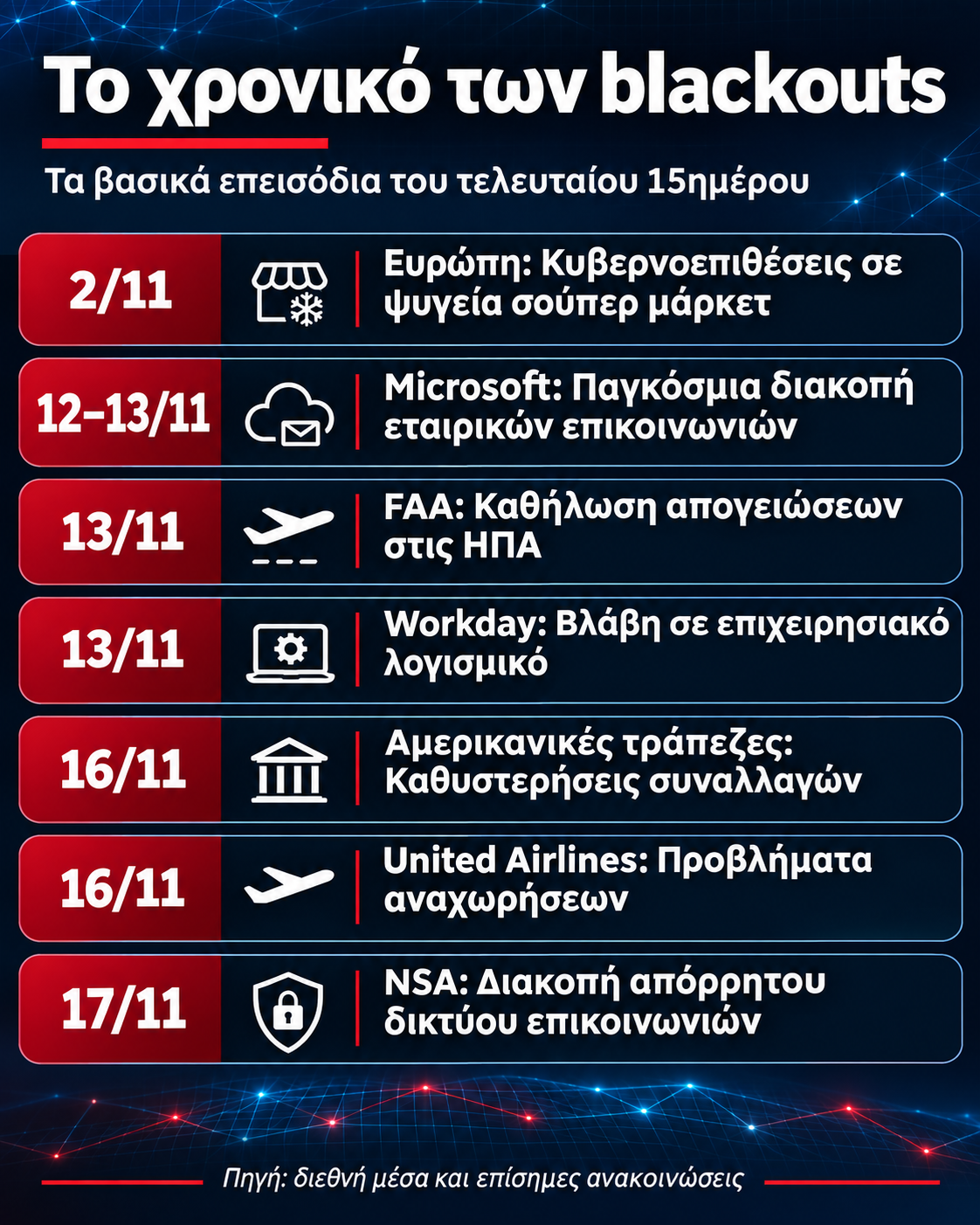
BLACKOUTS II: Trump leads the superpower home to the world’s biggest technology groups, but is now watching one US… outage follow another. Xi leads Washington’s main rival in artificial intelligence and cutting-edge technology.
Putin, meanwhile, is said to have made cyberspace a battleground with the West, as Russian hacking operations remain a constant headache for Western security services.
So theories of coordinated cyberattacks, and even of uncontrolled artificial intelligence (rogue AI), are proliferating.
But there have also been real cyberattacks attributed to Iran. On 9 November, France directly accused the Revolutionary Guards and the Shahid Kaveh unit of carrying out October attacks on cooling systems at around 700 commercial facilities, which even caused fires!
A new wave of attacks targeting European supermarkets was recorded on 2 November, with the perpetrators’ identities still under investigation.
It is also notable that, in several of the major US incidents, the initial technical explanations pointed to upgrades and maintenance.
BLACKOUTS III: At Microsoft, a software bug coincided with a transfer of workload and reduced capacity. At the FAA, work to replace equipment is officially said to have destabilised the older telecommunications network.
At Workday, a US software company specialising in human resources and financial management, a test of backup systems designed to deal with serious failures is said to have caused the major disruption!
This, however, exposes a worrying paradox. The more automated economies become, and the more critical functions rely on a small number of large suppliers, the more easily a technical failure can escalate into a crisis.
Once, a failure meant losing a few emails. In Germany, however, a warning about excessive chlorine in a hotel swimming pool was not delivered because of the Microsoft problem. As a result, 15 people were affected, four of whom were taken to hospital!
Asked about the succession of incidents, Trump said yesterday in Manila: “These things happen. Everything is fine.” Quite so. Perhaps that is the case. We will see.
What is certain is that in the age of high technology and artificial intelligence, an ordinary technical change can disrupt airports, banks and national security services.
This sudden burst of progress is proving very… fragile, with threats multiplying at a deeply worrying rate, whether from “failures” and oversights or from malicious or uncontrolled actors. Let’s hope it all turns out well, because, as is already clear in the US, the impact on people is far from negligible!
P.S. Late yesterday evening, another incident was added to the list: a cyberattack on Norway’s Equinor, Europe’s largest producer of natural gas and oil. The attack caused problems with internal systems and email, but did not affect production.
SERVICERS: “Business as usual” is the response from Intrum Hellas to reports of a merger with Cepal, in an effort to put an end to the speculation.
Talks have been under way for some time, but there appear to be pockets of resistance. Some people familiar with the market put the chances of a deal at 50-50.
For now, Intrum Hellas is running a voluntary exit scheme, with compensation of up to €170,000. In effect, the company is offering between 24 and 28 months’ salary, depending on age, an additional benefit for early applicants and medical cover after an employee leaves.
Whether there will be mergers more broadly among loan servicers remains to be seen…
GOVERNMENT: Following the removal of Lazaros Tsavdaridis, two more deputy ministers are in the spotlight. The mood around their continued presence in government appears to be turning against them, as their cases are now attracting attention even on the main television news bulletins.
Just days after being sworn in as deputy interior minister, Vangelis Liakos faced revelations about direct awards worth more than €1.14 million from six island municipalities to his sister’s accounting firm.
He stresses that he had no professional relationship with the business and that his sister’s work with local authorities began long before his political career. His critics in the opposition say that since he became an MP, the business has expanded sharply.
The issue, however, has taken on political significance, particularly since he took on a portfolio with responsibilities relating to municipalities.
The case of Nikos Tsafos is more complex. The issue of the ExxonMobil bonds he held while serving as the prime minister’s energy adviser is compounded by the discontent he has caused in parts of the energy market.
This is particularly true of energy storage, where delays and opposition have emerged. The latest rankings for battery projects even left out investments by state-owned DEPA Commercial, with a total capacity of about 250 MW!
Tsafos undoubtedly has a strong technocratic background. His critics, however, accuse him of failing to combine his technocratic approach with the political skills needed to manage the issues. As a result, he has opened up several fronts and created strong antagonism in the market.
Government insiders also believe he has the backing of Akis Skertsos, who is far from lacking detractors within New Democracy, particularly among MPs who have publicly clashed with him.
For now, Pavlos Marinakis is giving both deputy ministers his full backing. But the point is that, following the Tsavdaridis case, the pressure is beginning to build cumulatively. The discussion is gradually shifting from the explanations each man offers to the political cost of keeping them in office.
That has certainly not gone unnoticed at the Maximos Mansion.
POLYTECHNIC: A genuine disagreement, or an attempt to “have it both ways”?
Those called on to comment (mainly from the opposition) on New Democracy MP Giorgos Amyras’s remarks about those killed during the Polytechnic uprising are turning to this… perennial rhetorical question. His comments implicitly but unmistakably challenged Adonis Georgiadis’s assertion that no one was killed inside the historic site during the 1973 uprising.
“I genuinely find it incomprehensible that we are discussing whether the 24 – or 26, according to the revised edition of the National Hellenic Research Foundation – people killed in the Polytechnic uprising were killed inside the Polytechnic. (…) The tribute we owe to the 26 and their families, and to all those thousands of people who rose up so that we can enjoy the fruits of democracy, must be marked by respect and humility,” the MP said yesterday.
A day earlier, the health minister had said he stood by the “Tsèves report”, explaining: “I did not say either ‘there were’ or ‘there were not’ any dead. For those who do not know, in 1975 the government of Konstantinos Karamanlis commissioned the prosecutor Tsèves to investigate the crimes committed against young people at the Polytechnic in November 1973.
The truth is that there were no deaths inside the Polytechnic, but there were 34 deaths in the surrounding area and 1,018 people were injured. The Tsèves report does not say there were no deaths. This is fuss about nothing.”
Maximos Mansion, in turn, gave Mr Georgiadis its full backing, prompting the entire progressive opposition to portray him as “Mr Mitsotakis’s mouthpiece” in an effort to avoid losing a far-right audience, since “the Kasidiaris party is also lying in wait”.
But with Mr Amyras’s statement – made from the floor of parliament, no less – those who were deeply angered by Georgiadis’s remarks also appear to have been… given cover.
And so the rhetorical question about having it both ways has resurfaced, apparently to satisfy (?) all sides.
MARCH: As expected, this year’s march marking the anniversary of the Polytechnic uprising included in its “contingents” all the leaders of left-wing and progressive parties, both inside and outside parliament.
Alexis Tsipras, Nikos Androulakis, Dimitris Koutsoumbas, Rena Dourou and Zoe Konstantopoulou were there, walking at the front of their parties’ groups.
Most did not make it as far as the US embassy, turning back after the Hilton, as it would have been incongruous for them, as leaders of parties of government, to chant slogans outside the US embassy in Athens.
As television footage also showed, they opted to march in silence, so they would not have to shout the familiar slogan about “the murderers of the peoples”…
As we said, action, but not outside the diplomatic and political framework…
FEIDAKIS: Globus Maritime recorded stronger financial results in the third quarter of 2026, as higher freight rates boosted revenue and profitability at the shipping company led by Thanos Feidakis.
Net profit was $3.98 million, compared with $725,000 in the same period of 2025, while revenue rose to $15.1 million from $12.6 million. Daily time charter equivalent (TCE) earnings came to $19,400 per vessel, up 28% year on year, the company said.
Globus now has a fleet of 11 vessels and remains primarily exposed to the spot market and short-term charters, allowing it to take advantage of favourable market conditions.
For the first nine months, profit reached $9.11 million, compared with a loss of $2.63 million in 2025. Cash balances stood at $36.9 million at the end of September, against borrowings of $130 million.
SHIPPING: Pavlos Fakinos is joining Athens-based Tribune Maritime Advisors, returning to shipbroking after leaving Allied Shipbroking last September.
Mr Fakinos will focus on ship sale and purchase (S&P) and shipping finance. He has around a decade of professional experience, having previously worked at Diamond Maritime Investments, Grant Thornton, KPMG and Ernst & Young before taking on a market analyst role at Allied. He is also a member of the UK’s Association of Chartered Certified Accountants (ACCA).
Tribune was founded in 2017 by Stefanos A. Iliadis, a former Clarksons executive and Fakinos’s in-law, who has more than 20 years’ experience in ship sale and purchase and project finance.
The company’s activities include valuations, newbuildings, investments and ship recycling, combining expertise in shipbroking, finance and transaction analysis.
LATSIS: The exceptionally high charter rate for the Hellas Avatar is generating significant revenue for Euroholdings, the Nasdaq-listed shipping company of the Latsis family, which has chosen to keep its fleet exposed to the spot market. That strategy is proving highly lucrative.
As chief executive Aristides Pittas disclosed, the 50,000-dwt MR, built in 2005, secured a rate of about $125,000 a day for a 15-day period.
The rate is $37,500 above recent market benchmarks for modern MRs fitted with scrubbers in the Pacific. A measure of the market’s volatility is that the vessel began the quarter earning just $19,000 a day.
Euroholdings is expected to take delivery in December of its second MR, the Hellas Fighter, a 50,000-dwt vessel built in 2015. Delivery has been delayed because of problems unloading its cargo.
The company plans to follow a similar strategy with the second vessel, taking advantage of opportunities in the spot market. It is also considering ways to bolster its liquidity, including a possible capital increase, to finance further expansion in the tanker sector.
For now, however, no such decision has been made.
GEK TERNA: Axia-Alpha Finance expects strong performance across all of the listed company’s business areas in the first nine months of 2026, led by construction and concessions, alongside an improved showing in power generation and energy supply.
With the nine-month results due after the market closes, the broker estimates that consolidated revenue will reach €3.35 billion, up 16.4% year on year, while adjusted EBITDA will rise 20.5% to €559 million.
Adjusted net profit after minority interests is forecast at €150-151 million, an increase of 42%.
Construction revenue is expected to reach €1.4 billion, up 18%, with EBITDA rising 37.4% to €170 million.
Axia-Alpha estimates that the EBITDA margin will remain high, at 12%, thanks to the composition of the order book, more than 50% of which relates to the group’s own investment projects.
In concessions, revenue is forecast to rise 37% to €550 million and EBITDA 35% to €361 million, with the first-time consolidation of Egnatia Odos making a decisive contribution.
By contrast, EBITDA from power generation and energy supply is estimated at €44.3 million, down 48% because of a high base last year and one-off positive effects. Net finance costs are expected to rise 64%, mainly because of the consolidation of Egnatia Odos.
Notably, yesterday Santander raised its price target for the shares to €64 from €62, while maintaining its “overweight” rating. The move triggered a wave of buying, with the shares closing at €43.02, up 3.66%.
QUEST: Eurobank Equities forecasts an 8% increase in revenue to €1.1 billion and a 6% rise in reported EBITDA to €78 million for Quest Holdings, ahead of the release of its nine-month results after the market closes today.
The broker notes that EBITDA growth is being affected by the lower contribution from renewables following the sale of the relevant assets.
Excluding that business, EBITDA is estimated to rise by about 16%, with double-digit growth in IT services, ACS and commercial activities.
Investors are expected to focus during the subsequent conference call on the planned listing of Uni Systems on the stock exchange, as well as ACS’s return to full ownership by Quest, following the acquisition of the 20% stake held by GLS for €37 million.
PREMIA PROPERTIES: Edison sees strong growth potential at the listed company, estimating that its acquisition of AKTI Hotels & Resorts will significantly boost its financial results from 2027.
In the first nine months of 2026, revenue rose 26% to €32.6 million, while adjusted EBITDA increased 38% to €23.8 million. Rental income climbed 27% to €29.7 million, and funds from operations (FFO) rose 21% to €8.2 million.
The planned acquisition of AKTI, with 1,316 rooms, is expected to be completed by the end of the year. It will take Premia’s total investments above €1 billion, from €766.8 million at the end of September, while hotels will account for around 50% of the portfolio.
Edison forecasts that revenue will more than double in 2027 to €93.9 million, from €43.6 million in 2026, with EBITDA rising to €48.4 million. It also expects the dividend to increase from €0.06 to €0.08 per share.
In valuation terms, the shares trade at a discount of around 40% to net asset value (NAV), a gap that Edison believes could narrow as the investment programme is carried out.