The figures from last year’s tax returns, analysed by the Independent Authority for Public Revenue (AADE), reveal the irrationality of the tax system governing sole proprietorships and companies.
The system creates conditions for unfair competition and unequal treatment in the market. While hundreds of thousands of self-employed professionals and sole proprietorships are caught in the grip of deemed taxation (around 390,000 sole proprietorships and self-employed professionals are estimated to fall under the minimum deemed-income regime), the vast majority of companies — which are not subject to deemed taxation — appear on paper to be operating at a loss or making next to nothing.
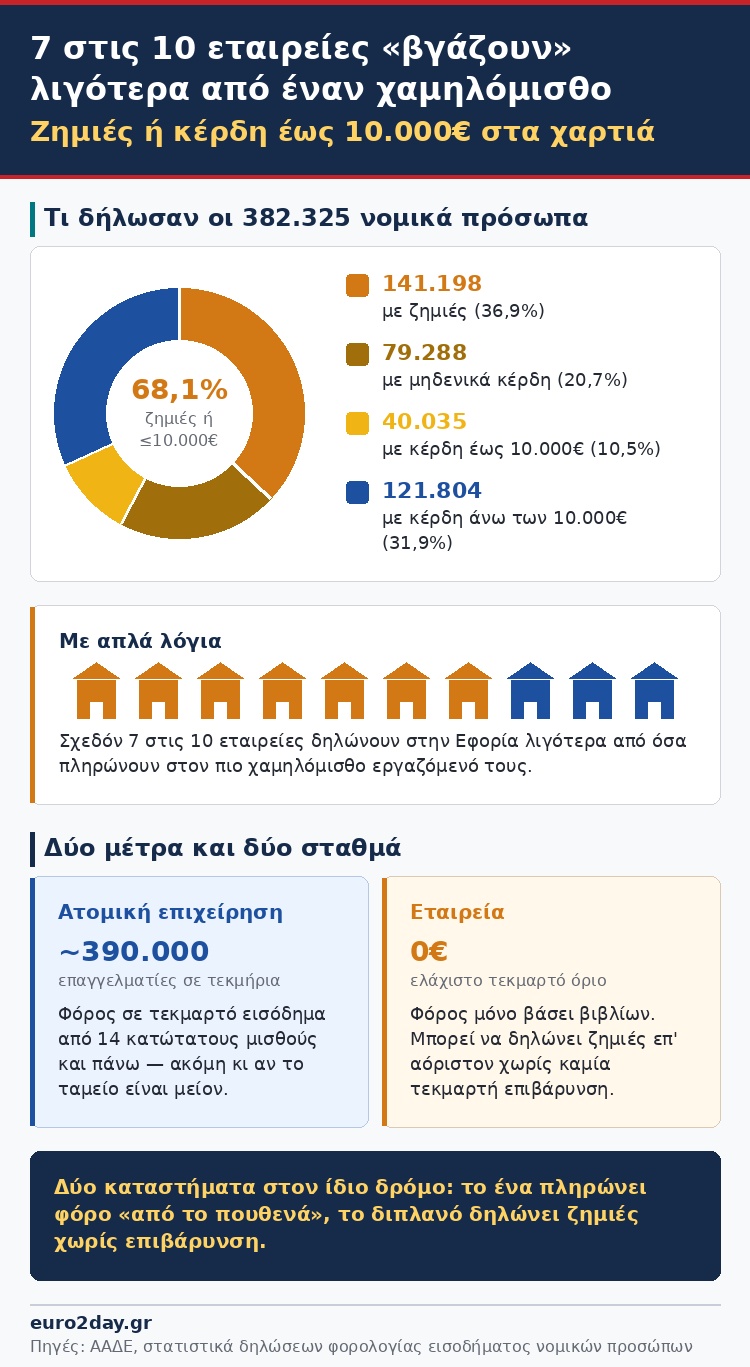
Specifically, of the 382,325 companies and other legal entities that filed returns, 260,521 (68.14%) reported losses, zero profits or annual taxable profits of up to €10,000.
In other words, almost seven in 10 companies tell the tax authorities that they earn less than even their lowest-paid employee.
Of these, 141,198 reported losses, 79,288 reported zero profits and just 40,035 recorded positive profits of up to €10,000.
The unfairness of the tax system stems from the way it taxes sole proprietorships set up by self-employed professionals and businesses with other legal forms — a distinction that determines who pays and who escapes the tax burden.
A professional operating as a sole proprietor is compulsorily taxed on deemed income that starts at the annual cost of employing a worker on the minimum wage (equivalent to 14 monthly salaries a year) and rises according to the number of years in operation and turnover — even if the business is in the red.
By contrast, a company (as a legal entity) is taxed solely on the basis of its accounts, with no minimum deemed-income threshold. As a result, two shops on the same street are treated entirely differently: the sole proprietor pays tax “out of nowhere” on income equivalent to 14 months’ pay, while the company next door can report losses indefinitely without any deemed-tax charge.
Shrinking
This distinction is no accident. It was not so long ago that major international economic organisations were urging Greek governments to reduce the large number of self-employed people and very small businesses.
During the debt crisis and the bailout programmes, the IMF and the OECD repeatedly argued that Greece suffered from an excessively large number of self-employed people and very small businesses, calling for them to be scaled back in favour of larger, more productive corporate structures.
A decade later, deemed taxation appears to be hollowing out sole proprietorships — but in a distorted way: not through healthy mergers, but through forced “corporatisation” as a means of tax survival, simply swelling the ranks of legal entities reporting losses or profits below the minimum wage.
A rush to IKEs, general partnerships and limited partnerships
Thousands of self-employed professionals and small and medium-sized business owners, watching their deemed-tax bill rise regardless of how their businesses are actually performing, are abandoning their sole-proprietor tax registration.
They are rushing to set up private capital companies (IKEs), general partnerships (OEs) or limited partnerships (EEs), seeking a safe haven beyond the reach of deemed taxation.
This is not simply an accounting adjustment, but an immediate response driven by the need to survive in a system that penalises sole-proprietor activity.
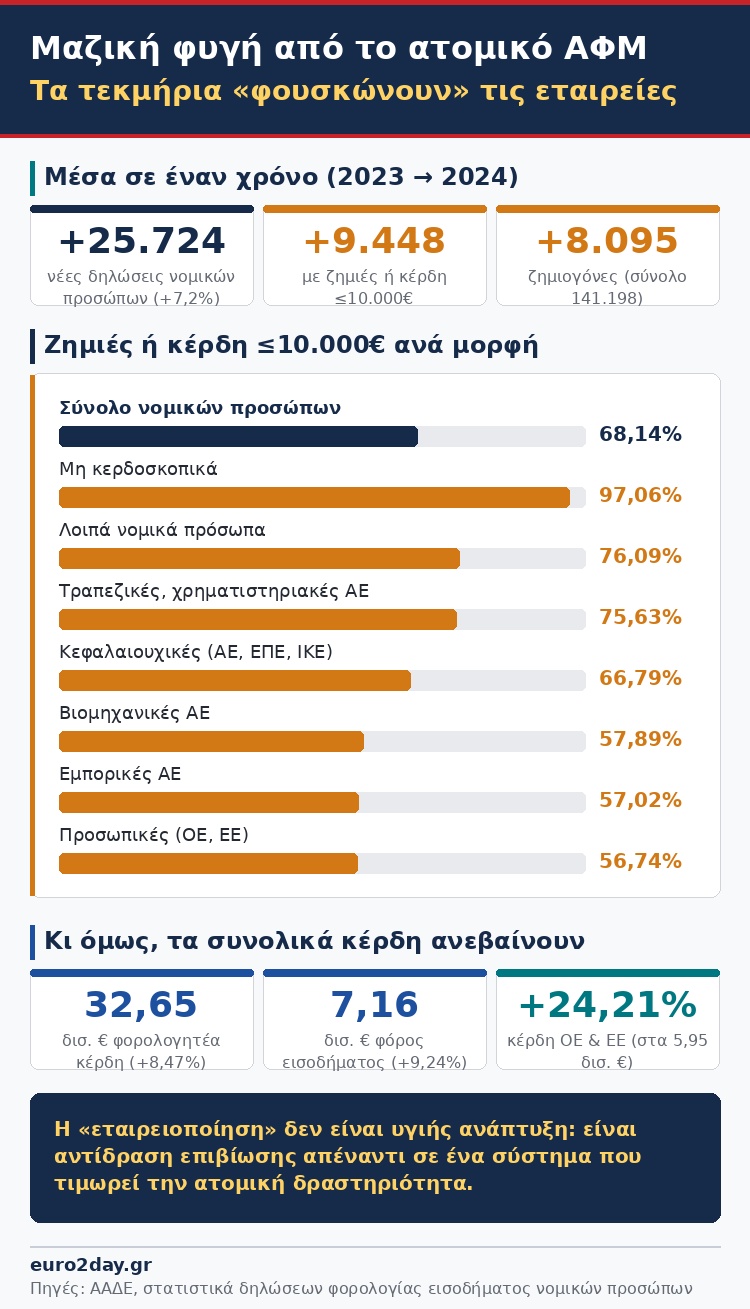
The AADE figures bear this out. In just one year, the number of returns filed by legal entities rose by 25,724 (7.2%) to 382,325, reflecting precisely this mass shift to corporate forms.
Although the proportion of companies reporting profits of up to €10,000 or losses edged down (from 70.41% in 2023 to 68.14% in 2024), their absolute number rose by 9,448.
Even more strikingly, the number of loss-making companies rose by 8,095 in a year, reaching 141,198.
By company type
Capital companies (public limited companies (AEs), limited liability companies (EPEs) and private capital companies (IKEs)): 143,150 returns were filed, of which 95,607 (66.79%) reported losses (69,610 cases), zero profits or profits of up to €10,000 (11,988 cases).
The anomaly is most pronounced among banking, brokerage and related public limited companies, where three in four (75.63%) reported profits below the minimum wage or losses.
The corresponding figures for industrial and commercial public limited companies were 57.89% and 57.02%.
Partnerships (general partnerships (OEs) and limited partnerships (EEs)): 148,494 returns were recorded. More than half (84,261, or 56.74%) reported losses (56,142 cases), zero profits or profits of up to €10,000 (19,394 cases).
However, total taxable profits in this category surged by 24.21%, from €4.79 billion to €5.95 billion, confirming the mass shift of healthy sole proprietorships to general and limited partnerships.
Non-profit and other legal entities: Among non-profits, 97.06% (55,787 returns) reported losses or profits of up to €10,000, while the figure for other legal entities was 76.09%.
The overall picture
Despite the widespread picture of losses, total taxable profits across all legal entities rose by €2.55 billion (8.47%) to €32.65 billion, while total income tax increased by €605.3 million (9.24%) to €7.16 billion.