The tax burden on households and businesses will remain heavy in 2027, despite targeted tax cuts taking effect.
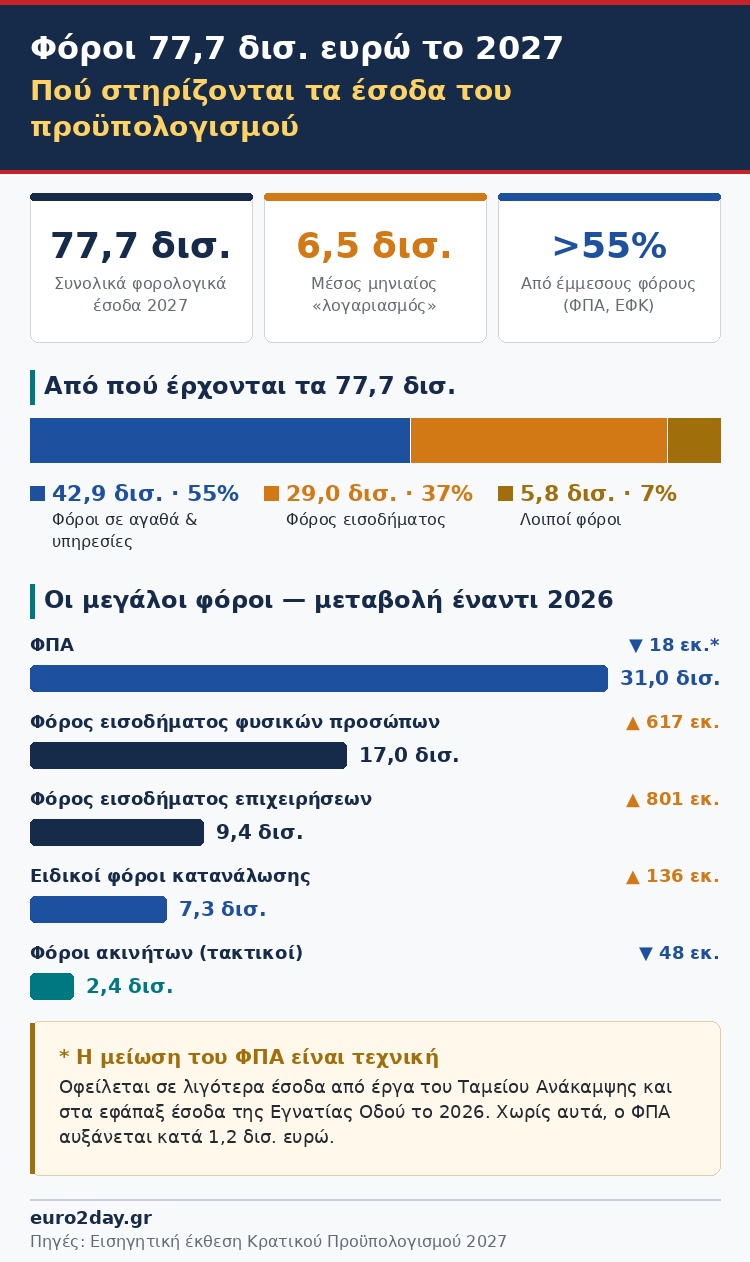
According to figures in the state budget report submitted to Parliament, taxpayers will have to dig deep, paying a total of €77.7 billion to the tax authorities — an average monthly bill of around €6.5 billion.
Projected economic growth, combined with rising nominal incomes and high prices, which boost receipts through consumer spending, is pushing tax revenue to new highs.
At the same time, the composition of revenue confirms a longstanding weakness in Greece’s tax system: the lion’s share continues to come from indirect taxes (VAT and excise duties), the most socially inequitable form of taxation because it falls equally on all citizens while disproportionately affecting low- and middle-income earners.
Indirect taxes and VAT
Budget figures show that taxes on goods and services will bring in €42.909 billion (up from €42.552 billion in 2026), an increase of €357 million and more than 55% of total tax revenue.
VAT remains the biggest contributor, with receipts forecast at €31.047 billion — almost 40% of all tax revenue.
Although the figure is nominally down by just €18 million from 2026 (€31.065 billion), the budget report makes clear that the decline is purely technical, reflecting lower VAT receipts from Recovery Fund projects and one-off revenue from the concession of Egnatia Odos in 2026. Excluding these two effects, comparable VAT revenue rises by €1.199 billion, confirming that consumer spending remains the budget’s main source of income.
Adding to the indirect tax burden are excise duties on fuel, tobacco and alcoholic drinks, which are forecast to bring in €7.345 billion, up €136 million from 2026 (€7.209 billion).
Income tax jumps by €1.53 billion
Direct taxes are also set to rise significantly. Income tax is expected to reach €28.974 billion, up €1.534 billion, or 5.6%, year on year:
- Individuals: Receipts are estimated at €17.036 billion, an increase of €617 million. The rise is attributed to higher nominal wages and pensions, as well as lower unemployment, despite changes to the tax bands.
- Companies: Businesses will pay €9.352 billion, up €801 million, reflecting higher profitability in 2026.
- Property taxes: This is the only category expected to edge lower, with recurring taxes at €2.365 billion, down €48 million from 2026.
A July tax crunch
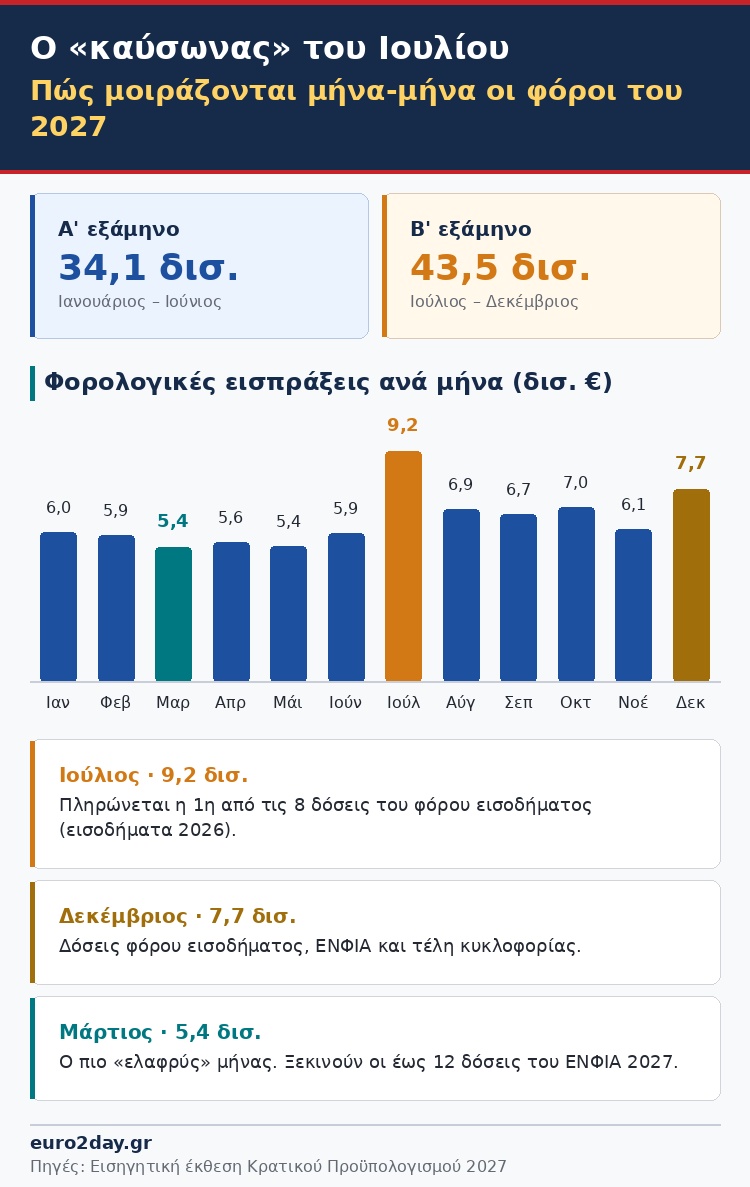
Tax obligations are distributed particularly unevenly across 2027, with the second half of the year set to be especially demanding. From July to December, taxpayers will be asked to pay €43.542 billion, compared with €34.135 billion in the first half of the year.
The most demanding month is July, when receipts are forecast to surge to €9.196 billion. The first of eight monthly instalments of income tax on 2026 earnings is due at the end of the month; tax returns can be filed from 15 March to 15 July.
The second most expensive month is December, at €7.685 billion (income tax instalments, ENFIA property tax and vehicle circulation tax). March has the lowest target, at €5.375 billion. Payments of ENFIA for 2027 begin that month and can be made in up to 12 monthly instalments (through February 2028), after the final instalments of 2026 ENFIA and 2025 income tax have been paid by 26 February.
More specifically, tax receipts will reach €5.964 billion in January, €5.854 billion in February, €5.375 billion in March, €5.591 billion in April, €5.410 billion in May, €5.941 billion in June, €9.196 billion in July, €6.886 billion in August, €6.698 billion in September, €6.960 billion in October, €6.117 billion in November and €7.685 billion in December.
The tax cuts taking effect
Against this mountain of obligations, the budget includes a series of relief measures, although they do not reverse the overall upward trend in revenue:
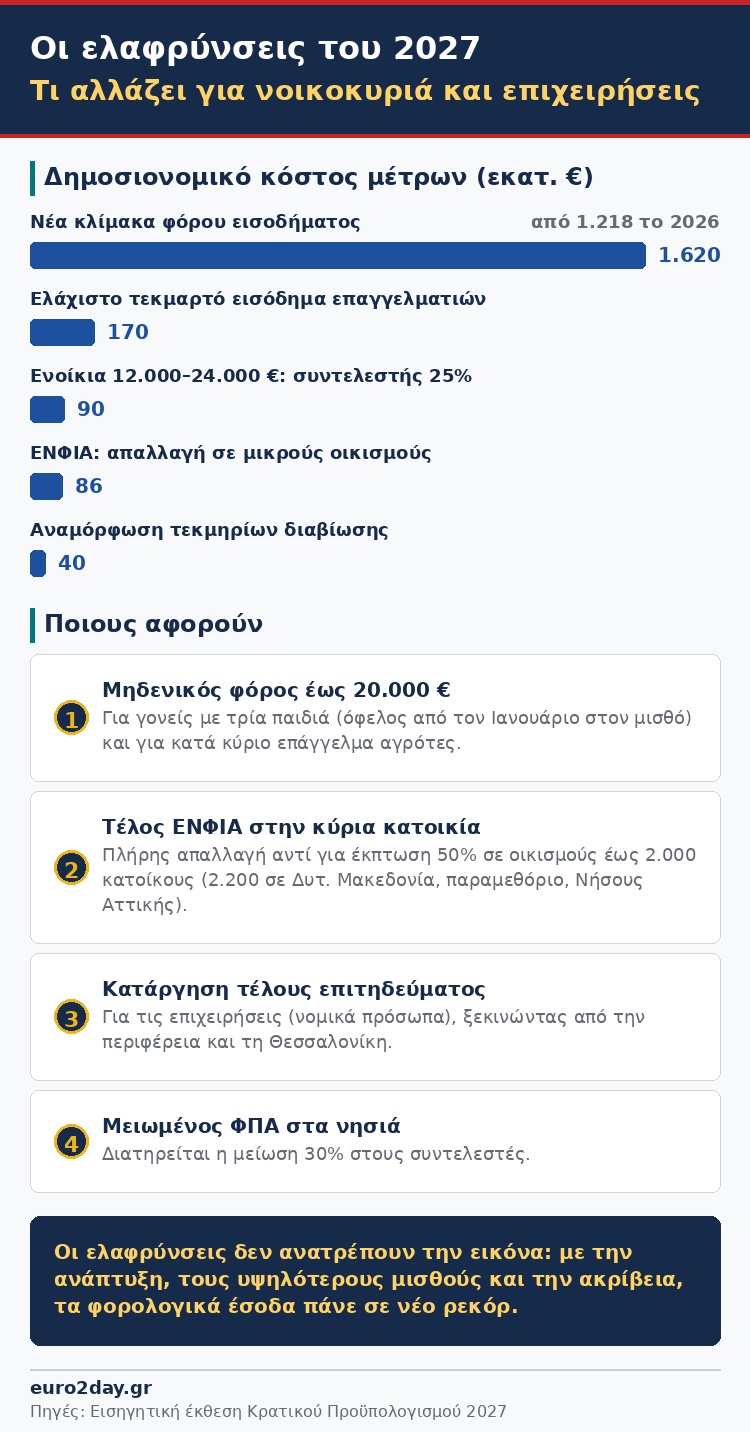
Income tax bands: The fiscal cost of the reform for individuals is €1.620 billion (up from €1.218 billion in 2026). A zero rate is also being introduced on income up to €20,000 for taxpayers with three dependent children, with the benefit reflected in employees’ tax withholding from January, and for farmers whose main occupation is farming.
Self-employed people and businesses: Relief is planned on minimum imputed income for compliant professionals (at a cost of €170 million), along with the abolition of the business levy for companies, starting in the regions and Thessaloniki.
Property and imputed expenses: Revising the rules on imputed living expenses delivers savings of €40 million, while the intermediate 25% tax rate on rental income between €12,000 and €24,000 reduces revenue by €90 million.
For ENFIA, the 50% discount is being replaced with a full exemption for primary residences in settlements with up to 2,000 residents (or up to 2,200 in Western Macedonia and border regional units, as well as the Attica Islands regional unit), at a cost of €86 million. The 30% reduction in VAT rates on the islands is also being maintained.