With gas just shy of €90, storage below 70% and December electricity futures at elevated levels in Greece and many other EU markets, Europe is preparing to face winter.
Although a week before December the spikes in the Greek wholesale market have eased — from prices of €300 and €350 to €140–150/MWh — there is no room for complacency, particularly after gas rebounded last week. Compared with a year ago, gas is trading at three times the price, while electricity is twice as expensive.
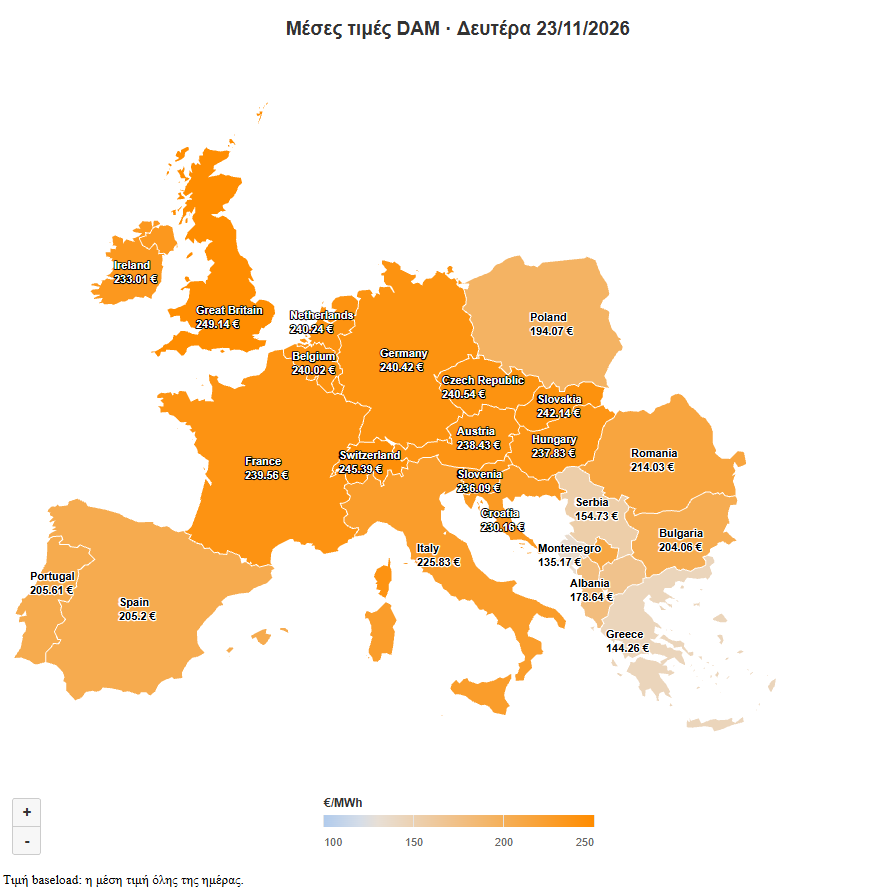
Much will depend on the weather and the contribution of renewables to the energy mix. At 71% today, they are once again helping to secure one of the lowest wholesale prices in Europe for Greece (€144.26/MWh), while prices of €200/MWh and above are setting the tone almost everywhere, with only a few exceptions.
From Bulgaria (€204.06/MWh), Romania (€214.03/MWh) and Hungary (€237.83/MWh), a benchmark for Southeast Europe, to Germany (€240.42), France (€239.56) and Spain (€205.2), a combination of cold weather, offline power plants and high gas prices is keeping markets elevated.
Against this backdrop, and with temperatures set to start falling in Greece in the coming days, an emergency summit will be held in Brussels on Thursday and Friday, 26-27 November. The main items on the agenda are how to bridge disagreements over the EU’s new seven-year budget and how to fund Ukraine.
Although talks and meetings involving Greek government ministers, Brussels officials and their counterparts in Eastern Europe have intensified recently, in an effort to build a bloc to press for greater fiscal flexibility, the issue is not included, at least, in the summit’s provisional agenda.
Last week, during bilateral meetings in Warsaw with his counterparts from Poland, Hungary, Slovakia, Croatia, Romania and Bulgaria, Environment and Energy Minister St. Papastavrou sought to lay the groundwork for a common front of six or seven countries at the Transatlantic Energy Cooperation (P-TEC) summit.
The push for flexibility, and Greece’s request to change how the funds unlocked by the national escape clause can be used, were also the focus of meetings held in Brussels on 16 and 17 November by the responsible deputy minister, Nikos Tsafos.
Low expectations for greater flexibility
The Greek side is nevertheless keeping expectations low. According to sources, talks at the European Commission’s headquarters once again highlighted the lack of consensus on the need for greater flexibility to tackle the energy crisis. Views remain divided, even as a specific tool such as the 2022 cap on natural gas prices is absent from the table — although that measure, too, was introduced with considerable delay.
At this stage, the same sources say, energy is not being discussed as a standalone issue but alongside many others — from the new budget for the EU’s 27 member states and fiscal pressures in the bond market to Ukraine — leaving everyone’s attention divided. While the general view is that a “course correction” is needed, according to officials, there is no agreement on which direction it should take.
This means the summit’s conclusions may indeed refer to the energy crisis. For now, however, nothing points to tangible progress on the request in Mitsotakis’ letter to Ursula von der Leyen to change how funds unlocked by the escape clause can be used. The aim is to ensure spending is not directed solely towards investments such as “Energy Saving” schemes and heat pumps, but can also fund targeted, temporary support for households and businesses.
At the same time, signals for electricity prices in Greece and the wider region are mixed, both for December and the first quarter of 2027.
Natural gas prices remain high
Although gas is below October’s peak of €104/MWh, it closed last week at €89.6/MWh, up 10% from its two-month low of €80 on 18 November. European gas storage stands at 69.3%, its lowest level for this time of year since 2011, when Gas Infrastructure Europe began recording data.
According to estimates by analysts and traders at Montel, if the winter is cold, wind output is low and critical power plants go offline, the EU could enter April 2027 with average gas storage levels of just 20%, with all that would mean for price pressures.
Electricity futures remain high
Hungary’s forward contract, which sets the tone across Southeast Europe, closed on Friday at €256.02/MWh (+5%), while Germany’s stood at €217.03/MWh, up even more, by 7%.
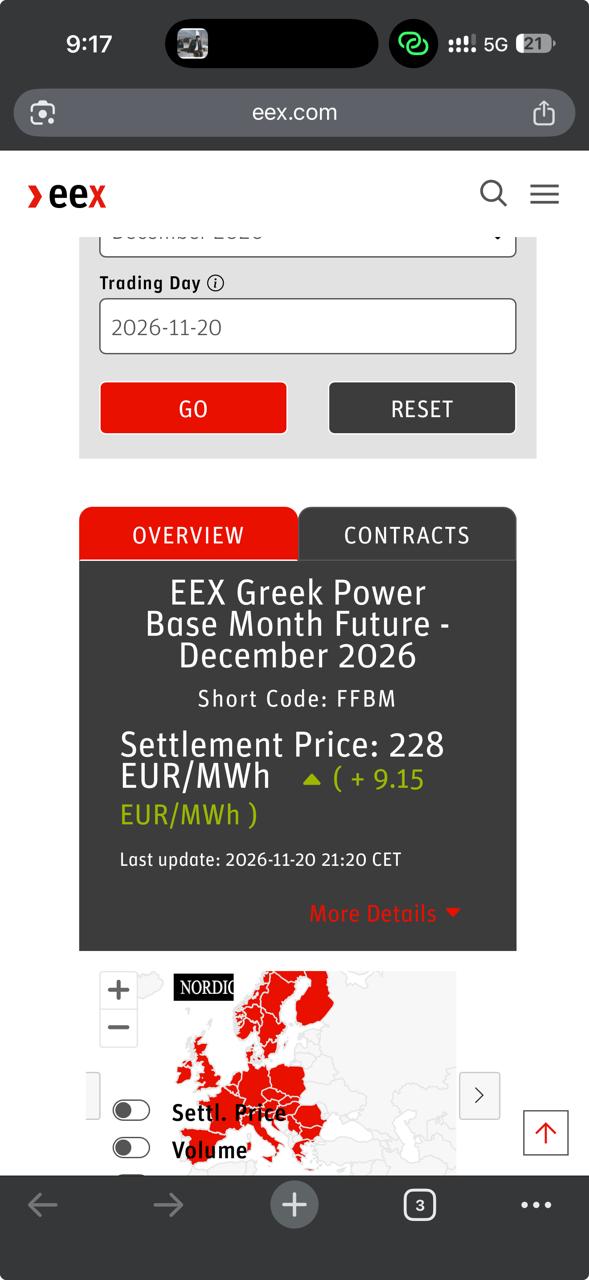
The equivalent Greek future is also at a high level, standing at €228/MWh (+4%), slightly above the monthly average of €224/MWh at which the wholesale price is running for November. If the month ended today, the average wholesale price would close 14% higher than in October, meaning December would mark the sixth consecutive month of retail price increases.
Hydropower improves
The hydropower balance in Southeast Europe remains below seasonal norms, despite improving by 2 TWh since early October, with output rising above five-year lows.
“Conditions in hydropower have improved considerably, but we have not yet overcome the difficulties,” says Gabor Szatmari, a Central and Southeast European market specialist at Montel EnAppSys.
Rainfall, forecast to be around 35% above the seasonal average over the next five weeks, could improve the outlook.
Nuclear power improves
Romania’s Cernavoda power plant, with capacity of 1.35 GW, is back at full capacity. Unit 6 of Bulgaria’s Kozloduy nuclear power plant has also been reconnected to the grid after scheduled maintenance, bringing the plant’s total output to 2 GW.