In a year when the beer market contracted by around 6%, Olympic Brewery bucked the trend. Following the announcement of the company’s 2025 financial results, Chief Financial Officer Ilias Popotas discusses its performance and the trends shaping the market.
He also outlines the company’s investment priorities for the period ahead, focusing on upgrading production facilities, reducing its environmental footprint and innovation.
How did volumes and value perform in 2026, given tourism, the World Cup and geopolitical cost pressures? What are Olympic Brewery’s main priorities as its three-year, €30 million investment programme comes to an end?
2026 confirms that the beer market continues to operate in a challenging environment, with the exception of the alcohol-free products category, which remains on an upward trajectory. Overall, however, consumption is under pressure, particularly in HoReCa, as well as in traditional retail.
At the same time, inflationary and geopolitical pressures continue to affect costs and consumer behaviour. The growth in tourism is certainly positive for the economy, but it is not translating proportionately into higher consumption, as we are seeing more restrained spending and shorter stays among some visitors. The World Cup also made a positive but limited contribution to the beer market during the year, given Greece’s absence from the tournament and the broadcast times of several matches.
In these conditions, at Olympic Brewery we are focusing on the factors we can influence directly: the efficiency of our operations, our competitiveness and the consistent implementation of our investment plans. In 2026, we are completing our three-year investment programme worth €30 million for 2024-2026. Under the programme, we have made targeted investments to improve our production facilities and our operations overall, with a focus on energy efficiency, automation, health and safety, and sales equipment.
Looking ahead, we will maintain the same commitment to investment, focusing on further modernising our production units in Sindos and Ritsona, reducing our environmental footprint and promoting innovation across all areas of our business, from products and packaging to production processes and sales equipment. These investments will improve the company’s efficiency and resilience over the long term, while enabling us to evolve in line with new standards and the changing needs of the market and consumers.
The beer market ended 2025 down by around 5-6%, but Olympic Brewery continued to grow. How did revenue, gross margin and operating profit perform, and what drove the company’s outperformance against the market?
In 2025, our revenue (before Excise Duty) increased by 4.1% to €207.4 million, while operating profit rose by 3.6% to €23.47 million. In a market that contracted by around 6%, we not only maintained our position but also achieved growth in key financial measures.
This performance reflects, among other things, our stronger position across all market channels. In the domestic market, we kept our volumes stable despite the overall decline in the category. The 5.8% increase in total sales volumes was linked to the parallel expansion of our export activity. Among other things, we made greater use of our domestic production to meet demand in other markets where the Carlsberg Group, of which we are a member, operates.
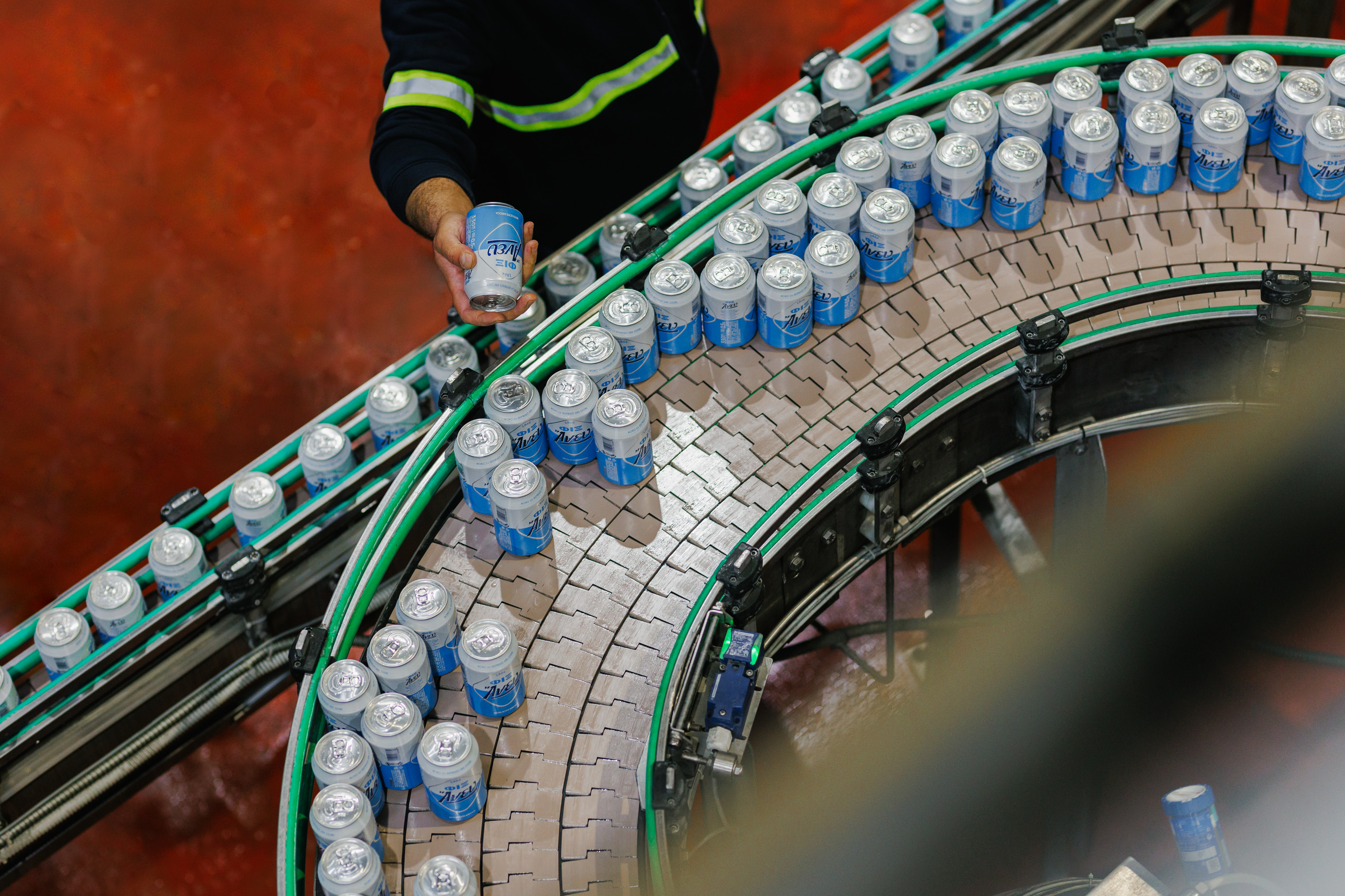
We also continued to invest in categories with strong growth prospects, such as premium brands and the fast-growing alcohol-free beer category, where we have a particularly strong presence with the FIX Άνευ product range. Since 2025, we have also strengthened our offering in this category with Mythos 0.0%.
Our performance relative to the market therefore reflects our stronger presence across different channels, the resilience of our domestic business, greater international reach and the strategic choices we consistently make across our portfolio.
At the same time, we implemented targeted cost-control policies and prioritised investment, while a reduction in finance costs also contributed positively to our overall financial performance.
Which cost factors—raw materials, packaging and energy—put the most pressure on margins?
Cost pressures do not stem from a single factor. Raw materials, packaging materials and energy have created a complex cost environment, which affected us in 2025 and became even more challenging in 2026, amid volatile geopolitical conditions.
We are monitoring these developments closely and are seeking to manage the associated risks effectively, as far as possible. Our cost-control policies and investments in more efficient production facilities, automation and energy efficiency all help in this respect.
How did demand evolve in retail, HoReCa and exports? How has pressure on disposable income changed consumer behaviour?
Demand varies significantly by channel. We are seeing greater resilience in modern retail, while HoReCa and smaller retail outlets are facing greater pressure. In smaller retail in particular, consumer restraint is compounded by the gradual decline in the number of outlets.
Pressure on disposable income has made consumers more careful and selective about how they spend. This does not necessarily mean, however, that they always turn to the cheapest option. For example, we are seeing a “less but better” approach: consumption may be more selective or less frequent, but quality and the overall experience remain highly valued on certain occasions.
Exports, meanwhile, continue to show positive momentum and are an important growth pillar for Olympic Brewery. Our products are now available in 39 countries across all five continents, with Mythos standing out in particular in international markets. International expansion remains an important part of our strategy, enabling us to pursue growth opportunities outside Greece while also strengthening the international presence of Greek brewing.
Low- and no-alcohol options now account for 31% of your portfolio. Are premium products, 0.0% beer and soft drinks the sector’s new drivers of profitability?
These categories have significant potential and are strategic areas of growth for us. In the premium segment, we have a strong presence with brands such as Kaiser, Carlsberg, 1664 Blanc and NISSOS. Alcohol-free beer is also one of the market’s most dynamic categories, with FIX Άνευ holding a leading position and Mythos 0.0% further broadening our offering. Through Tuborg, we also offer an expanded portfolio of soda water, tonic and mixers.
I would not focus solely, therefore, on whether any one category is the new “driver” of profitability, as you put it. For us, the opportunity lies in the strength and breadth of our overall portfolio and our ability to develop categories with different characteristics and significant growth prospects.
How will excise duty, the deposit-return system for packaging and the new European packaging rules affect the industry?
The gradual introduction of the deposit-return system for packaging and the new European packaging rules represent a significant challenge for the industry as a whole. These changes will require substantial adjustments by businesses and increase operational complexity, particularly during the initial implementation period.
It is important to us that the transition is operationally effective, achieving environmental goals without placing a disproportionate burden on the market or causing disruption and difficulties for consumers themselves. At a time when consumption is already under pressure, predictability and the smooth implementation of the new framework are particularly important.