The government’s economic team is counting on a new wave of fines and penalties in 2027 to boost public coffers.
The total bill for fines and monetary penalties is set to soar to €1.18bn, confirming that enforcement agencies are stepping up their efforts, as recent revelations of major tax evasion cases also show.
This represents an increase of €50m compared with 2026, demonstrating that collection pressure remains strong.
The biggest share of this burden comes from the tax office, with tax penalties now nearing the symbolic threshold of €1bn.
Specifically, tax fines and surcharges are budgeted at €962m. That is €92m more than the €870m forecast for 2026.
According to the budget figures, this revenue comes from two main sources: older cases that have already been assessed and are being collected gradually, and new violations expected to be uncovered by intensified inspections during the year.
The focus is on the concealment of taxable income, late filing of tax returns and all forms of tax non-compliance.
A further €41m is expected to flow into public coffers solely from surcharges for late payment of overdue debts to the state, reflecting the difficulty citizens face in meeting their obligations on time.
Beyond taxation, the Ministry of National Economy and Finance has cast a wide net of penalties covering almost every area of activity.
In the customs sector, projected receipts total €28m. Of this, €17m relates to customs violations and smuggling cases, €6m to surcharges on late payments and €5m to penalties for inaccurate declarations.
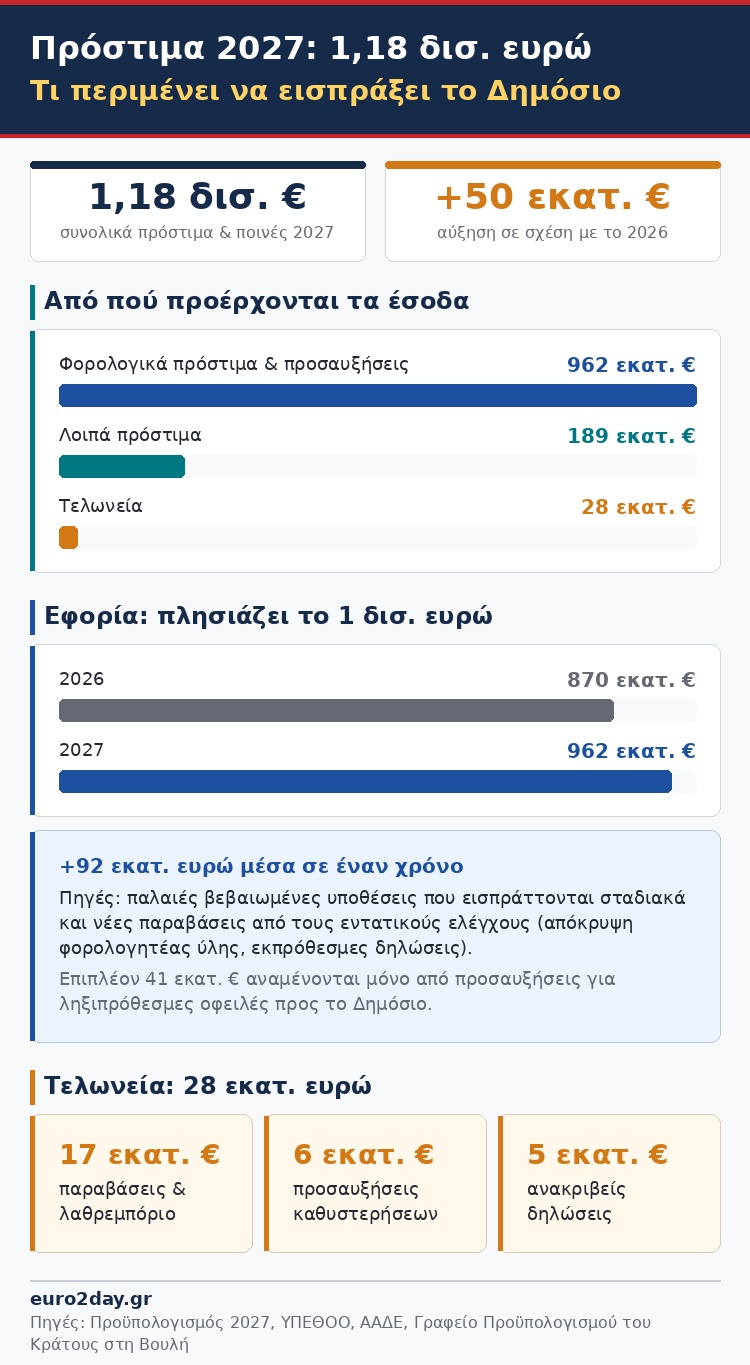
Meanwhile, other fines are estimated at €189m, reflecting the reach of enforcement across many areas of everyday life and business:
- Planning and environmental violations: The state expects to collect €6m in fines for insufficient parking spaces in buildings and €4m for unauthorised construction. A further €5m will go to the Green Fund and €1m to the Blue Fund.
- The labour market and consumer protection: Penalties for breaches of labour law are expected to generate €11m, while fines related to consumer protection amount to €2m.
- The courts and port authorities: Monetary penalties imposed by criminal courts are forecast to reach €20m, while violations of port regulations, such as illegal anchoring, are expected to generate €8m.
They remain unpaid
It is worth noting, however, that imposing fines and penalties does not automatically translate into equivalent revenue for the budget.
According to official figures from the Independent Authority for Public Revenue and the Parliamentary Budget Office, of the €79.04bn in genuinely collectible overdue debt (out of a total of €114.57bn, since €35.53bn has been classified as uncollectible), €17.45bn — or more than one in every five euros (22.09%) — relates to unpaid tax and non-tax fines.
There are three main reasons why many fines go unpaid: they are imposed on shell companies or insolvent debtors with no assets; many are challenged before the Dispute Resolution Directorate or the administrative courts, and are either cancelled or drastically reduced; while many fines remain unpaid because taxpayers cannot afford to pay them.