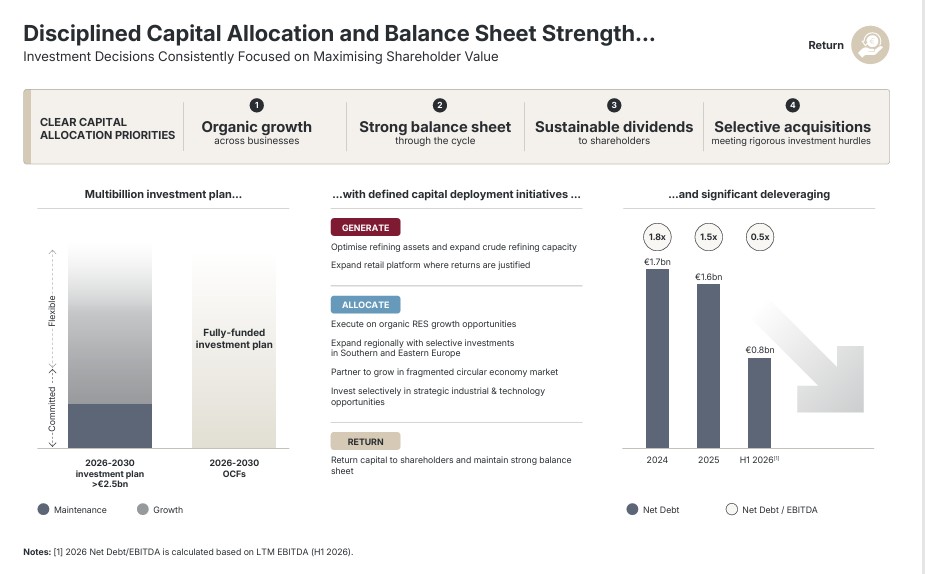
Motor Oil’s updated strategic plan lays out the ambitions of a group planning to invest more than €2.5bn by the end of the decade, funded entirely through equity, with refining at the heart of its priorities.
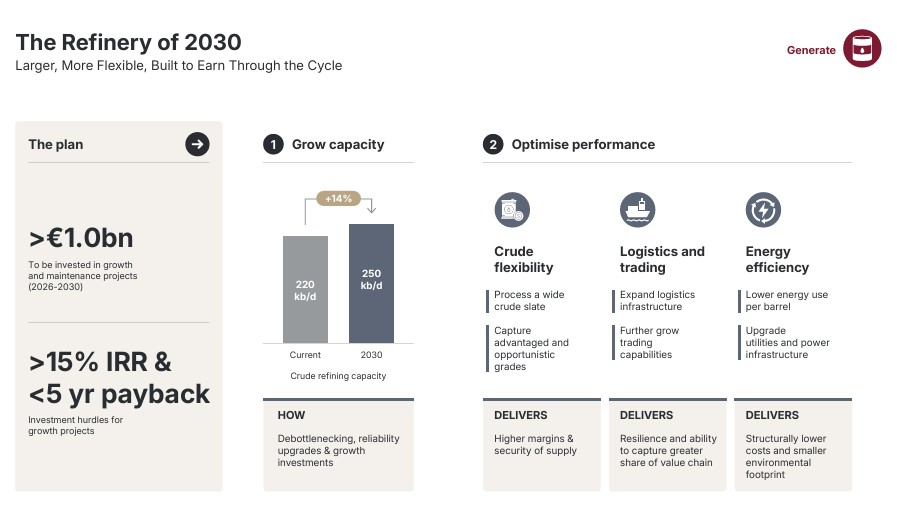
A closer look at the new plan from the Vardinoyannis group, published alongside its nine-month results, shows that its growth strategy is clearly focused on increasing refining capacity. The aim is to raise capacity from 220,000 barrels per day today to 250,000 in four years. Significant sums will also be invested in improving the performance of its facilities at Agioi Theodoroi, in logistics and in the energy efficiency of its oil products business.
In practice, refining will absorb more than €1bn, or 40% of the total investment MOH plans to deploy over the next four years across its full range of activities, from renewables and batteries to power generation and the circular economy. This figure does not include decarbonisation projects such as hydrogen, biofuels and the transport of CO2 for storage. The projects in this latter category that are now reaching maturity could absorb an additional €1bn of investment.
The above, and the strategic emphasis on refining, are considered essential because all forecasts agree that demand for oil products will remain stable globally through 2030, with no sign of a decline, despite the electrification of the energy sector, particularly in Europe. Demand is expected to remain at around 102m barrels per day, roughly the same level as in 2026. This means that groups moving quickly to position themselves for this new era will have an advantage.
That is true both because geopolitical upheavals are becoming increasingly frequent and tending to become part of everyday life, as MOH’s plan notes, and because Europe’s refining capacity deficit is growing. A total of 12 refineries have closed across the continent over the past six years, resulting in the loss of 1.2m barrels per day of capacity, which has not been replaced.
The group’s new strategic plan also points to the growing importance it attaches to a new retail model that turns filling stations into everyday service points for drivers. MOH currently has a share of more than 35% of the domestic fuel market, more than 100 stations across south-eastern Europe and 2,200 electric-vehicle charging points on Greek roads, with a target of 4,000 by the end of the decade.
More aims to double in scale
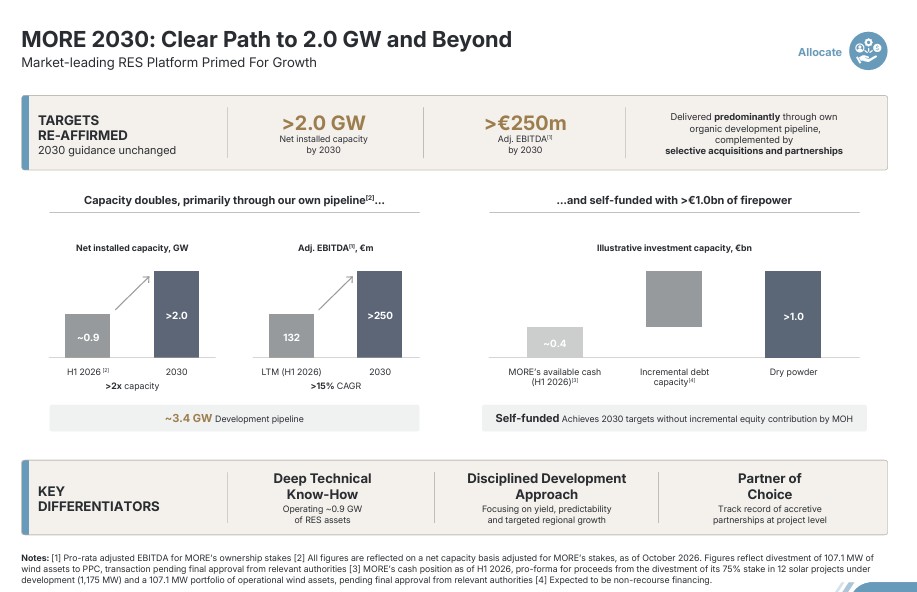
In renewables, the ambitious target is to double More’s installed capacity, from 0.9 GW today to 2 GW, with adjusted EBITDA of €250m, compared with €132m in the first half of 2026. Asked how all these “green” projects will be financed, the answer is the group’s firepower: available funds of €1bn, according to the updated plan.
The forthcoming merger of HERON and NRG, which is in its final stages, will also play an important role in the group’s increased scale. It will create a player with 550,000 customers, a 14% share of the electricity market and an 11% share of the gas market, as well as annual electricity generation of around 6.6 terawatt-hours. The two groups are working through the final details of the agreement, with the initial timetable envisaging completion of the transaction at the end of the year or in early 2027.
Taking into account the significant opportunities opening up in renewables and waste management, the group expects adjusted EBITDA excluding fuels to multiply by 2030, from €260m in the first half of 2026.
By the end of the decade, More alone is expected to contribute more than €250m, excluding the contribution of UtilityCo — the name of the new company to be formed by the HERON–NRG merger — as well as that of the circular economy business.
In summary, Motor Oil’s new strategic plan, worth more than €2.5bn and funded entirely through equity, focuses on investment to prioritise organic growth, underpinned by strong balance sheets and sustainable dividends for shareholders, with an emphasis on selective acquisitions, as the plan puts it.