The benefits of creating a third major player in the electricity market through the merger of HERON and NRG , completing the deal with Aktor for Dioriga Gas and More’s new moves in renewables are the developments we expect from Motor Oil next year.
Asked where the group will focus its efforts, the answer is, of course, refining, with group CEO Petros Tzanetakis expecting 2027 to be another strong year, driven by international demand for petroleum products, potentially strong refining margins and selective investment guided by financial discipline.
Yesterday, in response to an analyst’s question about whether the strategy update and €2.5bn of investment through 2030 — including more than €1bn in refining — signalled a greater appetite for capital expenditure, management was quick to clarify that this is not the case.
Rather, investment over the next four years will be more targeted. The 2022 plan also did not include the increase in refining capacity envisaged in the new plan, which targets 250,000 barrels by the end of the four-year period, up from 220,000 today.
In the same vein, management noted that the updated plan will be funded entirely from the group’s own resources, and will neither put dividends per share and shareholder returns at risk nor affect the path of debt reduction. The latter is reflected in the sharp cut in borrowing, from €1.6bn at the end of 2025 to €800m in the nine-month period, with the debt-to-EBITDA ratio falling to 0.5 from 1.5.
The NRG-HERON merger
The first good news of the new year will be the completion of the NRG-HERON merger, which is expected in the first quarter, the group’s general manager of strategy, George Triantafyllou, said yesterday.
The merger of two major players in the sector is clearly set to create a formidable force, capable of reshaping the energy market and perhaps acting as a catalyst for further consolidation in a sector still undergoing a far-reaching transformation.
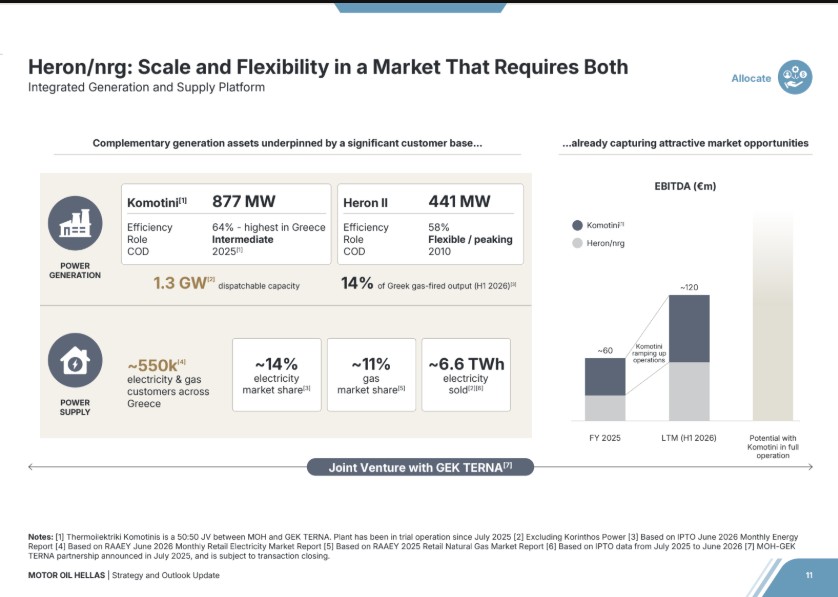
The merger, now in its final stages, is set to create a player — provisionally named UtilityCo — with 550,000 customers, a 14% share of the electricity market and 11% of the gas market, as well as annual power generation of around 6.6 terawatt-hours.
The new vertically integrated utility will have a generation portfolio combining baseload plants with flexible capacity. This means HERON II and a 35% stake in Korinthos Power, alongside the flexible capacity of the country’s newest and most efficient plant in Komotini (877 MW). In an energy landscape increasingly resembling “quicksand” because of the intermittency of renewables (when the wind does not blow or the sun does not shine, they switch off) and the continued shortage of batteries, flexibility as a natural hedge against risk is the only way to stay in the game.
There are many synergies from the merger, ranging from the mix of generation assets each player contributes, including offshore wind in the Thracian Sea, and joint energy management and trading, to staff working together, budgets and logistics.
The Aktor deal for Dioriga Gas
The sale to Aktor of a 50% stake in Dioriga Gas, the company developing the FSRU at Agioi Theodoroi, is entering its final stages, paving the way for a final investment decision (FID).
The agreement in principle reached in July provided for the creation of a joint venture with equal participation by the two groups, subject to finalising the contracts and securing the necessary approvals.
For the Vardinoyannis group, Motor Oil is partnering with a player in a move that will halve its risk. For Aktor, the deal forms part of its new business plan, worth €3bn through 2031, as it seeks to strengthen its presence in supplying south-eastern Europe with US LNG.
More aims to double in size
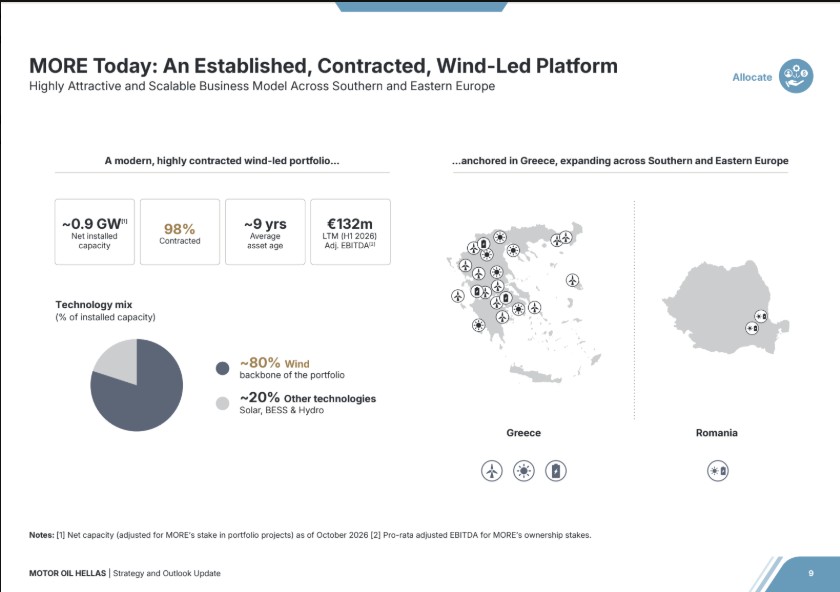
On the renewables front, the ambitious target for 2030, which will be pursued largely over the coming year, is to double More’s installed capacity. From 0.9 GW today, it is to reach 2 GW, with adjusted EBITDA of €250m, compared with €132m in the first half of 2026.
Asked how all these “green” projects will be financed, the answer is through the group’s financial firepower: available funds of €1bn, according to the updated plan.