A sixth consecutive wave of price rises is looming in December for the three million households that remain on green tariffs, with the only question being how much capacity the major players in the market still have to absorb some of the increases, given that even they are under pressure.
The scale of the problem is not captured by one more month of increases — the news would be if the opposite happened, since the average wholesale price is up 15% so far in November — but by the bigger picture since July, when the price rally began.
At that point, the average price on the market’s green tariffs was 17.68 cents/kWh, but in November it stood at 30.4 cents per kilowatt-hour.
That means the average price on green tariffs has risen by... 72% over the past five months. The picture is no better when looking at the four largest suppliers, whose tariffs cover more than 80% of the market: the average charge has surged from 16.4 cents in July to 26.7 cents in November.
Had the major suppliers not shown restraint in recent months and moved to absorb some of the cost, increases would have exceeded 100%, matching the surge in wholesale prices, which rose from €93/kWh in July to close at €197/kWh in November and are now averaging €227.1/kWh for the month.
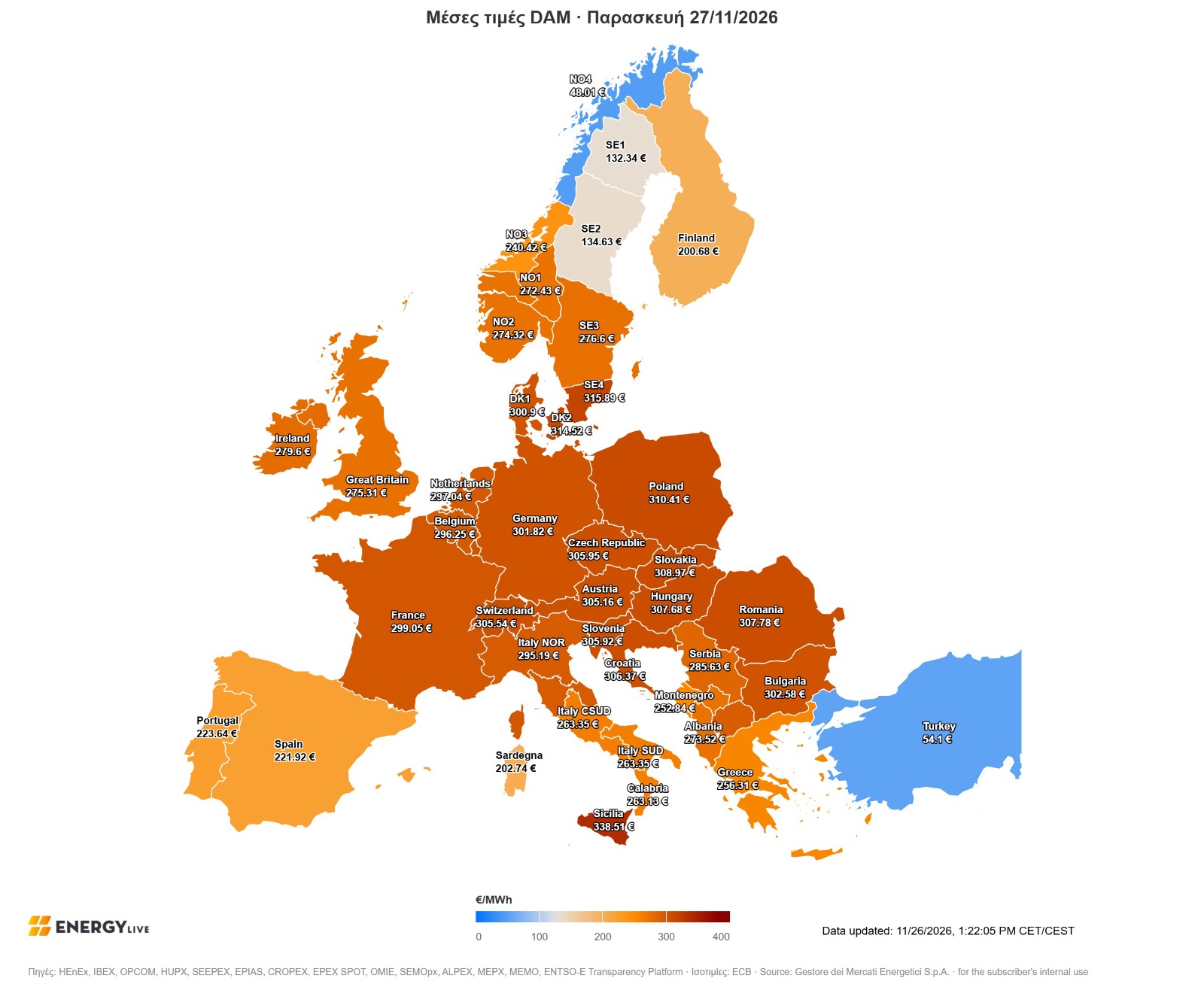
This is happening as the cold snap gripping Europe this month has led to large volumes of natural gas being withdrawn from European storage facilities, with levels falling to 67%, “a development that could encourage traders to bet on higher prices”, an Engie analyst said yesterday.
Against this backdrop, speculation in the gas market continues unabated, with prices stuck at around €90 and, like a rollercoaster, moving up and down by €5-10 each week — around half the... €20/MWh it once cost — increasingly often turning the European map red (or at least deep orange).
Today’s picture shows wholesale electricity prices of around €300/MWh prevailing in 11 countries, with many others close behind, while Greece stands at €256/MWh. That is lower than in neighbouring Bulgaria and Romania, but still very high.
Blue tariffs and hopes for milder weather
The government hopes the shift to blue tariffs will continue, and that the 124,000 customers added in a single month, September — driven by PPC’s promotional offer — will be joined by more in October, November and the months ahead, especially if this product remains available.
By contrast, officials fear gas price increases will continue over the next three months, with the weather their only hope and, in turn, subdued demand for LNG cargoes from Asia, which has so far acted as a “lifeline” for prices in Europe.
That is where things stand, with no sign that Athens’s request, shared by other Eastern European countries, to change how funds under the national escape clause are used — allowing them to support consumers instead of going to the “Energy Saving” scheme — has much chance of advancing.
The energy crisis was clearly not discussed at the European Council summit of the EU’s 27 leaders, which ended without agreement last night as differences over the multiannual budget remained unresolved. Expectations are also low ahead of the next Energy Council meeting on 10 December.
Greece has made some moves to build a common front with Eastern European countries on the issue of flexibility (Bulgaria, Romania, Croatia, Hungary, Slovakia and Poland), but the issue does not appear to be a priority.
Mytilineos: Commission hesitant to support households
Although the European Commission has taken some measures to support businesses in recent months, it is reluctant to do the same to support household electricity prices, as this would require many billions, Evangelos Mytilineos said yesterday, also commenting on governments’ stance.
“We have governments which, for the most part, make decisions against the will of the people, something I see on the streets every weekend in many European capitals. There is a disconnect between what people want and what governments are deciding today. That disconnect will be reflected in 2027,” he added, citing fuel as an example.
“If a referendum were held today and voters were asked to choose between continuing aid to Ukraine and cutting petrol prices by 30%, 99% would choose the latter,” he said.