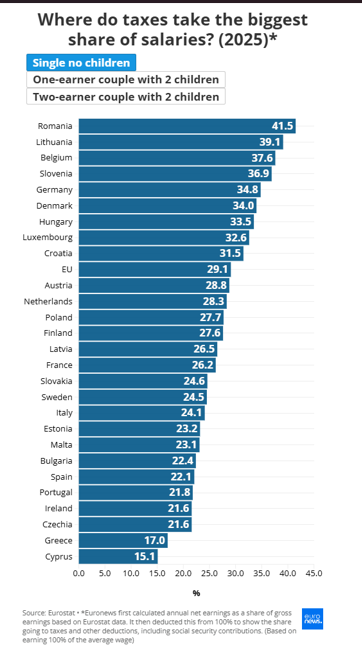
The lowest burden on wages in the European Union is borne by workers in Greece, together with those in Cyprus, according to the data recorded by Eurostat and presented by Euronews Business for 2025. The percentage of gross earnings lost to taxes and social security contributions stands in Greece at 17% for a single person without children, compared with 29.1% on average in the EU.
The picture becomes even clearer when compared with the countries at the top of the burden scale: in Romania the corresponding percentage reaches 41.5%, in Lithuania 39.1% and in Belgium 37.6%, that is, far above Greek levels.
In other words, when the comparison is made on net wages and not nominal ones, the average worker in Greece retains a much larger part of their gross salary compared with most European countries.
According to ANA-MPA, the comparison is important for one more reason: it overturns the simplistic picture that Greece ranks 2nd after Bulgaria among the countries with the lowest wages. When examining what ultimately goes “into the worker’s pocket” after deductions for taxes and contributions, the picture in our country is different and clearly more favorable.
What the data show
In the tables published by Euronews, based on Eurostat data, Greece appears 2nd after Cyprus in the lowest burdens and far below the average of the European Union, both for workers without children and for families with children.
Especially for a single-parent family with two children in Greece, the burden declines further, placing this category among the most favored on the European map.
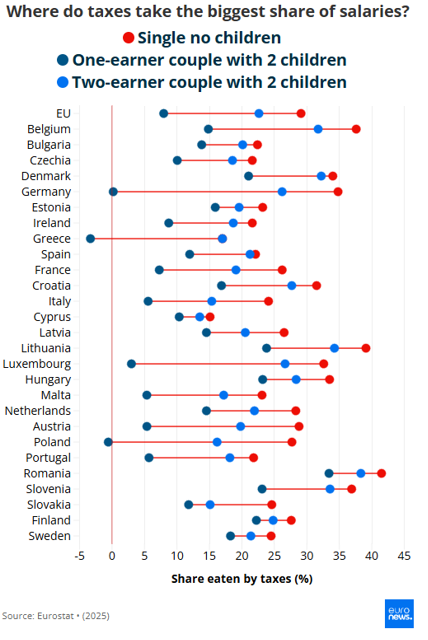
The picture is similar for couples with two children as well. Greece remains in the last positions of the ranking, with the burden percentage again standing at 17%, while in many other countries the corresponding percentages are noticeably higher.
The data concern the year 2025. However, from 1/1/2026 a new tax scale is being applied in Greece with even greater reductions for everyone -and especially for families with children- something that may change the picture in the next comparisons, once tax returns for this year’s incomes are submitted, incorporating also the new wage increases that have already been granted since April.
What goes “into the pocket”
This difference is reflected not only in the rates, but also in absolute amounts: much less is deducted from an average worker in Greece than in countries where deductions absorb up to more than 40% of earnings.
How is this “translated” for workers?
As the following table shows for average annual wages before and after the tax and insurance deductions applied by country:
- Based on nominal wages, Greece ranks as the 2nd country (after Bulgaria) with the lowest wages in the EU overall for 2025. With an average annual gross income of 18,124 euros, the average worker in Greece appears to receive less than half each year compared with the annual earnings of an average European worker who receives 37,958 euros per year. That is, it falls short by 19,834 euros from the average nominal wage of workers in the EU.
- Based on net wages, Greece automatically rises two places in the ranking, while the gap compared with all the others is drastically reduced: average deductions for the Greek worker amount to 3,074 euros and net earnings to 15,050 euros. Thus it ranks 4th in the EU.
By contrast, other countries, even starting from higher nominal wages, “fall” below even the average worker’s “net” wage in Greece.
Specifically, using net earnings as the basis of comparison:
- The average European worker undergoes deductions of 11,029 euros per year (that is, more than triple the amount of the Greek worker who loses 3,074 euros annually).
- In Romania, where the average gross annual income was 22,620 euros, deductions amount to 9,387 euros per year. Automatically the net income “falls” to 13,233 euros annually, which is the 3rd lowest wage in the EU.
- Similarly in Hungary, from 19,500 euros gross, deductions amount to 6,033 euros and annual earnings are “cut” to 12,967 euros “net”, below Bulgaria (16,774 euros gross with 13,017 euros net annually).
- In other countries, where initial wages are much higher, deductions are also many times higher than those in Greece.
For example, in Germany from 47,514 euros per year it “falls” to 31,000 (-16,514 euros), in France from 41,764 it “falls” to 30,832 euros (-10,932 euros), in Spain from 32,446 it is reduced to 25,263 euros (-7,210 euros), in Portugal from 25,187 euros, 19,709 euros remain “net” (-5,478 euros), in Croatia from 25,199 euros, 17,256 euros remain for the average worker (-7,943 euros), while in Slovakia from a nominal wage of 20,803 euros, the “net” remaining for the worker does not exceed 15,686 euros (-5,117 euros) and the final difference in “net in the pocket” is reduced to 636 euros per year.
The burdens by household type
Based on these data:
- For single people without children:
- Wage deductions in Greece do not exceed 17% and in Cyprus 15.1%, meaning Greece has the 2nd lowest burden in Europe. The EU average is 29.1%, so Greece is far below the European total.
- In the countries showing the highest deductions, the percentage reaches 41.5% in Romania, 39.1% in Lithuania and 37.6% in Belgium.
- Compared with the most burdened countries, Greece’s gap is about 20 to 24 percentage points, that is, almost 1/4 of the difference in nominal earnings.
- For workers with children:
- A single-parent family with two children in Greece gains about 3.3 percentage points compared with single people without children.
- For a couple with two children, in Greece the burden remains at 17%.
With this picture, Greece remains in the last positions of the burden list in the family categories as well, while in most other countries the burdens are clearly higher.
SOURCE: ANA-MPA