On the triptych of “incompetence, lack of transparency and lack of meritocracy” PASOK bases its interpellation to the government, accusing it of lack of planning and failure in changing the country’s productive model, on the occasion of the approximately 90 billion euros in European resources that New Democracy had at its disposal.
The interpellation has been scheduled for Friday and the Recovery Fund is at the center of it. According to PASOK MP Pavlos Geroulanos, the Recovery Fund appears to be concluding with full absorption of the 36 billion euros, but with fewer, different and cheaper projects than those initially included.
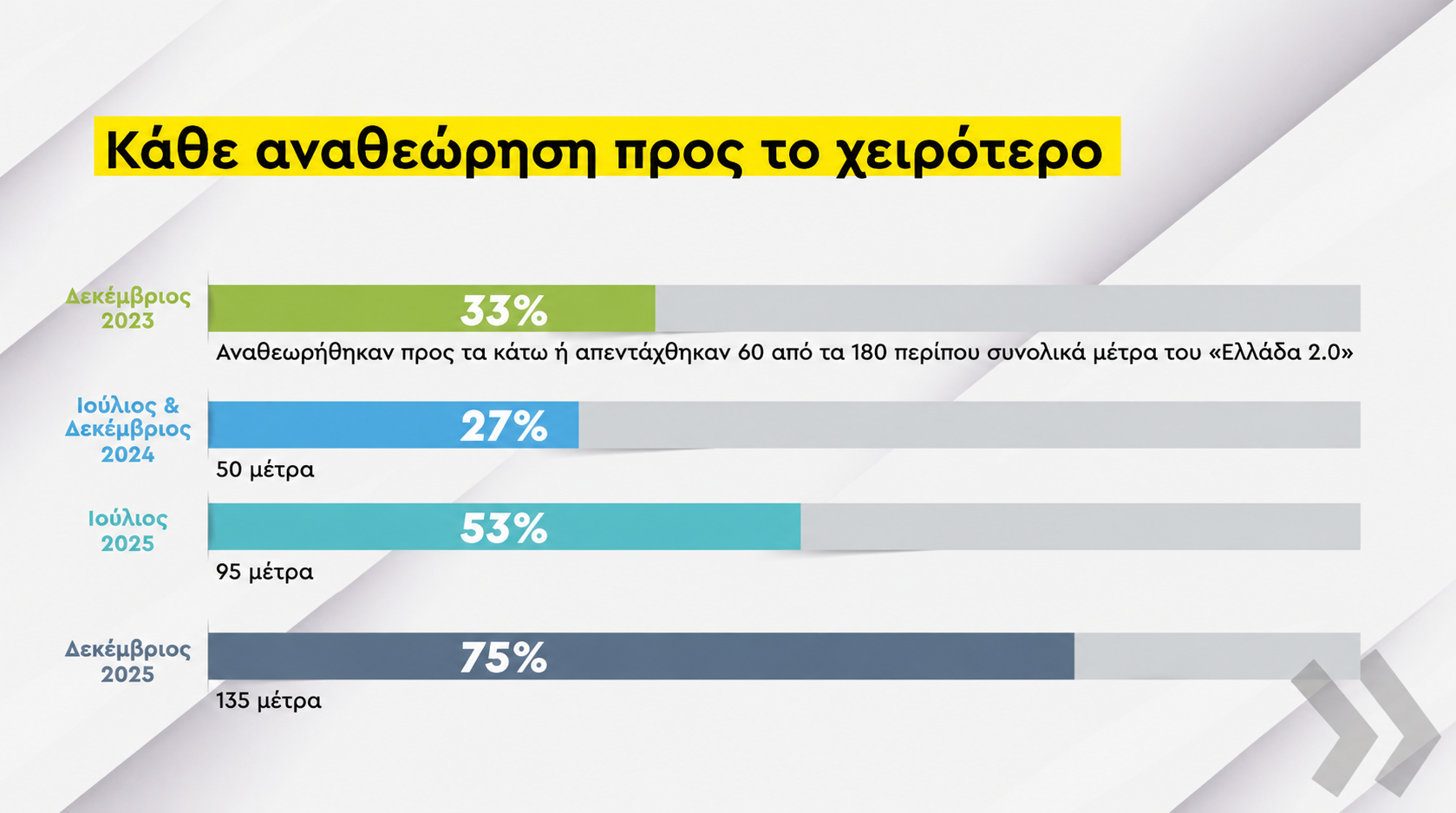
Mr. Geroulanos presented data today that emerged from the comparison of the projects that had been included and the final outcome. The presentation arrives at the following main conclusions:
First, each of the four revisions included cuts or downgrading of critical projects. “Each revision for the worse,” it is stated in the special analysis of 195 Recovery Fund projects, which examines their course from the first revision, in December 2023, until December 2025. It is noted that one more revision is still pending.
Second, two thirds of the measures deviate from the original planning.
Third, in the latest revision of December 2025, according to Mr. Geroulanos’s analysis, significant problems are identified in the grants component.
Fourth, serious problems are also found in the expenditure component.
Fifth, instead of accelerating the implementation of the milestone projects, the pace of their progress is slowing down.
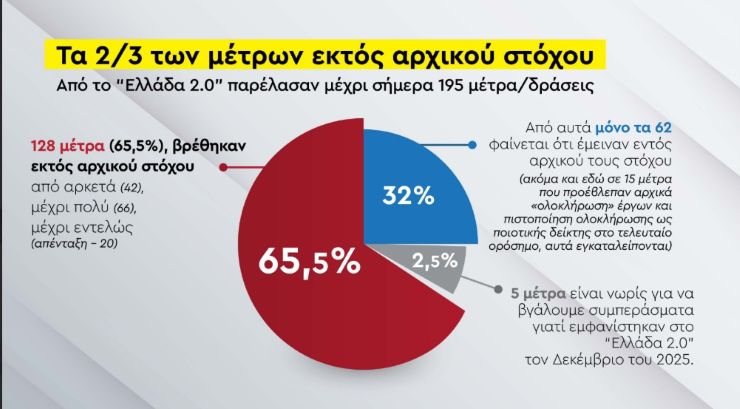
According to the data presented, significant projects were removed or substantially reduced, including water supply projects, regional civil protection centers, 5G networks, submarine fiber-optic cables, childcare units in businesses, research and innovation actions, railway network projects and the electronic toll system.
At the same time, a list of measures is presented in which significant target reductions or reductions in physical scope are recorded, such as:
- National irrigation network
- Aerial means for crisis management
- Active employment policies
- Excellence in universities and innovation
- Personal doctor
- Social inclusion
- Digital transformation of tax and customs authorities
- Strengthening the capacity of the financial system to finance the real economy
- Northern Road Axis of Crete (VOAK)
- Restoration of accessibility after the severe weather events Daniel and Elias
- Energy storage
- Organizational reform of the railway sector
For this reason, PASOK is requesting detailed explanations for each measure, comparing the initial commitments with the final result. At the same time, it asks for disclosure of which projects were initially included in the Recovery Fund but were ultimately not implemented, arguing that the government does not provide relevant information.
As a characteristic example, Mr. Geroulanos mentions that the initial plan provided for the implementation of 18 major irrigation projects through PPPs by the end of the program. However, as he argues, none of them remained included in the Recovery Fund.
Example 1
In measure 16870 of Greece 2.0, which concerns investments for the electrical interconnection of the islands and the upgrading of the electricity network, the 2021 plan provided for the awarding of all ADMIE contracts for the installation of the Naxos-Thera cable connection, the Koumoundourou-Corinth ultra-high-voltage cable, as well as the substations of Milos, Folegandros and Serifos, together with the corresponding interconnections.
After the latest revisions, the milestone now provides only for the construction of Phase IV of the Cyclades interconnection, the upgrading of the Koumoundourou UHV Center and the construction of the Corinth-Koumoundourou overhead transmission line.
According to Mr. Geroulanos’s presentation, there is no longer any reference to the island substations or the remaining interconnections, which, as he argues, constitutes a significant reduction in the physical scope of the project.
Example 2
In the “Greece 2.0” program, for investments and entrepreneurship, the initial plan provided for:
a) By 30 June 2023, the approval of applications from 9,700 businesses for interventions that would reduce greenhouse gas emissions by at least 30%. b) By 31 December 2025, the completion of energy upgrade interventions in the same 9,700 businesses.
After the revisions, the targets were reduced as follows:
- Milestone 33 now provides for the approval of applications for 3,500 businesses.
- Milestone 36 provides for the implementation of energy upgrade interventions in only 2,600 businesses.
- According to Mr. Geroulanos’s analysis, these changes constitute a significant, both quantitative and qualitative, downgrading of the measure’s original target.