Green tariffs will remain stable for one more month, with the average charge for eight out of ten households, as the share of the three largest providers, “hovering” marginally below 15 cents, since overproduction from RES, which participates daily in the energy mix with shares of 40%-50%, limited natural gas units.
From that point on, the mini - “heatwave” of wholesale prices with which July began is keeping providers on alert, as the rise in temperatures brought increased demand and a jump in the Energy Exchange.
X-raying the picture of the first days of the traditionally most difficult summer month, the average wholesale price stands today at 145.5 euros/ Megawatt-hour, with Greece being the 2nd most expensive market pan-European together with Bulgaria and behind Romania, while the maximum evening price “hits” 302 euros and while the day before yesterday it had soared to 519 euros/ MWh.
Although it is far too early for forecasts or references to the “scorched” summer of 2024, it is significant that with the first strong rise in temperatures, a scene of extreme intraday fluctuations is once again taking shape.
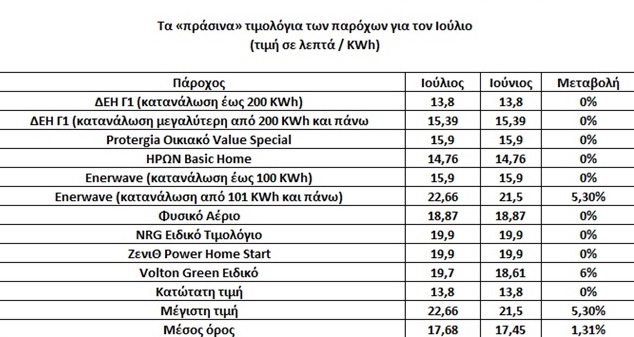
Regarding the green tariffs for July, the second and more "dangerous" month of summer began without any change in electricity prices for almost all households.
This means that the overwhelming majority of consumers with green-colored tariffs will continue for one more month to pay for the kilowatt-hour on average below 15 cents, as the surge in photovoltaic production together with still low consumption for the season kept the average wholesale price of June almost at the same levels, at 93 euros / Megawatt-hour. The increase is 4.5% from the corresponding one in May (89 euros).
In the case of PPC (G1), the tariff remains the lowest on the market, as the charge for the first consumption tier (200 kilowatt-hours) remains at 13.8 cents, while if consumption exceeds these levels, it remains at 15.39 cents.
Charges remained unchanged both for Protergia, at 15.9 cents (Protergia Home Value Special), and for Heron with the price at 14.76 cents (Heron Basic Home).
In the case of Enerwave, which now has very limited exposure to green tariffs, the company continues to price consumption for the first 100 kilowatt-hours at 15.9 cents, while from 101 kWh and above it readjusts the charge by 5%, to 22.66 euros.
The green tariffs of NRG (19.9 cents), Zenith (19.9 cents) and Natural Gas (18.87 cents) remained stable, while that of Volton (19.7) is increased by 6%.
In summary, the picture for the entire market is shaped for July as well at 17.7 cents (17.4 cents was the average in May).
Regarding the first signs of wholesale prices for July, natural gas entered the game strongly, as a result of the heatwave, the low winds that reduce the performance of wind farms, but also because of exports to neighboring countries, where temperatures, demand and energy exchanges are moving higher than Greece’s data.
The picture is reflected in today’s mix where gas participates with more than 39%, versus 41% for RES, 6.5% for hydroelectric power but also 5.5% for lignite. Yesterday things were even more difficult in our neighborhood, where Greece was “playing” at 169 euros/ Megawatt-hour, Bulgaria at 170.25 euros, Romania had exceeded 226 euros and Hungary 235 euros, leading pan-European rankings, with the tone set by temperatures of 38 and 40 degrees.