It may have caused stormy reactions over the large increases in the premiums of lifetime health programs that it recently announced, however NN Hellas, the leading company in total premiums, has turned into a… profit-generating machine and within three fiscal years (2024 – 2026) will have paid to its Dutch parent company dividends and capital returns of almost 200 million euros.
NN Hellas has recently been at the center of an intense confrontation. The increases in the premiums of lifetime health programs were considered extreme and unjustified: the company itself speaks of an average increase of 7.6%, while EKPOIZO refers to increases of 9% - 12% and elderly policyholders reported increases on the order of 30%.
In any case, the increases were much greater than those that would be justified by the Annual Adjustment Index for long-term health insurance (EDA), which ELSTAT announced in June, after the increases had been imposed by the companies. Specifically, for 2024, the EDA with the effect of age showed an increase of 6.24%, while without the effect of age the increase was 1.25%.
“Margin over volume” strategy
Behind the communication pressure that NN received over the large increases lie the figures from the company’s official financial reports, which “depict” a strategy that has turned the Greek subsidiary into a highly efficient machine for generating capital for the Dutch parent group.
NN Hellas, while remaining the largest insurance company in Greece based on total written premiums, adopts a strategy that gives absolute priority to profit margin over production volume (“margin over volume”).
In 2024, this strategy became evident in the health sector: the company chose not to follow an aggressive pricing policy to maintain its shares in the sector, which led to restrained growth in premium production (5.6%) and its decline to the 15-25% market share range from the previous 25-35% -according to data published by the Competition Commission. Thus, it left room for Ethniki Asfalistiki to regain the market’s top position.
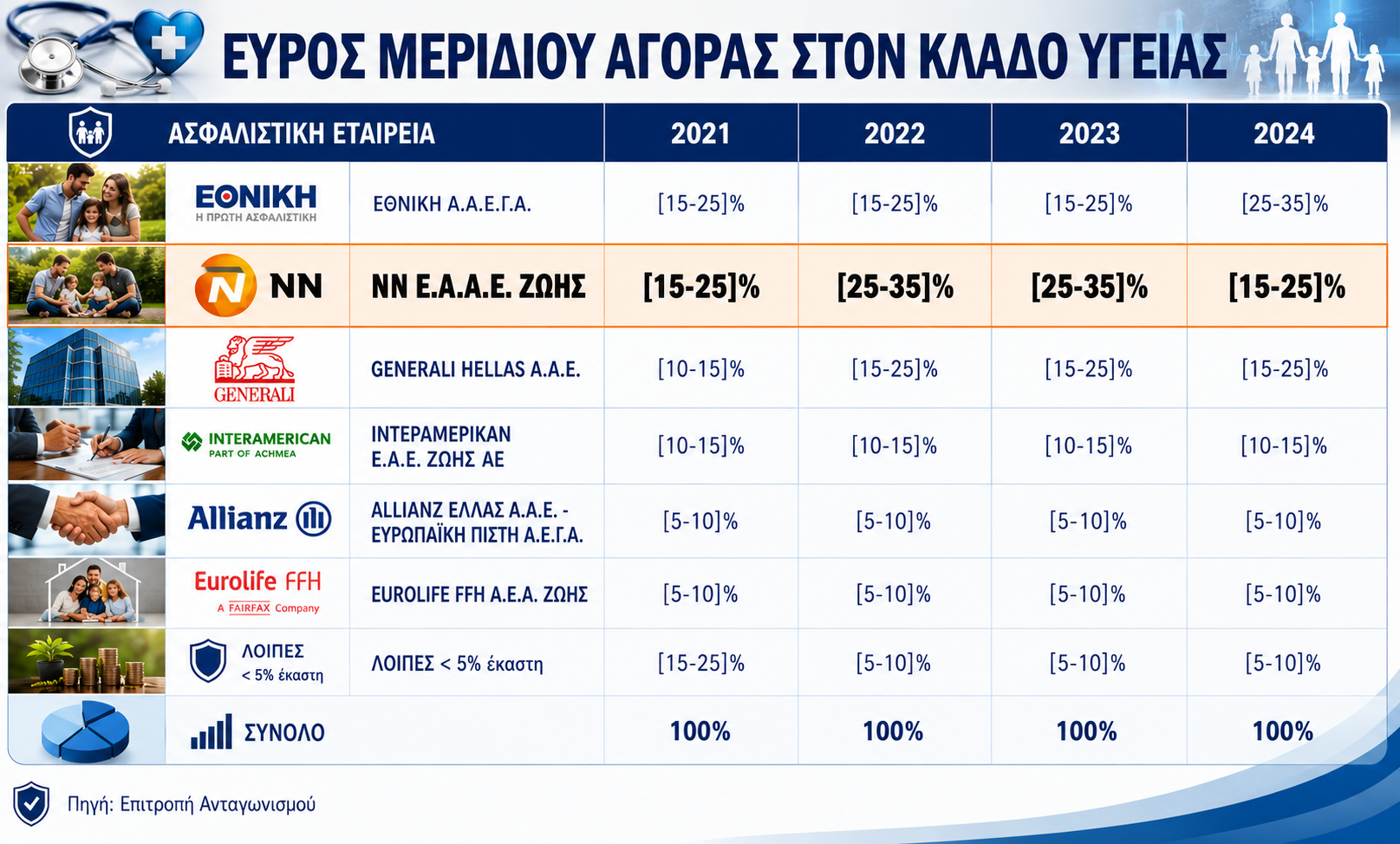
Instead of battling for market share, NN Hellas focused on the efficiency of its portfolio. In this context, the premium adjustment in lifetime programs in recent years is not simply a response to medical inflation, but a tool for improving profitability and managing morbidity risk, as the company primarily seeks to increase the efficiency of the portfolio and not its size.
The financial takeoff of 2024
The financial results confirm that this choice is extremely profitable:
- In 2024, NN Hellas’s pre-tax profits amounted to 87.4 million euros, making a 260% leap from 24.3 million euros in 2023. Comparing also with the performance of previous years, it becomes clear that the company is “changing level” in its profitability. Its operating result came to 90.2 million euros, an amount almost double the 47.9 million of 2023. All this with restrained growth in total premium production (7.7%), which amounted to 950 million euros, compared with 882 million in 2023.
- The trend continued in 2025, with the operating result strengthening further to 97.2 million euros, confirming that the large increase of the previous year was not temporary. It is noted that the figures come from the solvency report for 2025, as the company’s financial statements have not been published, in which the development of pre-tax profitability will also be shown.
- The Contractual Service Margin (CSM), a critical indicator for the efficiency of the portfolio, which also outlines future profitability, increased from 355.9 million euros in 2023 to 464.7 million euros in 2024.
- Despite medical inflation, in 2024 the company managed to keep gross insurance claims in the sickness and accident sector at 175 million euros (from 176.9 million euros in 2023), noting the “improved morbidity of insurance contracts.”
A flood of profits for the parent company
NN Hellas has now begun to pay large amounts every year to the parent NN group:
- In 2024, the Greek subsidiary proceeded with a capital return to the parent company amounting to 60 million euros.
- In 2025, it proceeded with a dividend distribution amounting to 64 million euros. Thus, in two years it paid a total of 124 million euros to the parent company.
- The distributions will continue in 2026, with a dividend distribution of an additional 70 million euros, which will raise the “Greek” return for the NN group over three years to 194 million euros.
The “key” to the increases
The increases in health insurance premiums, both in annual and in lifetime programs, are part of NN’s business strategy, aimed at maximizing profitability. Lifetime programs in particular are a “wound” for those companies that continue to manage a large volume of such contracts.
As confirmed by the figures recently published by ELSTAT, the costs of lifetime programs are outrageously higher than the corresponding costs of annual ones, where coverages have been “trimmed.” It is characteristic that for each insured person, on average, companies pay 950 euros per year in lifetime programs, an amount 2.6 times greater than the corresponding cost in annual programs.
The large premium increases, not only this year but also in previous years, lead to two paths: either the risk will be priced better, or the insured person will… relieve the company of their presence, abandoning the policy due to the high cost.
In NN’s case, the recorded increase in the Contractual Service Margin and the reduction in health claims confirm that the goal of a more… juicy portfolio is being achieved, even if this may mean that policyholder dissatisfaction is “flaring up.”