The idea for today’s article came from a recent Euronews article titled “Greek Stocks vs. Nasdaq: Which Market Has Performed Better Over the Last 5 Years?” At first glance, the comparison seems odd. The Nasdaq 100 index in the U.S. consists mainly of high-tech companies driven by AI, the cloud, etc. In contrast, the Athens Stock Exchange General Index is more “traditional”—featuring banks, utilities, and the like.
We therefore includedthe S&P 500 and the pan-European Euro Stoxx 50 for comparison, with data covering both the last 5 years and the last 10 years.
As noted in the Euronews article, the Athens Stock Exchange General Index lost over 90% of its value from a high of 5,334.5 points in October 2007 to 516.7 points in February 2016. The banking index played a decisive role in the collapse of the Greek stock market, plummeting by 99.6%.
Of course, the collapse of the Athens Stock Exchange was not unrelated to the deep, prolonged recession of the Greek economy and the debt crisis that accompanied it.
However, since then, and especially in recent years, the landscape has changed completely, resulting in the Athens Stock Exchange becoming one of the greatest recovery stories of the modern era.
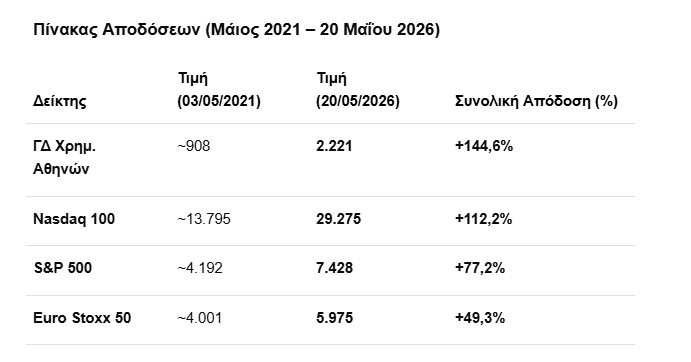
In the first table, we see the total returns of the above indices from May 2021 through yesterday. As the results show, the Athens Stock Exchange General Index outperformed the Nasdaq, gaining approximately 145% compared to the latter’s 112%. It also significantly outperformed both the S&P 500 and the Euro Stoxx 50.
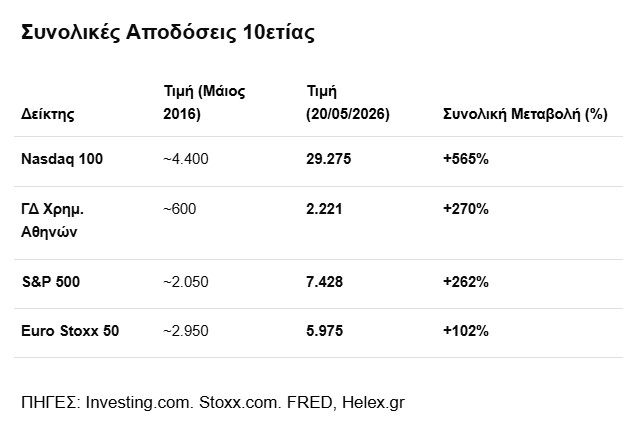
However, it is also interesting to compare the total returns of the above indices over a 10-year period. When we perform the same analysis over a 10-year period from May 2016 until yesterday, the Nasdaq 100 index wins hands down with a sixfold return. Once again, the Athens Stock Exchange performs very well, recording the next-highest return at 270%, surpassing the S&P 500, which had a return of 262%. In contrast, the pan-European Euro Stoxx 50 index lagged behind, posting gains of 102%.
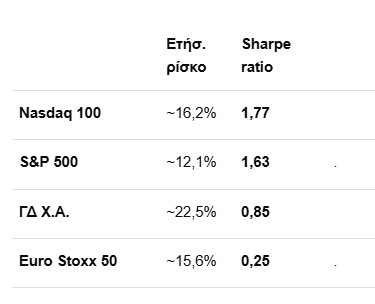
However, it is not only performance that matters, but also volatility—the risk associated with stock indices. The Sharpe ratio measures the excess return for each unit of risk taken on by the investor. The higher the value, the greater the investor’s compensation for the risks taken.
Calculations of the Sharpe ratio over the past 10 years show that the Athens Stock Exchange General Index was characterized by high volatility and lower returns compared to the two U.S. stock market indices.
However, the most disappointing aspect, which the tables above do not capture, is the fact that only a very small fraction of Greek households participated in the rally. As a result, many missed the opportunity to grow their wealth far more than they would have with traditional investments, such as savings accounts.
This reflects many things. From a lack of financial knowledge to a lack of investment culture and the bitter experience of the bubble bursting in 1999. This may change gradually, but it will take time and education starting in school.