The first quarter of 2026 confirmed that the four systemic banks are starting the year with a strong operational foundation, but also with a more demanding investment narrative. The period of easy positive surprises driven by high interest rates is largely over.
Now the market is seeking higher-quality earnings growth, namely credit expansion, resilience in net interest income, strong fee income, controlled risk costs, and sufficient capital reserves for high dividends to shareholders.
Based on the firms’ analyses, the picture is not uniform, but remains positive. Eurobank stands out for the diversification of its business model, National Bank of Greece for its profitability and capital strength, Alpha Bank for its strong commission growth, and Piraeus Bank for its robust credit expansion and consistency with guidance.
The common thread is that analysts remain largely in buy positions, with target prices retaining significant upside potential, although valuations are no longer as low as in previous years.
For the sector as a whole, the first quarter showed that Greek banks can maintain high profitability even after the peak of the interest rate cycle. The focus is now shifting from the interest rate spread to credit growth, fees, and commissions.
This makes the stocks less cheap, but also more institutionally mature as an investment case. Analysts continue to see upside potential, provided that banks continue to generate capital, increase lending without compromising asset quality, and translate their strong operational performance into consistent returns for shareholders.
Eurobank
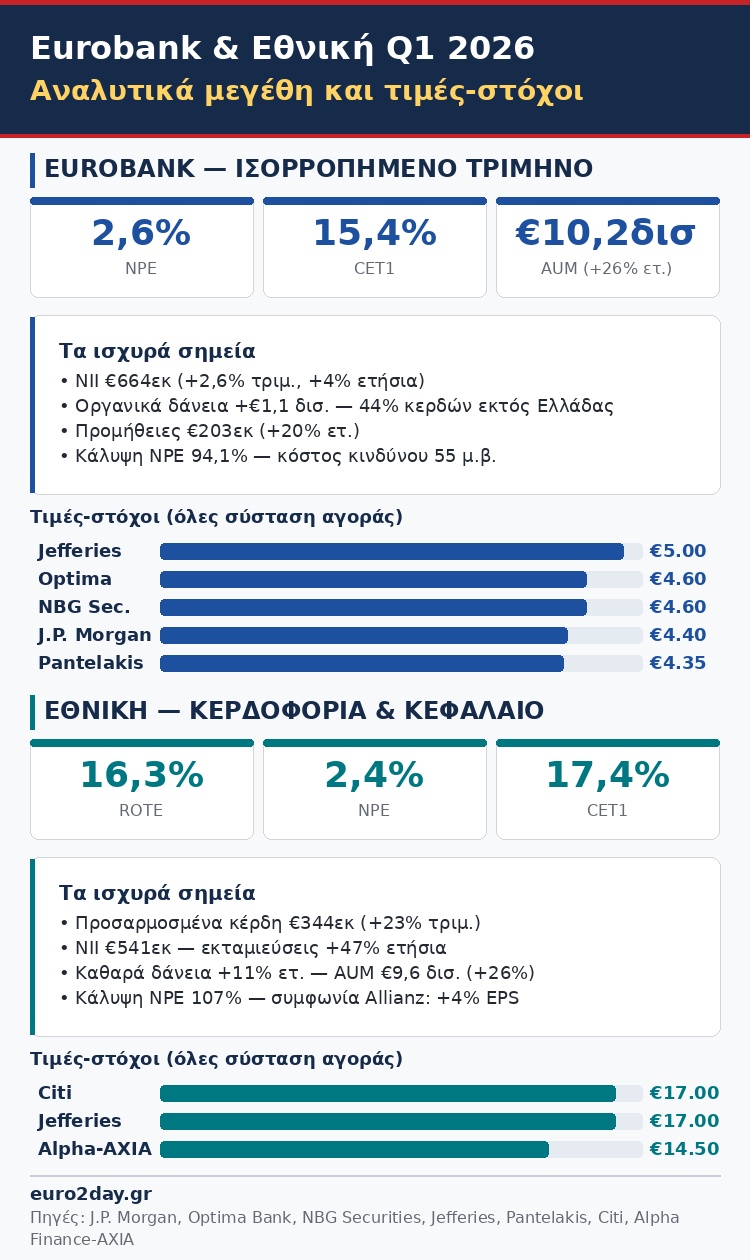
Eurobank delivered one of the most balanced quarters in the sector. Net interest income stood at €664 million, up 2.6% quarter-on-quarter and 4% year-on-year, despite seasonality and fewer calendar days.
J.P. Morgan notes that this performance makes this year’s guidance for net interest income of nearly €2.6 billion appear conservative, as the first-quarter annualized rate points to a higher figure, exceeding €2.7 billion.
Eurobank’s second strong point was credit expansion. Organic loans increased by €1.1 billion in the quarter, with management remaining on track for the annual target of €3.8 billion. Optima Bank notes that €0.6 billion of the increase came from outside Greece, a fact that confirms the group’s international reach.
NBG Securities emphasizes that international operations accounted for 44% of core pre-provision earnings, indicating that Eurobank is not solely dependent on the Greek market.
In terms of fees, net revenue reached €203 million, down from the very strong fourth quarter but up 20% year-over-year. Jefferies highlights assets under management, which reached €10.2 billion and increased by 26% year-over-year.
Asset quality remained strong, with a non-performing loan ratio of 2.6%, a coverage ratio of 94.1%, and a cost of risk of 55 basis points. The common equity tier 1 ratio stood at 15.4%, a level that leaves room for high dividends and selective growth initiatives, even after the impact of the Eurolife transaction.
For the stock, Optima Bank issues a buy recommendation and a target price of €4.60, as does NBG Securities, while Jefferies sets the bar at €5. J.P. Morgan sets a target price of €4.40 and Pantelakis Securities €4.35. The message is that Eurobank warrants a higher valuation, provided it continues to combine loan growth, strong commissions, and controlled credit costs.
National Bank
National Bank also confirmed its strong profitability. Adjusted net profit stood at €344 million, up 23% quarter-on-quarter and 17% higher than the average estimate compiled by the bank itself.
Reported earnings were lower, at €272 million, due to a €60 million cost from a voluntary retirement program. Citi describes the start of the year as strong, with outperforming trading revenue, net interest income, and a lower tax rate.
National Bank’s net interest income reached €541 million, up 2% from the previous quarter and higher than consensus estimates. The bank benefited from growth in loans and the securities portfolio, while Alpha Finance-AXIA notes that there is a possibility of a positive deviation, particularly if interest rates remain higher than previous assumptions.
Return on tangible equity stood at 16.3% based on published data and at 15.3% after adjusting for high trading income.
Credit expansion remains a key driver. Net loans increased 11% year-over-year and 2% quarter-over-quarter, while the group’s disbursements rose 47% year-over-year, according to Jefferies. In terms of fees, the 8% year-over-year increase was driven by mutual funds and investment products, with assets under management reaching €9.6 billion, up 26%.
The new agreement with Allianz adds another element to National Bank’s narrative. The bank has agreed to acquire a 30% minority stake in Allianz European Reliance, along with a ten-year exclusive distribution agreement for insurance products. The deal is expected to have a limited capital impact, approximately 20 basis points, but to boost earnings per share by 4% and return on tangible equity by over 50 basis points.
Asset quality remains one of National Bank’s strengths. The non-performing loan ratio remained at 2.4%, coverage improved to 107%, and the cost of risk hovered near 39 basis points. The common equity tier 1 ratio stood at 17.4% following the special dividend of €300 million, a level that continues to provide significant flexibility.
Citi and Jefferies have a target price of €17, while Alpha Finance-AXIA has a target of €14.50, all with a buy recommendation.
Piraeus Bank
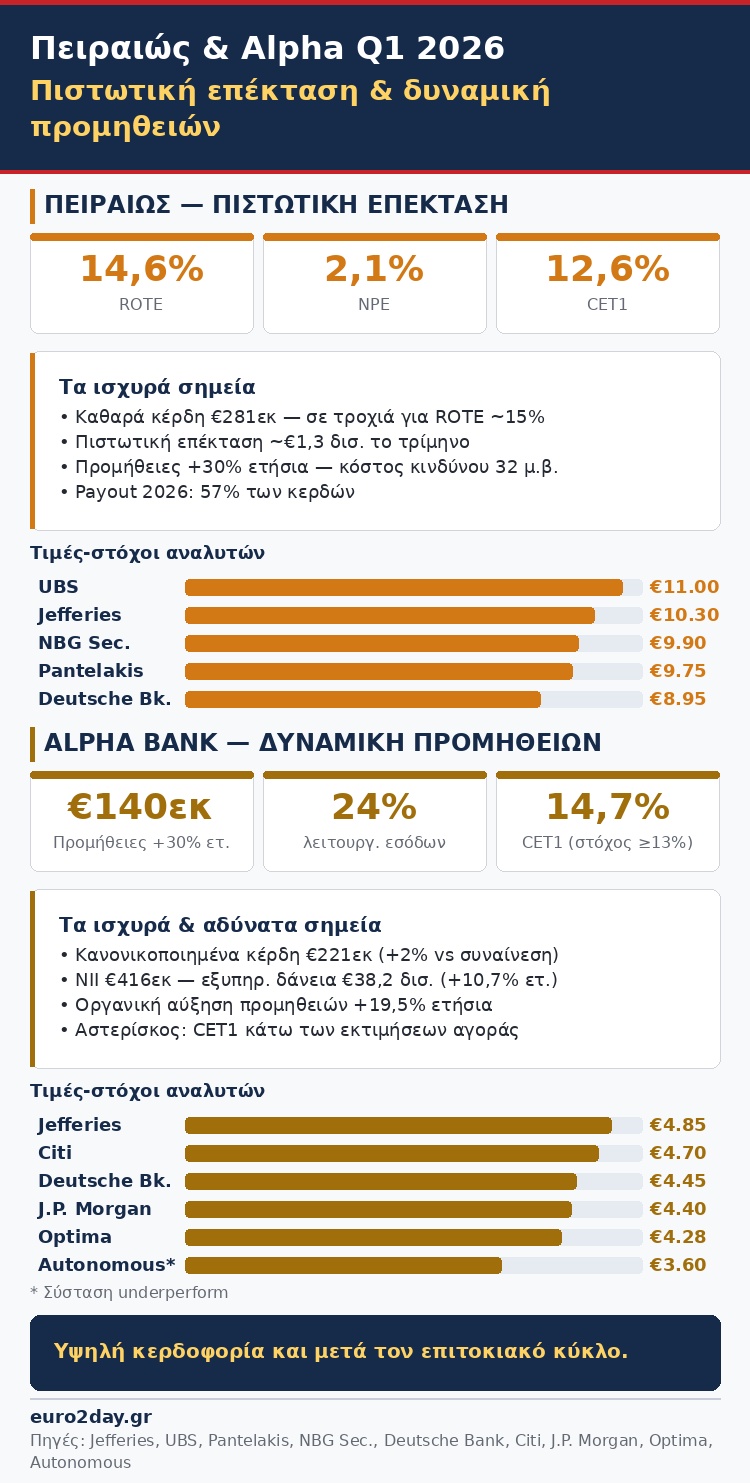
Piraeus Bank reported a solid quarter, with no major surprises but strong credit expansion. Net profits came in at €281 million, close to consensus estimates, while return on tangible equity reached 14.6%, on track with the annual target of approximately 15%.
Net interest income was €481 million, essentially flat on a quarterly basis, as volume growth offset pressure on margins. The strongest signal came from loans. Net credit expansion reached approximately €1.3 billion in the quarter, with performing exposures up 11% year-over-year.
Pantelakis Securities notes that the performance is particularly strong for a first quarter and increases the likelihood of exceeding annual targets. Fees and commissions rose by more than 30% year-over-year, supported by insurance operations, asset management, and bancassurance.
Regarding asset quality, the non-performing loan ratio stood at 2.1%, coverage was close to 70%, and the cost of risk was 32 basis points, below the annual target. The CET1 ratio fell to 12.6%, mainly due to credit expansion and provisioning, but capital buffers remain adequate.
Jefferies sets a target price of €10.30, UBS €11, Pantelakis Securities €9.75, NBG Securities €9.90, and Deutsche Bank €8.95. The dividend payout ratio for 2026 is expected to be 57% of earnings, a factor that strengthens the stock’s investment profile and keeps investor interest high.
Alpha Bank
Alpha Bank had a different profile. Normalized net profits amounted to €221 million, about 2% higher than the consensus, but reported earnings fell to €182 million due to a €47 million charge from voluntary redundancies and negative contributions from associates.
The clear bright spot was commissions, which reached €140 million, up approximately 29% to 30% year-over-year and 11% above market estimates.
Deutsche Bank notes that the outperformance came from corporate lending, bancassurance, investment banking, and wealth management. Beta Securities emphasizes that even without the recent acquisitions, organic fee growth was 4.4% on a quarterly basis and 19.5% on an annual basis.
For J.P. Morgan, commissions are now Alpha Bank’s key differentiator, as they account for 24% of operating revenue, up from 20% a year ago.
Net interest income stood at €416 million, up 1% on a quarterly basis and 5% on an annual basis, in line with consensus estimates. Credit expansion remained healthy, with performing loans at €38.2 billion according to Beta Securities, up 10.7% year-over-year. Deposits totaled €55.4 billion, up 10% year-over-year.
The caveat for Alpha Bank may concern capital. The CET1 ratio stood at 14.7%, lower than market estimates, due to an increase in risk-weighted assets, a dividend payout forecast, and the impact of acquisitions. The level remains above the internal target of 13%, but the market will monitor the pace of capital generation.
Jefferies sets a target price of €4.85, Citi €4.70, Deutsche Bank €4.45, J.P. Morgan €4.40, and Optima Bank €4.28, all with a positive stance, except for Autonomous, which maintains an underperform rating and a target price of €3.60.
Looking ahead, the key question is whether Alpha Bank can maintain its fee income momentum, integrate acquisitions without additional pressure on capital, and further increase its return on equity.
* See the banks’ detailed results in the “Supporting Materials” column.