As these lines are being written, the Trump administration appears to be more or less ready (everything the American president says is always “more or less”) to sign a compromise agreement that now reveals the U.S.’s inability to subdue the Iranian regime.
This is a particularly fragile agreement, which is already provoking reactions within the US and Israel, as it falls far short of the goals of a war that has come at a tremendous cost—both to its key players and to the global economy.
Consequently, it could easily be overturned by future developments. The trajectory of the conflict, however, now seems predetermined. It is no coincidence that, if it goes ahead, the agreement will be immediately accepted by most of the world.
The perpetuation of the current situation, as well as a return to widespread hostilities, are now considered by most experts and politicians to be far worse outcomes.
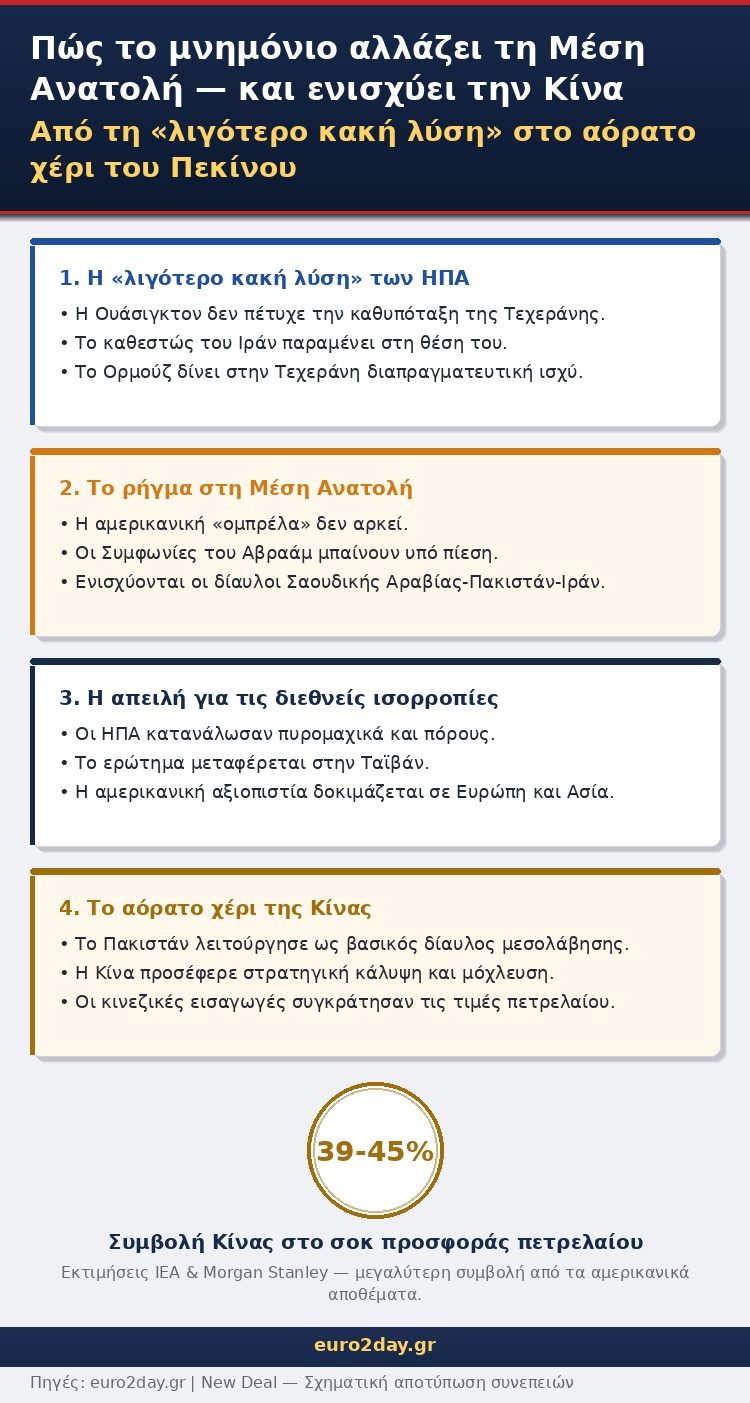
Despite the devastating blows it has suffered, the hardline regime in Tehran remains in place and interprets its resilience, as well as its control of the Strait of Hormuz, as a strategic victory.
This fact also increases its negotiating demands. Its conventional weapons may have decreased in number, but they remain sufficient to counter any new attacks asymmetrically.
Meanwhile, its control over the Strait of Hormuz—and its ability to inflict significant damage on neighboring states—has now been confirmed in practice.
As for nuclear weapons, the hopes of Israel and the U.S. for the complete elimination of Tehran’s capabilities have all but vanished.
Perhaps equally important is that it is already becoming clear that, in order for Iran not to proceed with the permanent imposition of tolls in the Gulf, it will have to secure very substantial economic concessions: the lifting of sanctions and the return of frozen assets.
Tehran has no reason to sign an agreement unless it secures hard cash to address social unrest, which, once the immediate external threat subsides, could later lead to the overthrow of the regime.
The New Rift in the Middle East
Geopolitically, the reckless adventure in Iran threatens to become a serious blow to the United States, as well as to Bibi Netanyahu’s Israel.
Most countries in the region have realized for the first time that the U.S. “protective umbrella” is insufficient and that Israel’s aggressive stance, which indirectly sparked the conflict, poses just as serious a threat to their security as “fanatical” Iran.
Trump’s public thanks to a number of Muslim leaders in the region, Sunni and Shia, including Turkey, as well as the main mediator, Pakistan (which has an extremely close relationship with China), vividly illustrate the structural changes taking place beneath the surface.
Saudi Arabia’s defense alliance with nuclear-armed Pakistan a few months ago pointed in the same direction. And this was confirmed by the willingness of the most powerful of the Arab states in the Persian Gulf to promote a “non-aggression pact” with Iran.
In short, the apparent inability of the U.S. to subdue Iran and the enormous damage caused by this war may well put the “final nail in the coffin” on the famous Abraham Accords, while simultaneously paving the way for a purely Islamic initiative to assert security interests in the region.
With the United Arab Emirates, which has become Israel’s most steadfast ally in the region, following this path rather reluctantly, knowing it lacks the power to swim against the tide, further fueling the existing rivalry with Saudi Arabia.
The threat of upsetting the international balance
The repercussions, however, are not limited to the Middle East. Beyond the displeasure of the U.S.’s traditional allies over the extremely costly adventure launched by Donald Trump, U.S. involvement in this war has weakened America’s position both in Europe and, above all, in Asia.
As we predicted in the memo “The Swan Song of the Sole Superpower,” the U.S. expended enormous quantities of valuable ammunition in order to strike Iran and protect Israel, with mixed results, as confirmed by a number of American and international media outlets.
Quantities that cannot be quickly replaced, affecting both the adequacy of their own resources and the ability to supply allies in Europe and Asia.
Doubts are now widespread as to whether the U.S. would have not only the intention but also the capability to defend Taiwan in the event of aggressive actions by China, including a naval blockade.
Perhaps even more significant is that President Trump, during his visit to Beijing, appeared to be "watering down" his stance on Taiwan, calling major arms deals into question, while the island’s strong opposition appears to be moving even closer to China.
China’s invisible hand
China is the major power that, as is often the case with those not directly involved in a costly war, has so far emerged as the geopolitical winner from the conflict in the Persian Gulf.
By maneuvering discreetly to avoid being blamed for a failure, it has managed to emerge as a key player in the developments, in a manner reminiscent of the heyday of British diplomacy, when “Old Albion” still played a powerful role in international affairs.
One of its key allies in the Islamic world, Pakistan, assumed the primary role of mediator. There is no doubt, however, that it was China that provided strategic cover, as well as the necessary “leverage,” including as the almost exclusive buyer of Iran’s oil.
The “parade” of nearly all the key figures involved in the conflict is a strong indication of the pivotal role China has played.
From the recent visits by Trump and Putin and, of course, senior officials from Pakistan and Iran, to the visit by the Crown Prince of Abu Dhabi and Xi’s phone call with the leader of Saudi Arabia.
But there is another very serious factor, almost unknown to non-experts.
China made the strategic choice to dramatically reduce oil imports in the period following the outbreak of war in the Persian Gulf, playing the biggest role in keeping oil prices at levels around $100 per barrel.
To be precise, analysts at the IEA and Morgan Stanley estimate that this reduction accounted for 39–45% of the absorption of the supply “shock” created by the Gulf crisis, a percentage far greater than the release of U.S. reserves into the international market.
There are various speculations about how China managed to do this without a noticeable reduction in domestic demand or its visible reserves.
What matters, however, is that if China reverses this policy even partially, the price of oil could face very strong upward pressure.
The Day After and the Unpredictable Trump
No one can predict whether the impending agreement between the U.S. and Iran will provide a solution—permanent or temporary—for the Persian Gulf.
Even if we return to scenarios of a new conflict, however, given that Trump is extremely volatile and the current solution puts him in a difficult political position, very little is likely to change to the benefit of the US.
Now or in the future, the “lesser evil” solution does not appear to have any better alternatives. And the longer it is delayed, the higher the cost to the American and global economies.