The Greek shipping industry reaffirms its role as a leading force in global maritime transport, while also maintaining a leading position in the discussion on the decarbonization of the sector.
The new annual report from the Union of Greek Shipowners outlines a fleet with a global reach, a strong economic footprint, and growing investments in “green” technologies, but also clear warnings about the risks posed by fragmented regional policies.
Greece currently controls 19.1% of the global merchant fleet in terms of deadweight tonnage (dwt), with the Greek-owned fleet numbering approximately 5,800 ships and exceeding 458 million dwt. This dominance has been maintained for decades and is particularly evident in the strategic sectors of tankers and LNG carriers, where Greece holds leading market shares internationally.
According to the report’s data, Greek shipowners control 26% of the global fleet of oil tankers, 23% of LNG carriers, and 22% of bulk carriers. At the same time, the Greek-owned fleet makes more than 175,000 port calls in 171 countries, confirming its role as the world’s largest “cross-trader, ” as over 98% of its capacity serves third-country trade.
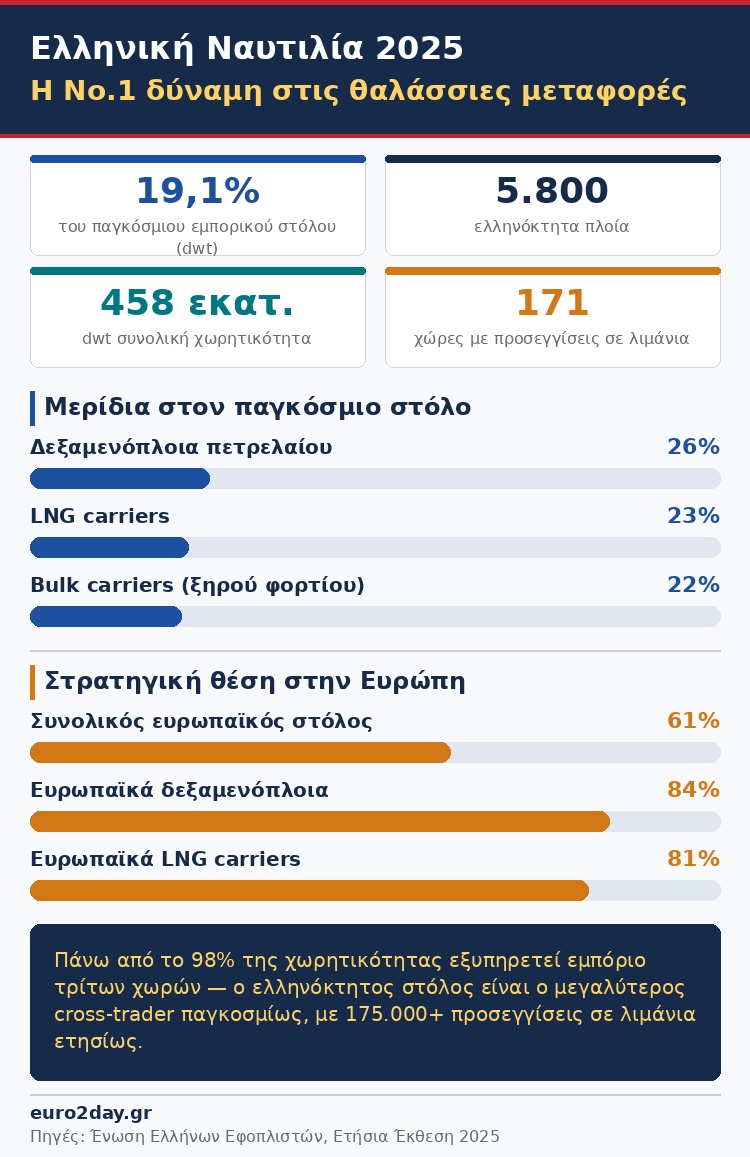
The report also places particular emphasis on the strategic importance of Greek shipping for Europe. Greek companies control 61% of the total capacity of the fleet under European control, while in certain ship categories, such as tankers and LNG carriers, the percentages reach 84% and 81%, respectively.
At the same time, the Greek shipping industry is striving to position itself at the forefront of the energy transition. The Hellenic Shipowners’ Association (HSA) maintains that the Greek fleet already has one of the youngest fleets globally and the largest number of ships capable of using alternative fuels.
Investments in new ships are on the rise again. Currently, 725 ships owned by Greek interests are under construction, with a total capacity of 70 million dwt and a value of $60 billion. Compared to 2021, Greek orders have increased sevenfold in terms of the number of ships.
Particular emphasis is placed on energy-saving technologies and environmental equipment. The report notes that the Greek fleet ranks above the global average in all key categories of “green” equipment and boasts the largest fleet equipped with energy-saving technologies and SOx scrubbers.
In fact, while in early 2024 only one in three Greek ships had at least one energy-saving technology, today that percentage exceeds 50%.
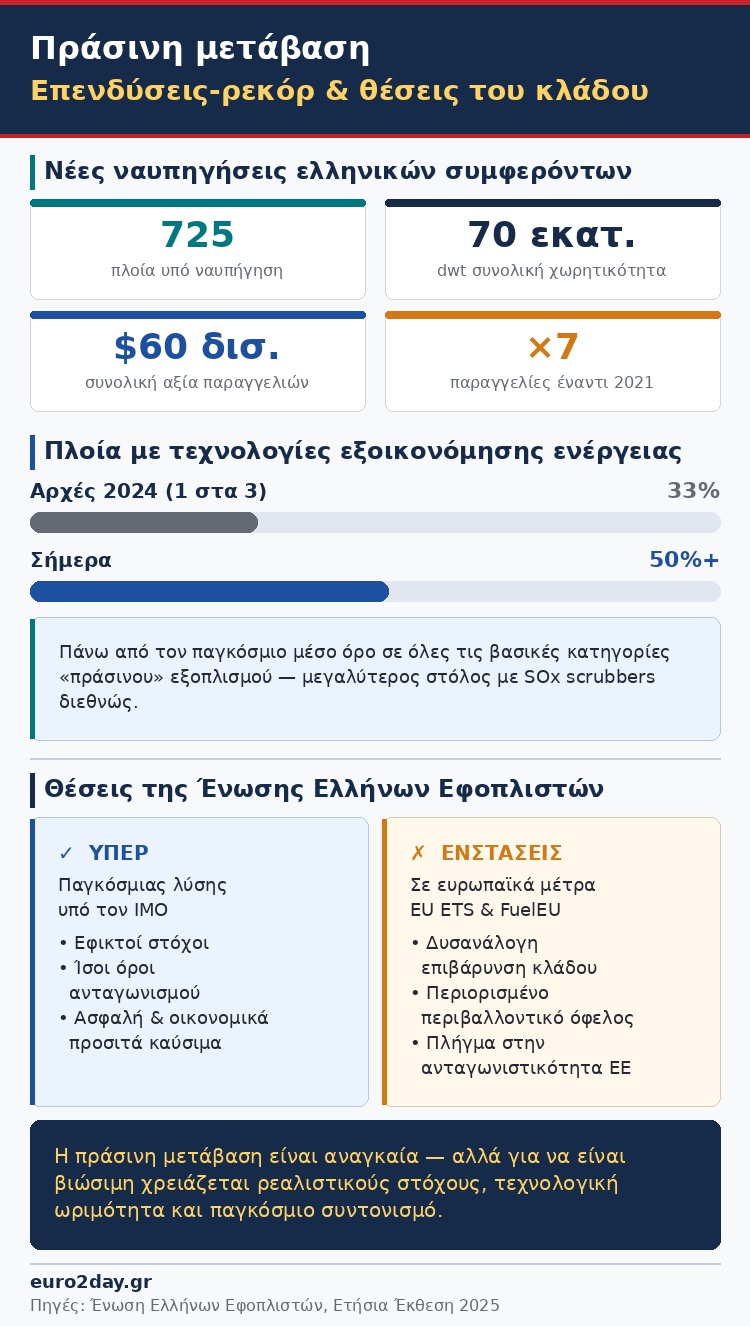
However, the Union of Greek Shipowners emphasizes that the path toward decarbonization cannot be based on “unilateral” or piecemeal regulations. The report highlights the need for a “realistic and global solution” under the IMO, with an emphasis on the availability of safe and affordable low- or zero-carbon fuels .
The Greek shipping community calls for:
- achievable global goals,
- a level playing field,
- active participation of all stakeholders,
- leveraging the industry’s expertise,
- and absolute priority for the safety of ships and seafarers.
At the same time, clear objections are raised against European measures such as the EU ETS and FuelEU Maritime, which—according to the report— disproportionately burden shipping without offering substantial environmental benefits, while undermining the competitiveness of the European economy.
The report’s key message is that shipping is at a critical energy crossroads: the green transition is considered necessary, but to be sustainable it must be based on realistic targets, technological maturity, and global coordination.
* See the study in the Related Materials section.