Greece is the only country in Europe where households spend more than they earn, with the picture across the Old Continent showing significant variations in net savings rates, and experts attributing the phenomenon mainly to precautionary saving and the need to cover retirement costs.
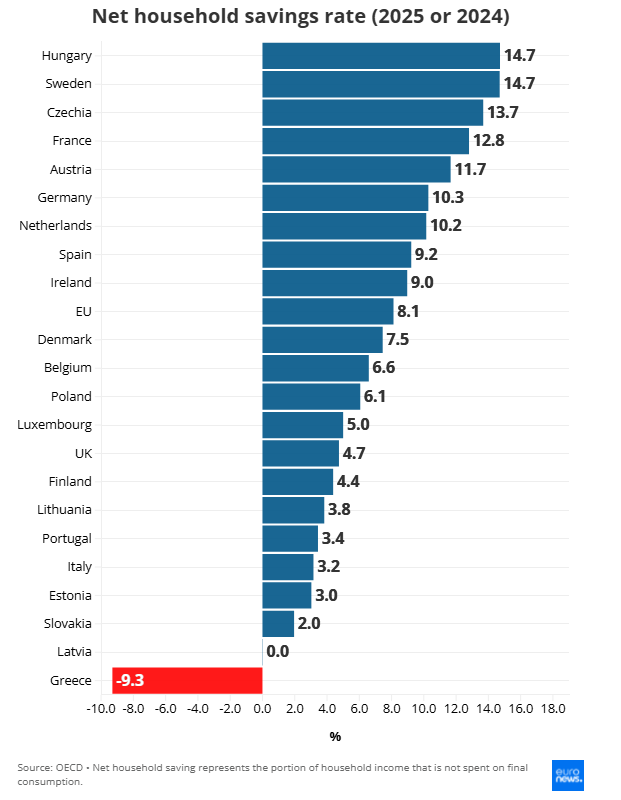
According to the OECD, net household savings rates vary significantly across Europe. In 2024 or 2025, they ranged from -9.3% in Greece to 14.7% in Sweden and Hungary, compared to an EU average of 8.1 %.
Greece’s negative figure means that households are spending more than their net disposable income, either by drawing on accumulated savings or by resorting to borrowing to finance their expenditures.
In addition to Hungary and Sweden, the net savings rate exceeds 10% in the Czech Republic (13.7%), France (12.8%), Germany (10.3%), and the Netherlands (10.2%).
Spain (9.2%) and Ireland (9%) also remain above the EU average.
The Case of Greece
Michael Haliasos, a professor at Goethe University in Frankfurt, notes that Greece has the highest percentage of households with consumption exceeding income in the EU at the height of the debt crisis in 2015 and the second highest—after Romania—even as recently as 2020, during the pandemic, when consumption had been drastically curtailed.
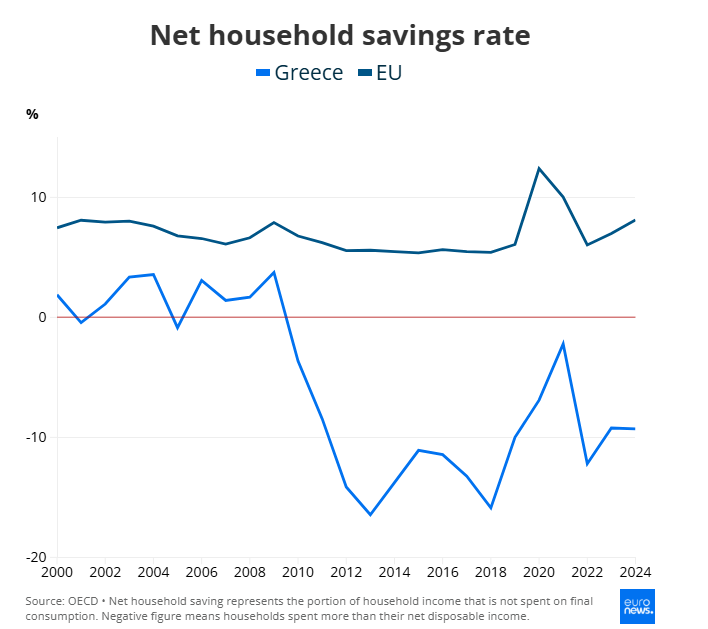
The savings rate in Greece was mostly positive in the early 2000s, although it temporarily fell below zero during certain periods.
The picture changed dramatically starting in 2010, as the debt crisis drove the rate to significantly negative levels, hitting a low of -16.5% in 2013. Since then, it has not recovered substantially.
After approaching zero again in 2021, Greece fell back to -12.2% in 2022 and has since hovered around -9%.
The EU average remained broadly stable over the same period, with the exception of a spike to 12.4% in 2020, when pandemic lockdowns significantly curtailed households’ consumption capacity.
Greece is also among the EU countries where, in 2024, the average level of adjusted gross disposable household income per capita was more than 20% lower than the EU average, according to Eurostat.
Michael Haliasos emphasizes that there are no EU countries that are consistently “high” or “low” in terms of savings, as their performance is influenced by each country’s different response to crises.
“The key factors determining the savings rate are the age composition of the population and how different age and occupational groups of households react to crises,” he explains.
United Kingdom and Italy: The major economies with the lowest savings rates
While France, Germany, and Spain have savings rates higher than the EU average, the United Kingdom (4.7%) and Italy (3.2%) show significantly lower rates.
In Latvia, the rate is zero—suggesting that households spend every euro of their income. Slovakia (2%), Estonia (3%), Portugal (3.4%), and Lithuania (3.8%) also fall below 4%.
Two Nordic countries are also below the EU average: Denmark (7.5%) and Finland (4.4%).
Comparing savings rates is difficult
“Calculating household savings rates is extremely difficult, while comparing them across countries is even more complex,” according toHaliasos.
As he points out, there are significant difficulties in measuring both disposable income and household consumption.
Income is often underestimated or not fully reported, due to fears regarding tax authorities or confidentiality issues.
At the same time, consumption is difficult to capture through surveys, as it relies on respondents’ memory, while methods for addressing these measurement challenges vary from country to country.
Why Europeans Save - The Role of Social Safety Nets
Charles Yuji Horioka and Luigi Ventura found that the generosity of social safety nets influences the importance of individual savings motives.
Citizens tend to save less for retirement in countries with generous public pension systems and less for unexpected expenses in countries with strong public health care systems.
“These findings suggest that the incentives for retirement and precautionary savings are the dominant reasons for saving in Europe, partly because social safety nets are not fully adequate,” they noted in their NBER paper, published in 2025.