As in many EU countries, housing affordability is a key structural challenge in Greece, albeit with specific characteristics, the IMF notes in its report on Greece.
The burden of housing costs is high despite the high rate of full homeownership (over 60%), a fact that partly reflects the high recurring housing costs associated with an aging and energy-inefficient building stock, as well as underinvestment in renovations following the Global Financial Crisis.
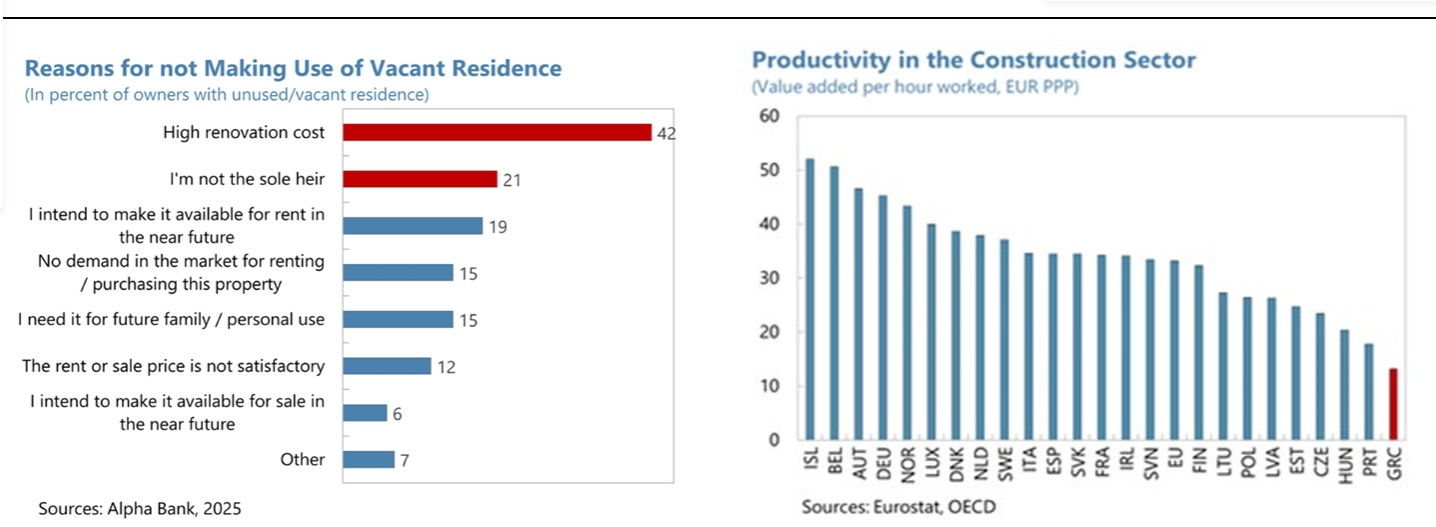
Imbalances in the housing market also stem from challenges in the distribution of housing supply rather than typical shortages, as a significant proportion of the housing stock (approximately 35%) is not used as a primary residence.
Many vacant properties remain off the market for long periods without renovation, mainly due to owners’ liquidity constraints and high renovation costs, as well as fragmented ownership structures and urban planning compliance issues.
Imbalances in the housing market are exacerbated by mismatches between supply and demand in terms of size, quality, and location of housing, particularly in areas affected by short-term rentals and demographic pressures (e.g., increased internal migration, a higher proportion of single-person households and students).
Policies should focus on making more effective use of the existing housing stock, alongside better-targeted and appropriately calibrated measures to improve housing affordability.
The government has implemented measures to alleviate household housing costs (e.g., a rent rebate program) and to support access to homeownership (e.g., subsidized mortgages for low- and middle-income first-time homebuyers and universal VAT exemptions on new construction).
Although such interventions provide temporary relief, their impact may prove short-lived as prices and rents adjust, while their costs could rise over time.
Demand-side measures, particularly the rent relief program, should be better targeted at vulnerable groups, with clearly defined exit and evaluation mechanisms, to limit fiscal slippage and pass-through to prices. Authorities should also consider phasing out the VAT exemption on new construction.
To curb speculative demand and support the supply of long-term rentals (LTRs), the authorities have raised the investment thresholds for the Golden Visa and tightened the regulatory framework for short-term rentals, while providing tax incentives for long-term rentals.
The effectiveness of these measures should be regularly evaluated, including potential spillover effects on the tourism sector.
The authorities have also addressed information asymmetry in the housing market through the Real Estate Ownership and Management Registry (MIDA).
Additional interventions, such as reducing the minimum duration of lease agreements, expediting the resolution of disputes over late payments, and introducing rent guarantee mechanisms for vulnerable tenants, would help reduce the risk premium associated with long-term leases and overdue debts related to housing costs.
As the IMF notes, priority should be given to revitalizing existing housing stock by expanding and better targeting existing renovation programs, including energy efficiency upgrades.
These efforts could be combined with targeted disincentives for long-term property inactivity (e.g., additional taxes on vacant homes) in high-demand areas, as well as with decisive action to reduce barriers to housing mobility (e.g., changes to inheritance law, expediting the resolution of pending legal cases or compliance issues).
More ambitious social rental housing programs, combined with fiscally neutral incentives for builders of affordable housing in high-pressure areas, would help reduce supply-demand mismatches. Close cooperation with social, energy, and EU-level initiatives will be essential to maximize impact while keeping fiscal costs under control.
The authorities agreed that policy should prioritize mobilizing underutilized housing stock to improve housing affordability. They expressed their determination to expand social housing and broaden measures to utilize the idle housing stock, while expressing the expectation that the upcoming amendment to inheritance law and the tenant registry will help increase the housing supply, by addressing the fragmentation of ownership and reducing the risks associated with long-term leases.
The authorities also emphasized that the new housing strategy will map out the challenges regarding housing affordability by region and household category and will contribute to the design of future measures.
They further noted that the effectiveness of restrictions on short-term rentals will continue to be monitored and adjusted where necessary.