On average, Greek listed companies and major domestic conglomerates offer bondholders higher yields than government bonds.
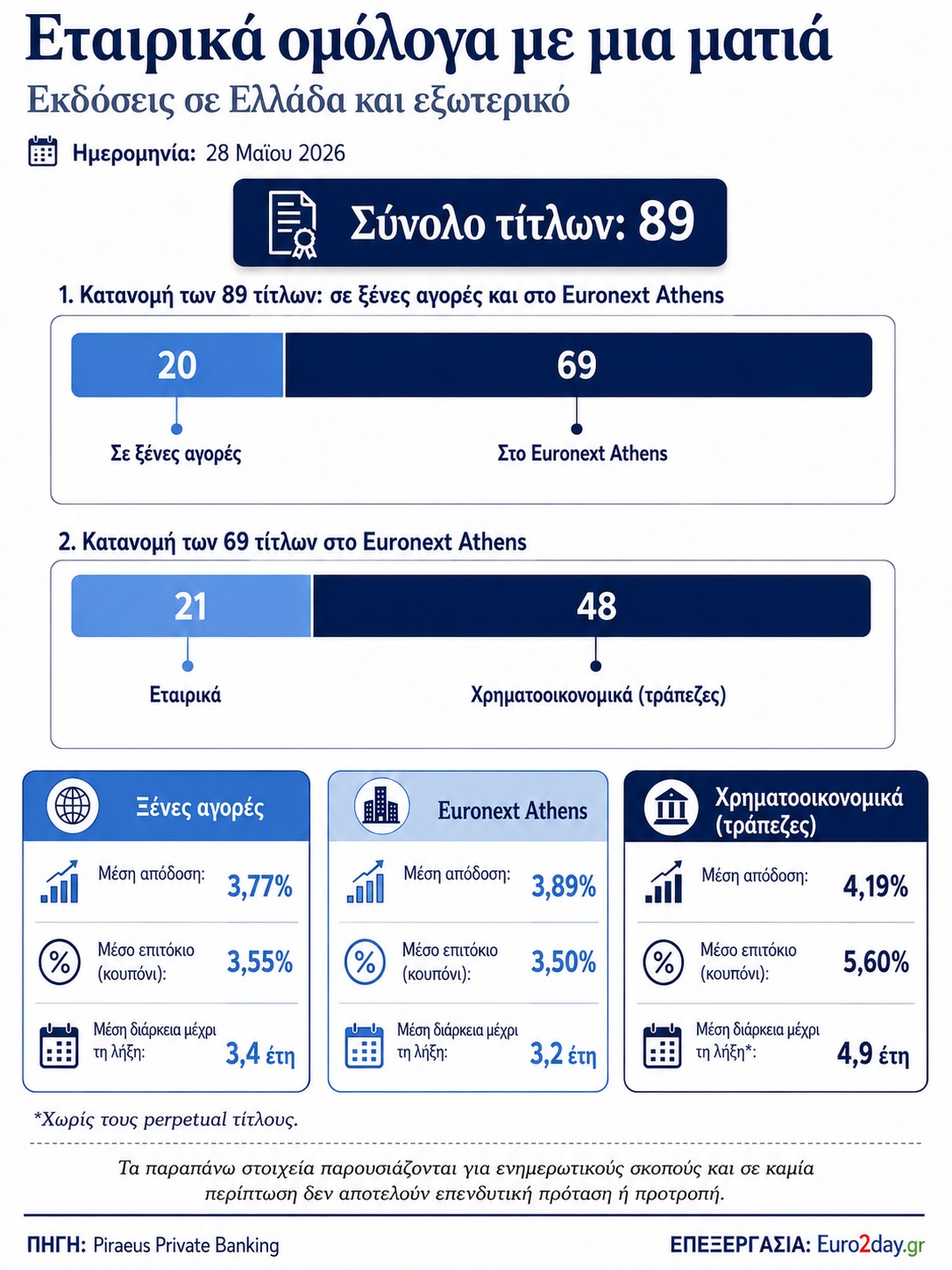
Corporate bond issues in Greece and abroad offer yields ranging from 3.5% to 7%, while the yield on the Greek 10-year bond hovered near 3.45% at the end of May , and interest rates on ordinary deposits are close to zero.
At the same time, inflation is running at 5.4%, while uncertainty and rising energy prices are causing central banks to hesitate regarding interest rate levels. In these cases, the dilemma is as follows: raise interest rates and put the brakes on growth, which is already suffering from uncertainty, or pursue a more accommodative monetary policy at the risk of letting inflation get out of control.
The bond offers returns in two ways: through the couponand through changes in its price. It is issued at 100 and always matures at 100. Consequently, an investor who buys it below 100 will receive the price difference and the interest rate (coupon). Buying above 100 “erodes” the return. In the case of stocks, returns come from price changes and dividends.
In any case, investors should be aware that when buying a bond, they also assume the issuer’s risk, so they should be careful in their selection and not base their decision solely on yield.
How to Acquire Them
Let’s look at how interest rates (coupons), maturities, and yields relate to bonds. The data comes from the Piraeus Private Banking table dated May 28, 2026, and pertains to yields at the current market price (yield to maturity).
For example, we select large issues that were typically traded in foreign markets. These securities are also accessible to Greek investors, provided they meet a minimum capital requirement (usually between 100,000 and 150,000 euros). Purchases are made through banks and brokerage firms. Indirectly, access to major foreign issuances can be gained by investing in mutual funds that invest in such bonds.
Returning to the examples, we see the Metlen Energy & Metals bond (XS2920504292), maturing in October 2029, with a 4% coupon and a BB+ rating. The market price is 99.24 (out of 100, which is the par value). Since the investor will receive 4% from the coupon and the price increase from 99.24% to 100% of par, the yield to maturity is 4.24%. The yield to the next potential renewal/call date (July 2029) is 4.26%.
For mini bonds (on the Athens Stock Exchange), access is easier, as the minimum investment is €1,000. For example, the Ideal Holdings bond (GRC148123CB9) maturing in December 2028, a 5.5% coupon, and a price of 103% (above par), the yield to maturity is 4.26%. A price above 100 means that the market views the issuer favorably relative to current interest rate levels, but this affects the yield accordingly.
The examples and data from May 28 show that the current price reflects the market’s valuation relative to current interest rate levels. A price below par increases the final yield, while a higher price decreases it. A high yield on the call date indicates that the market is discounting early repayment.
Government bonds
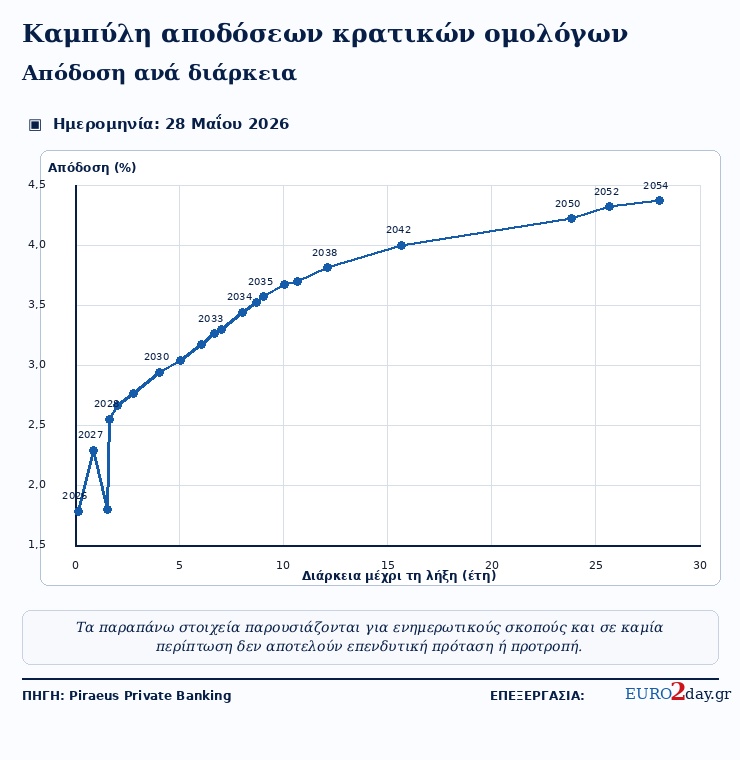
For comparison, the Greek government is currently borrowing at yields ranging from 1.78% for the July 2026 maturity to 4.37% for the 2054 maturity. The 10-year bond (maturing in 2034) yields 3.44%, with a BBB– rating.
Stocks and Bonds
Generally, stocks are more volatile in the face of short-term price fluctuations, but they can become more resilient if companies maintain profitability and can more easily pass on costs during periods of inflation. On the other hand, bonds use their price to adjust to current market conditions, as the coupon and maturity price are considered fixed.
The case of floating-rate bonds, where the interest rate changes, is more complex. The change in the rate is influenced by the bond’s current price, the time to maturity, and the general level of interest rates. In most bonds, interest rates are fixed.
Banking and securities industry executives report that:
- Historically,stocks have shown greater short-term sensitivity to market fluctuations, while in the long termthey have proven more resilient to inflation, particularly for companies that can pass on costs.
- Bonds, by contrast, are more stable under normal conditions but are exposed to specific risks: if interest rates rise, their market value falls—and if inflation exceeds the coupon rate, the real return becomes negative.
The international landscape
It is no coincidence that this discussion is coming up now. The war in the Middle East has overturned forecasts that seemed stable at the beginning of 2026. Brent crude temporarily rose above $126 per barrel, putting significant pressure on a European economy already facing supply-side disruptions. Inflation in the eurozone climbed to 3% in April, while eurozone growth slowed to 0.8% year-over-year in the first quarter. For Greece, growth was revised downward (1.8% for 2026, compared to over 2% previously) and inflation was revised upward. Inflation in April was already above 5%.
Faced with this dilemma, the ECB is keeping interest rates unchanged. The key interest rate remains at 2.15%, with the deposit rate at 2%. President Christine Lagarde attributes the rise in inflation to 2.6% for 2026 to the consequences of the conflict in the Middle East. She has described the situation as extremely difficult to assess due to the fluctuating pace of developments: war, ceasefire, peace talks, their collapse, and a naval blockade.
When to Choose Them
There is no rule for what an investor should prefer, as these are investment vehicles with different rationales. Generally, in an environment:
- When interest rates rise, the relative attractiveness of stocks increases, because companies with real assets can pass on costs. Bonds—especially long-term ones—lose market value.
- Wheninterest rates are stable or falling, the appeal of bonds increases. They offer both yield and principal, regardless of market fluctuations.
- In times ofhigh uncertainty —such as the present—the risk associated with long-term bonds increases. On the other hand, short- and medium-term bonds with good credit ratings can serve as a counterbalance.
* See detailed yields for all Greek corporate and government bonds in the “Supplementary Material” column