Retirement applications are rising at a rapid pace in 2026, as nearly 75,000 insured individuals submitted applications to the EFKA during the first four months of the year.
This mass exodus toward retirement, driven by demographic factors as well as concerns about future changes to the social security system, is presenting the system with one of the greatest challenges in recent years, while all signs indicate that this year will see a new record high in applications.
Data from the “ATLAS” information system for the first four months of the year reflect the significant increase in new applications, which are approaching 75,000, while the Agency works to keep the backlog under control and expedite the processing of applications.
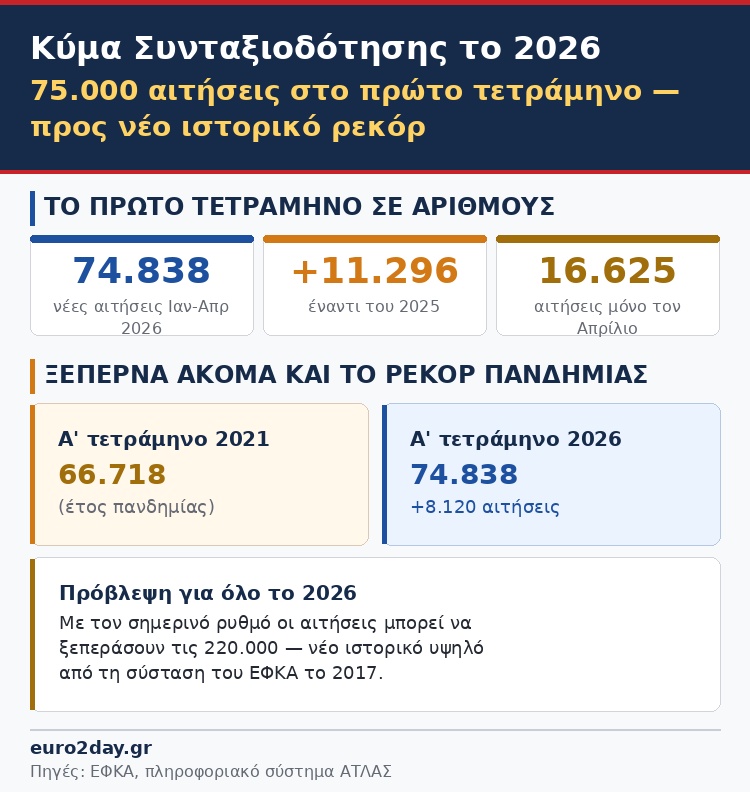
In detail and according to official data, from January through April 2026, a total of 74,838 new pension applications were submitted, an increase of 11,296 compared to the corresponding four-month period in 2025, when 63,542 applications were recorded. In April alone, 16,625 new applications were submitted, confirming the ongoing pressure on the social security system.
This situation presents a new reality for the EFKA, as even the historic record set in 2021—the year of the pandemic—now appears likely to be surpassed. At that time, 66,718 applications had been submitted in the first four months, which is 8,120 fewer than this year. If the current pace continues, total applications for 2026 may exceed 220,000, setting a new all-time high since the establishment of EFKA in 2017.
The increased flow of applications is attributed to a combination of factors. On the one hand, the generation of workers born in the 1960s is now retiring en masse, creating a new “wave” of exits from the labor market.
On the other hand, intense speculation about possible increases in the retirement age after 2027 is acting as a catalyst for decisions among thousands of insured individuals seeking to secure their entitlements before any changes take effect.
Concerns about a potential tightening of the rules for purchasing fictitious years also play a significant role, as currently seven out of ten insured individuals utilize fictitious time—such as education, military service, or children—to meet the required retirement conditions. It should, of course, be noted that the Ministry of Labor has made it clear that there is no such intention.
At the same time, starting in 2026, the method for calculating pensionable earnings will also change, as the calculation will now be based on the wage change index rather than inflation, a fact that has led many insured individuals to decide to retire earlier. In this case as well, of course, the differences in pension amounts will be negligible, at least during the first few years of the new index’s implementation.
Another significant incentive is the new employment regime for working retirees. The elimination of the 30% pension cut and its replacement with a special fund for the social security system has changed the landscape, allowing many to continue working without the significant loss of income that occurred in the past. Already, more than 300,000 retirees have registered their employment on the EFKA’s special platform.
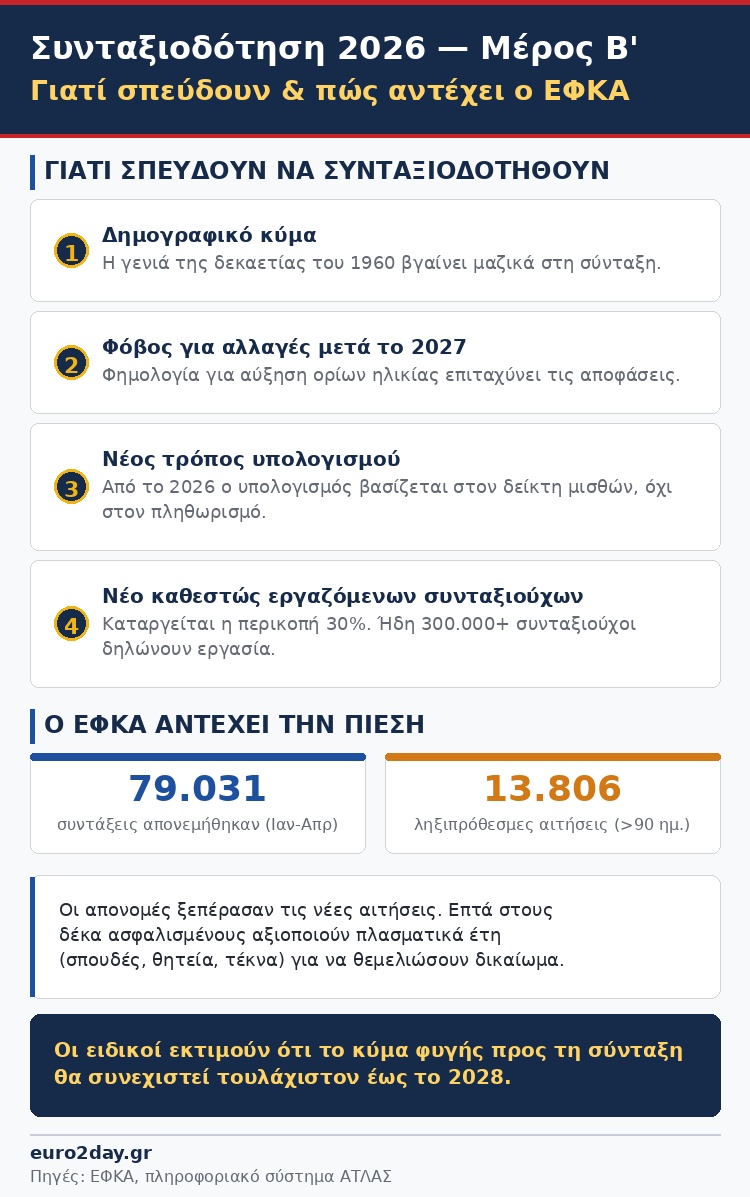
And experts estimate that the wave of retirements will continue at least until 2028, as more and more workers choose a safe exit from the labor market ahead of potential changes to the social security landscape.
Despite the heavy pressure, the pension disbursement mechanism continues to show improved performance. According to data from the “ATLAS” system, 79,031 retirement applications were processed in the first four months of the year, which is more than the number of new applications filed during the same period. In April alone, 19,583 pensions were issued, nearly half of which were old-age pensions. The number of disability and survivor pensions processed during the month was also significant.
This picture reflects the significant improvement achieved in recent years in the speed of pension processing. As EFKA Administrator Alexandros Varveris points out, the days when insured individuals had to wait up to two years to receive a pension appear to be a thing of the past, thanks to the digitization of procedures and the expansion of automated awards.
However, backlogs remain a reality and serve as a key indicator of the system’s resilience. The number of overdue primary pension applications—that is, those pending for more than 90 days—reached 13,806 in April. Most of these involve insured persons from the former IKA and the former OAEE, while cases involving international pensions remain particularly complex.
As Mr. Varveris noted, “the issues with successive and parallel pensions have been resolved to a certain extent and are now even issued automatically, while international pensions continue to pose a challenge, although ‘significant progress has been made.’”