The European Commission gives Greece an "A" grade for the progress it has made on fiscal matters through the drastic reduction of the deficit. However, it notes “sluggish” progress in addressing the “twin” deficits of the current account and in strengthening the economy’s competitiveness.
More than fifteen years after Greece’s economic collapse, which was caused by the “twin” deficits of fiscal management and the current account balance—which had soared to 15% of GDP at the time— the European Commission paints a bleak picture of the structural weaknesses in the economy’s external sector.
The European Commission’s report (In-Depth Review 2026) highlights the chronic pathologies and contemporary challenges facing the Greek economy in terms of openness and competitiveness.
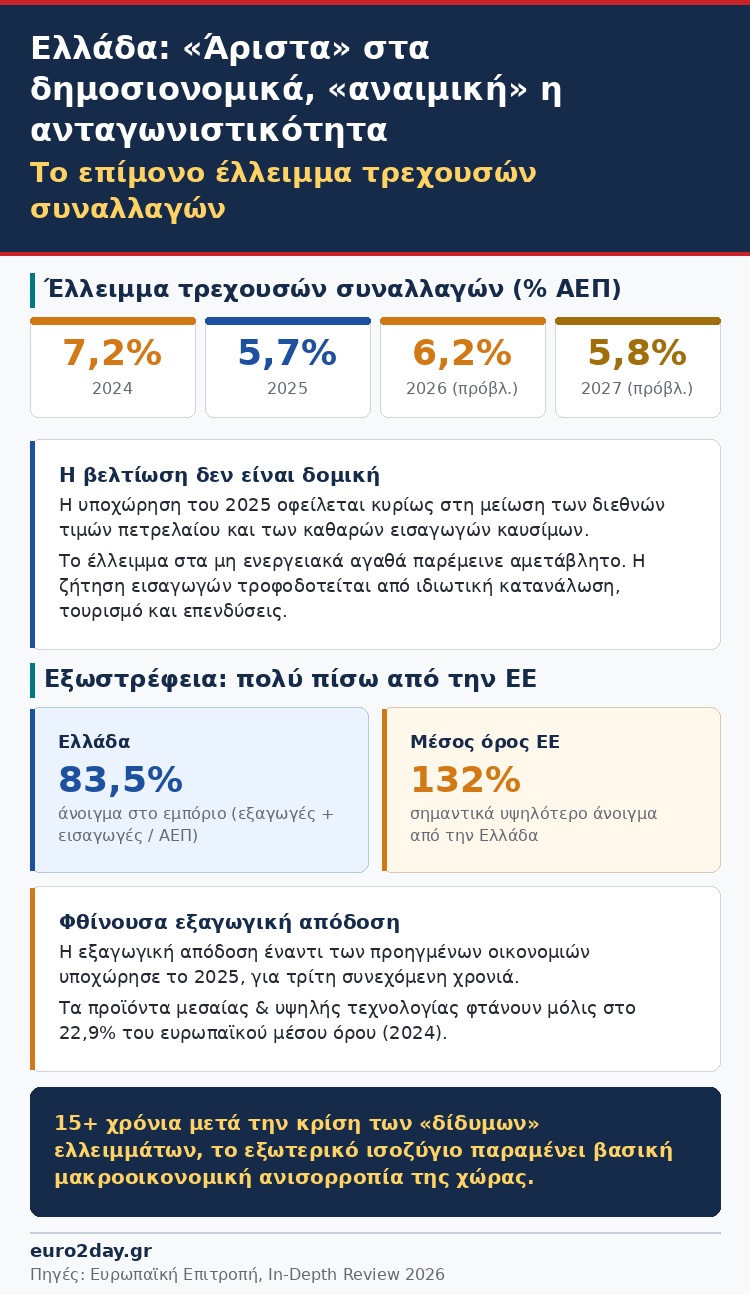
The persistent deficit
The current account deficit, the Commission notes, remains one of the country’s key macroeconomic imbalances, staying at levels higher than those recorded before the pandemic.
The deficit fell to 5.7% of GDP in 2025, down from 7.2% in 2024. However, this improvement is mainly due to lower international oil prices and a reduction in net oil imports, rather than any structural change. The deficit in non-energy goods remained broadly unchanged, while strong demand for imports continues to be driven by private consumption, tourism, and rising investment.
The services balance was supported by another exceptional year for tourism, although falling freight rates limited the surplus from transportation.
The deficit is expected to remain high and increase slightly to 6.2% of GDP in 2026, due to increased demand for imported capital goods linked to projects under the Recovery Fund and the NSRF, the Commission estimates. In 2027, it is projected to decline slightly to 5.8%, but will remain well above the levels justified by the country’s economic fundamentals.
It is also noted that Greece’s export performance relative to advanced economies saw a slight decline in 2025, marking a decline for the third consecutive year. Furthermore, despite improvements over the past decade, the Greek economy’s openness to trade—that is, the sum of exports and imports relative to GDP—lags significantly behind the European average: it has risen to 83.5% of GDP, compared to an EU average of 132%.
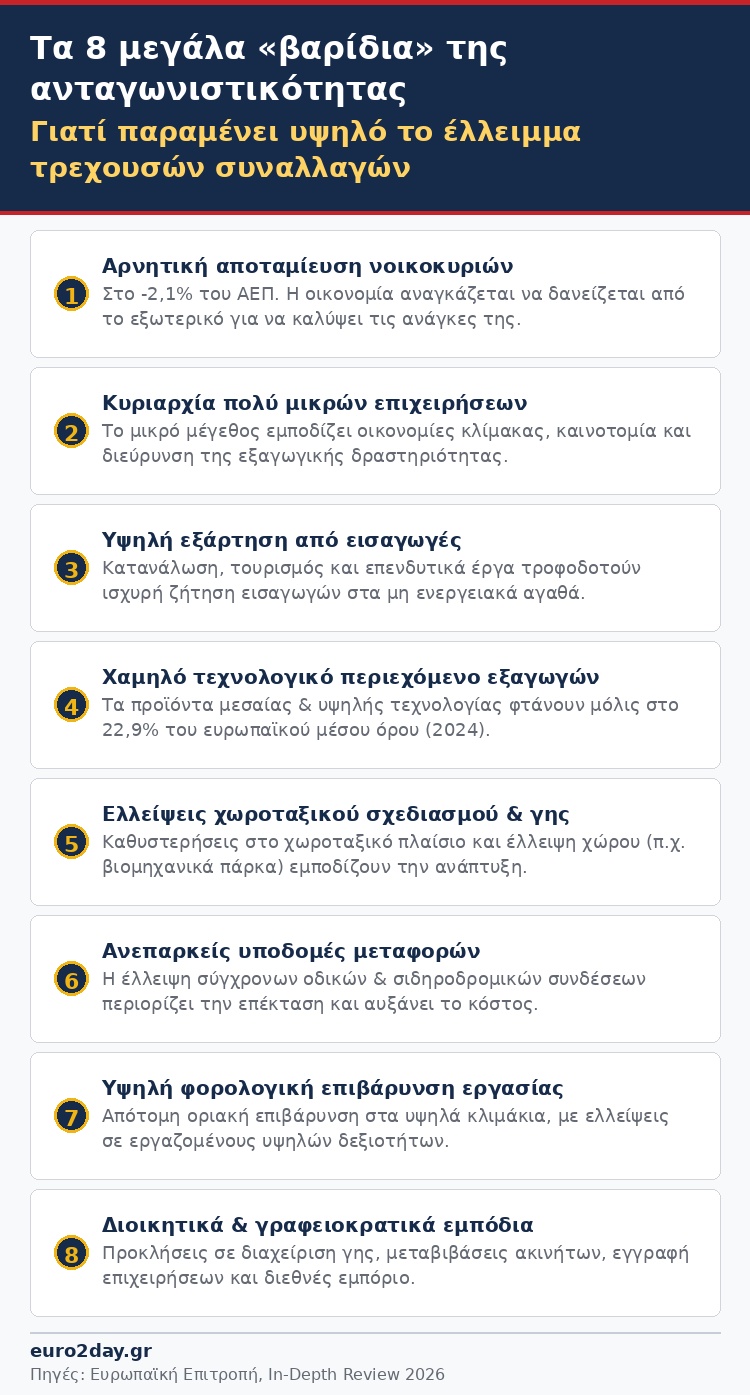
The 8 major “drag factors”
The Commission’s report highlights the eight major “drag factors” that are holding back the economy’s competitiveness and explain the persistently large current account deficit:
- Negative household savings: Extremely low, even negative, household savings (-2.1% of GDP) place a significant burden on the country’s external balance, forcing the economy to borrow from abroad to meet its needs.
- Dominance of micro and small enterprises: The small size of Greek companies prevents them from achieving economies of scale, which limits their ability to innovate and expand their export activity.
- High dependence on imports: Both increased private consumption and tourism, as well as necessary investment projects—e.g., through the Recovery Fund—fuel a continuous and strong demand for imports, keeping the deficit in non-energy goods high.
- Low technological content of exports: Although the complexity of the export basket has improved, the share of medium- and high-tech products remains extremely low, reaching just 22.9% of the European average for 2024.
- Shortcomings in spatial planning and available land: Delays in finalizing the spatial planning framework and the lack of available space—such as modern industrial parks—constitute a direct obstacle for businesses seeking to expand.
- Inadequate transportation infrastructure: The absence of adequate and modern road and rail connections limits businesses’ ability to expand and reduce transportation costs.
- High tax burden on labor: Despite tax and contribution cuts, the marginal tax burden on the highest income brackets remains steep. This reduces businesses’ ability to hire and retain highly skilled workers, creating shortages in the labor market.
- Administrative and bureaucratic barriers: Despite the overall improvement in the business environment, challenges persist in land management, property transfers, procedures for registering new businesses, and administrative barriers to international trade.