There is no doubt that tech company stock valuations are extremely high—to put it mildly—based on historical data. The AI narrative also gives many pause, as the high capital expenditures may not be justified by future profits. It is also a fact that inflation is well above the desired 2% target in the U.S. and the eurozone. As a result, the ECB is preparing to raise its key interest rate to 2.25% from 2% in the coming days, while the Fed is not expected to cut rates.
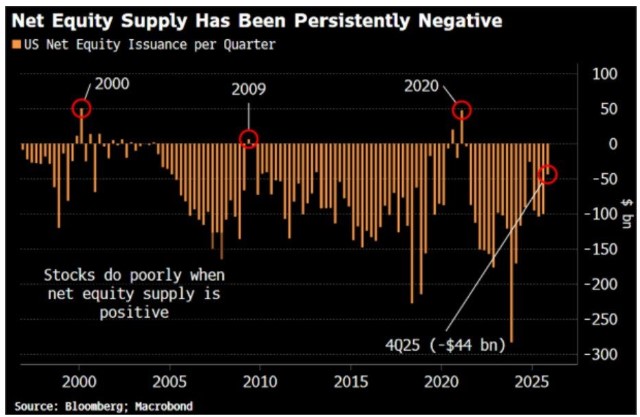
Additionally, on Friday, SpaceX will hold the largest initial public offering (IPO) in history, followed by OpenAI and Anthropic. What has historically happened when the net supply of shares is positive is shown in the chart below.
All of these are serious reasons for investors to be extremely cautious. However, it is also a serious reason for the market to continue rising, as strange as that may sound. It is true that almost everyone associates bull markets with widespread optimism.
However, history teaches us that strong, long-lasting bull markets occur when there is skepticism and, at times, gloomy predictions of an impending market crash. Why is that? If everyone were optimistic about the market’s trajectory, they would have already positioned themselves and therefore would not have enough liquidity to push it to higher levels.
Conversely, when skepticism prevails, many retain sufficient liquidity and often bet on a market decline. However, those betting on a decline eventually turn from net short sellers into buyers. Furthermore, institutional investors who wait on the sidelines for the market to fall—and when it doesn’t—are often forced to reinvest because they are underperforming their competitors.
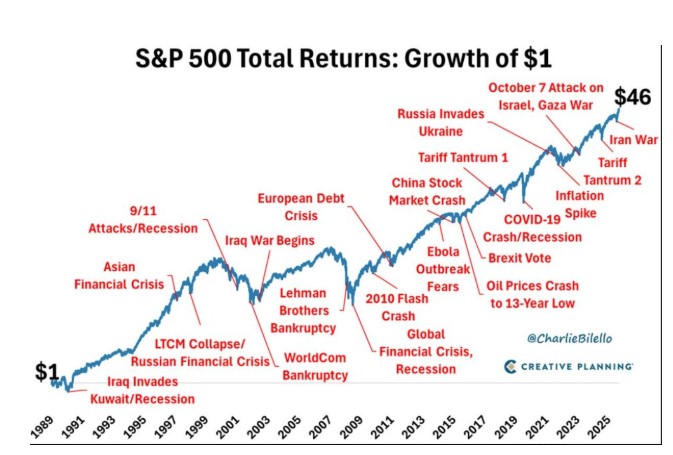
The result is what has been called “The Wall of Worry,” and it fuels the rally as concerns and fears prevent the market from reaching excessively high levels.
In a sense, the risks we outlined above regarding the stock market’s further rise are the very same factors driving it forward. The hesitant institutional investors waiting for a stock market correction represent the future demand that will drive the indices higher.
In a way, then, $1 in the S&P 500 index in 1989 could become $46 in 2026, according to Charlie Bilello’s calculations.