The price of gold has fallen 8% over the past 30 days, dropping below $4,300 an ounce yesterday. And yet, inflation is on the rise, tensions in the Middle East persist, and oil prices are at $90 a barrel or higher, disappointing gold enthusiasts.Under these conditions, gold should be rallying. It is therefore natural to ask whether it has lost its appeal as the primary tool for hedging against uncertainty and as a safe haven in difficult times.
Some attribute the precious metal’s behavior to the market’s focus on the serious possibility of rising interest rates and its indifference to long-term geopolitical risk.
In other words, the market believes that interest rates are more important than global geopolitical instability. However, history shows that investors rush to “hard” assets, such as gold, when confidence in financial markets wanes. This has not happened yet.
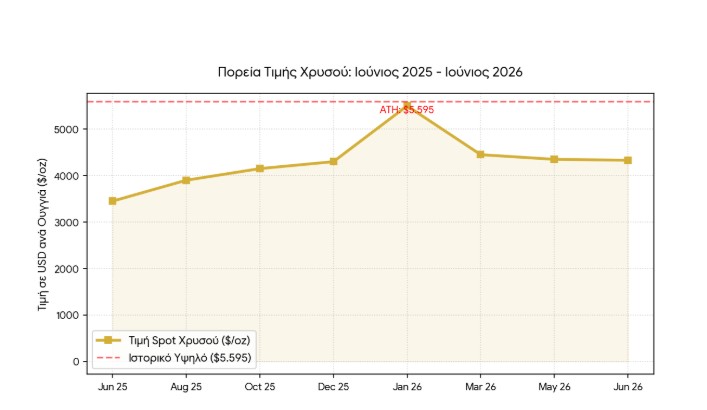
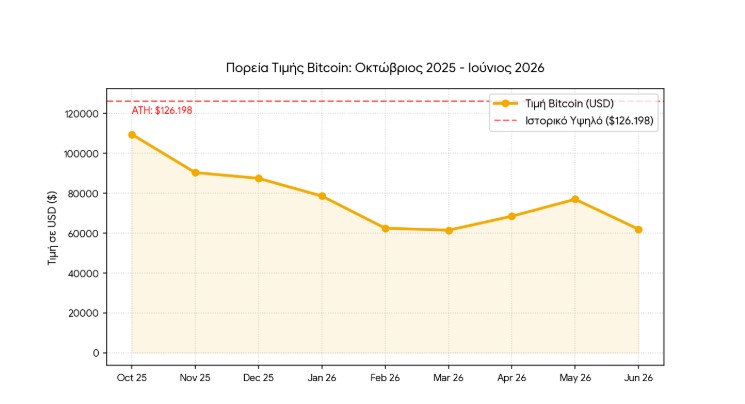
But it’s not just gold that hasn’t fared well. The picture is even worse in the cryptocurrency market, particularly for Bitcoin, which is its flagship.
Since last October, when Bitcoin surpassed the record high of $126,000, its trajectory has been downward. In February, it fell to $60,000, recovered slightly later but returned to a downward trajectory, and last night stood at $61,770. Since May, the price of Bitcoin has been below the 200-day moving average, which is considered significant for its trajectory.
However, this decline is accompanied by certain characteristics that were not present in the past. One of these is the presence of institutional investors (ETFs) and lower volatility compared to other past Bitcoin bear markets.
While gold and crypto are not performing well, the same cannot be said for stocks. It is true that there have been liquidations of gold and crypto in recent months, and some of that money has flowed into stocks. These purchases gave a further boost to stock prices, along with upwardly revised earnings per share from listed companies in the U.S. and elsewhere.
It is also to be expected that there will be selling by investors who bought stocks earlier and are now posting significant gains. As if all that weren’t enough, we also have the major IPOs of Anthropic, OpenAI, and SpaceX, while Google is also in need of funds.
This time, crypto and gold cannot provide liquidity to stocks as they did a few months ago. Therefore, the situation should be cause for concern.
On the other hand, a major stock market crash would have an immediate impact on the economy, and that is not what anyone wants.
For this reason, some believe that if things go south on the stock markets, the Fed—and, to a lesser extent, the ECB—will step in, injecting whatever liquidity is needed to save the day.
They are probably right.