Artificial Intelligence is not merely a new technology. It is a paradigm shift. For the first time, technology is not limited to replacing manual tasks; it extends to cognitive processes such as research, analysis, writing, decision-making, and information management. This does not mean that professions are “going away.” It means that certain tasks within professions are changing radically, while others are becoming more important.
The market does not devalue people. It reevaluates roles. And the next decade will be decisive in shaping how this transition unfolds.
AI does not eliminate professions—it transforms roles
Every profession, from lawyers to plumbers, involves three levels of work: routine, analysis, and human judgment. AI takes over much of the routine work, enhances analysis, and highlights human judgment as the most valuable element.
Value is shifting. And those who shift with it will find themselves in a better position.
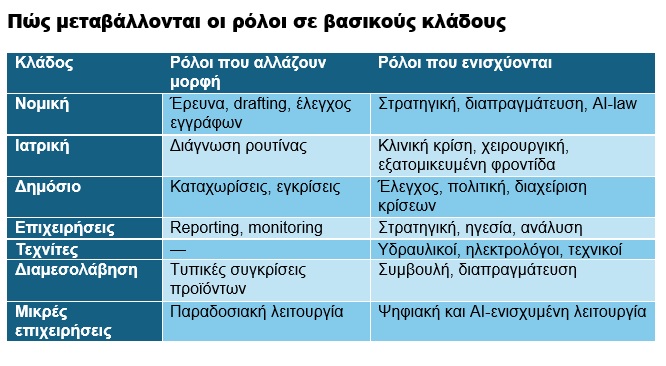
Lawyers: Less routine, more strategy
Legal work is changing rapidly. AI systems can support case law research, document review, and the drafting of basic contracts with impressive speed and accuracy. This does not diminish the lawyer’s importance; it elevates it. The role is shifting from routine execution toward strategy, negotiation, judgment in the face of uncertainty, and human case management.
The lawyer of the future is not a “procedural executor.” They are a strategic advisor who leverages AI to enhance their judgment.
Doctors: Enhanced Diagnosis
AI can support diagnosis, analyze imaging tests, and identify patterns that often escape the human eye. This does not diminish the doctor’s role; it frees them from time-consuming procedures. The focus shifts toward clinical judgment, personalized care, chronic disease management, surgical expertise, and the human connection with the patient.
Medicine remains deeply human. AI is a tool, not a replacement.
Civil servants: From document management to policy management
The digitization of the state and the next phase—AI gov—will transform many administrative processes. Registrations, approvals, and routine tasks will become faster and more reliable through automation. This does not diminish the importance of civil servants. On the contrary, it highlights roles such as inspection, oversight, policy planning, crisis management, data analysis, and service coordination.
The public sector is not shrinking. It is evolving.
Businesses: Middle management is changing shape
In many businesses, a large part of daily work involves reporting, monitoring, presentations, and procedural coordination. These tasks will be largely supported by AI. This does not reduce the need for executives. Their profile is changing. Value is shifting toward strategic thinking, people management, decision-making, judgment in the face of uncertainty, and the ability to leverage AI tools.
Middle management isn’t disappearing; it’s evolving.
Skilled Trades: Steady Demand, Higher Value
Manual trades—plumbers, electricians, refrigeration technicians, elevator technicians, carpenters, and natural gas technicians—are in one of the strongest positions in the market. AI cannot perform on-site work, diagnose physical problems in a space, or carry out technical interventions. The demand for skilled tradespeople in Europe is already high and is projected to rise.
AI will assist with diagnosis, organization, and task management, but execution remains a human task. Technicians are not under threat; they are being empowered.
Brokers, real estate agents, insurance advisors: Intermediation is changing, but the need for trust remains
Intermediary professions are changing significantly. AI can compare products, analyze risks, appraise real estate, and propose solutions. However, this does not replace the human dimension of advice. The professionals who will continue to be highly valued are those who offer expertise, local knowledge, negotiation skills, risk management, and a personal relationship.
Technology handles the information; people remain essential for judgment.
Small Businesses: Adaptation Is Key
Small businesses will be affected by automation and competition from large platforms. However, those that adopt AI tools for inventory, pricing, customer service, and marketing will significantly boost their competitiveness.
Small businesses are not threatened by AI. They are threatened by inaction. Those who adapt will be in a better position than ever.
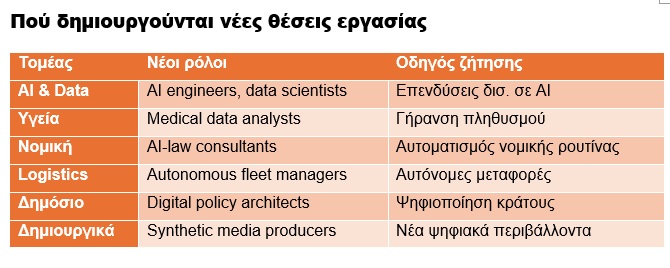
What does this mean for today’s worker?
The market does not undervalue people. It undervalues roles that do not evolve. And it values those who can combine experience, judgment, and technological proficiency.
Adaptability isn’t a matter of age or profession. It’s a matter of willingness to learn. The next decade will reward those who invest in skills that can’t be automated: judgment, communication, specialization, and leveraging AI tools.
Conclusion: Work never ends—it evolves
AI does not replace human value. It highlights it. It does not eliminate professions. It transforms roles. It does not reduce the need for people. It increases the need for people who can combine technology, judgment, and trust.
The next decade won’t be easy. But it will be full of opportunities for those who clearly see where value is shifting—and move with it.
Sources: PwC – AI Jobs Barometer (2024) UK Government – Impact of AI on Jobs and Training (2024) UK Government – AI Skills for Life and Work (2025) World Economic Forum – Future of Jobs Report (2023–2025) McKinsey Global Institute – Generative AI and the Future of Work (2023) OECD – AI and Labour Markets (2024)
* Nicholas Havoutis has many years of experience leading strategic financial units, having served as an executive at JPMorgan (New York), Chase Manhattan Bank (London), and Eurobank (Athens). At the same time, he has a significant presence in the SME sector. Today, as head of SoZone Limited, he advises companies and investors on international expansion, operational optimization, and M&A strategies.