The Ministry of Labor’s new bill on occupational insurance is in its final stages; it aims to establish a new operational framework which aims to give a strong boost to the second pillar of social security and significantly increase the participation of employees and businesses in the Occupational Insurance Funds (TEA).
According to reports, the bill has now been finalized, and the goal is to submit it immediately, with the possibility of it being passed as early as this summer.
The central aim of the initiative, as Labor Minister Niki Kerameos clarified (in an interview with Kathimerini on Sunday), is to make the TEA more flexible, more protective for the insured, and more attractive for both businesses and employees.
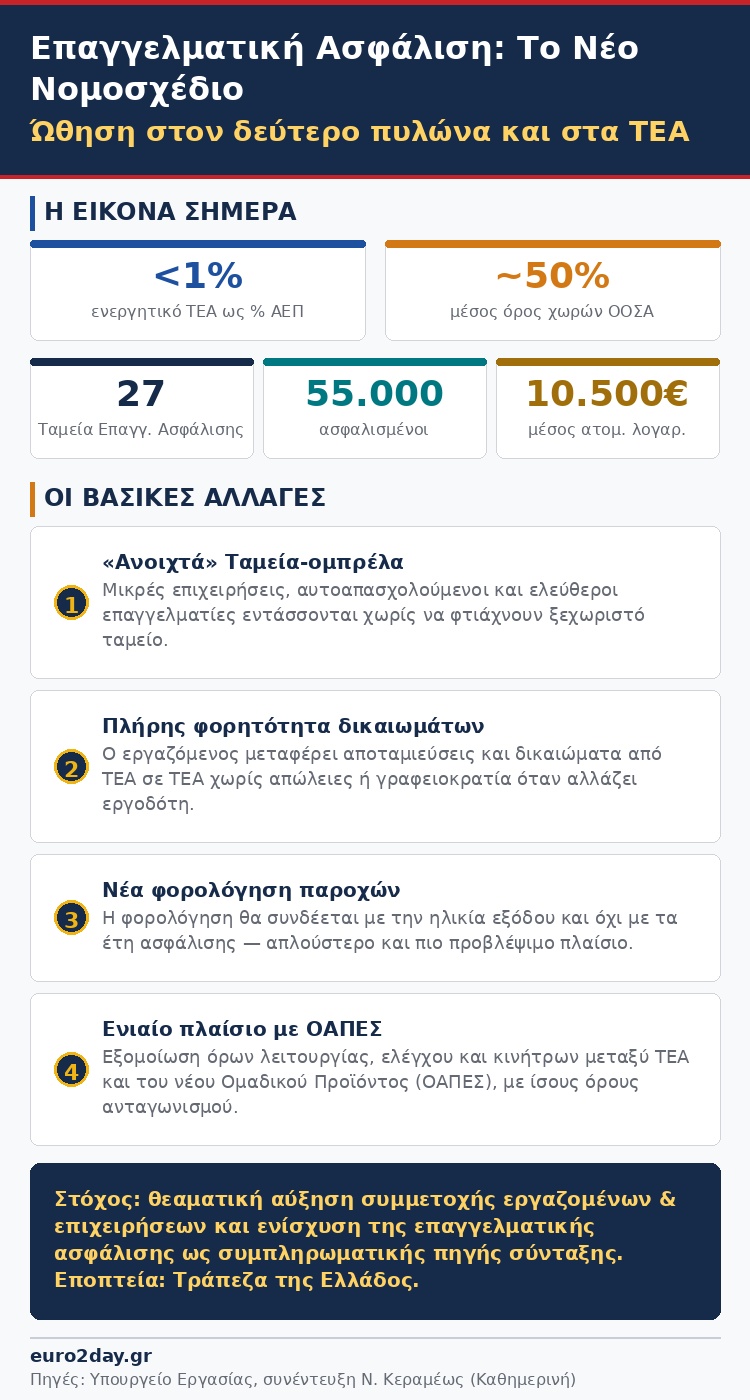
The most significant change concerns the establishment of so-called “open” Occupational Insurance Funds. These are umbrella funds that small businesses, the self-employed, and independent professionals can join, without requiring each employer to set up a separate fund.
This initiative aims to address a fundamental weakness in the Greek market, as the overwhelming majority of businesses are very small and lack the capacity to independently organize a professional fund. The new model is expected to significantly expand access to occupational insurance,
At the same time, the ministry is moving forward with the establishment of full portability of insurance rights. Thus, an employee who changes employers will be able to easily transfer their savings and entitlements from one TEA to another or to a different occupational pension scheme, without losses or bureaucratic hurdles.
The regulation is considered crucial for the protection of insured individuals, in conjunction with the strict supervisory framework that the Bank of Greece will continue to enforce.
Tax changes on the table
Of particular interest are the planned changes to the tax treatment of TEA benefits. Ms. Kerameos revealed that the ministry is examining a new taxation model, which will no longer be linked to years of insurance but to the insured person’s age upon leaving the system.
This change is expected to significantly simplify the framework, reduce the interpretive difficulties that have even led to pending legal cases, and offer greater predictability to insured individuals regarding the final return on their investment.
The new framework will also seek to eliminate distortions that currently exist between TEAs and group insurance plans offered by insurance companies.
Specifically, it is envisaged that the operating, oversight, and incentive frameworks will be harmonized between the TEAs and the new Group Occupational Pension Insurance Product (OAPES), which will also be part of the second pillar of social security. The government is seeking a unified supervisory framework and a level playing field between the two schemes.
The Ministry of Labor believes there is significant room for growth in occupational insurance in Greece. According to available data, the assets of Greek occupational insurance funds currently account for less than 1% of GDP, while the average in OECD countries is close to 50%. Currently, there are only 27 Occupational Insurance Funds in operation, covering approximately 55,000 insured individuals, while the average balance of individual accounts stands at 10,500 euros.
With the measures being promoted, the Ministry of Labor aims to dramatically increase participation by workers and businesses, create new Occupational Insurance Funds, and strengthen the role of occupational insurance as a supplementary source of retirement income in the coming years, while continuing to provide steady support for the first pillar of social security, which includes EFKA and TEKA.