In countries with strong institutions, the date of national elections is set in stone and does not change simply because the current prime minister wishes it so, citing some pretext, as is customary in Greece.It is true that the current prime minister has adhered to the election schedule so far. However, if we are to believe his close associates, Mr. Mitsotakis will weigh the pros and cons and reach a decision before the end of August.
The international environment, and specifically the trend in energy prices, will be the primary factor in whatever decision he makes, they say. September 27 is the date they are marking, although he himself states that elections will take place in the spring of 2027.
The likelihood of elections in September will increase if it is estimated that the international price of oil will remain at current levels or fall slightly lower in the coming months or quarters. This is because the impact on the Greek economy would be negative to neutral.
Conversely, if oil prices fall significantly, this could help improve the economic climate, and the government could hope to benefit from it.
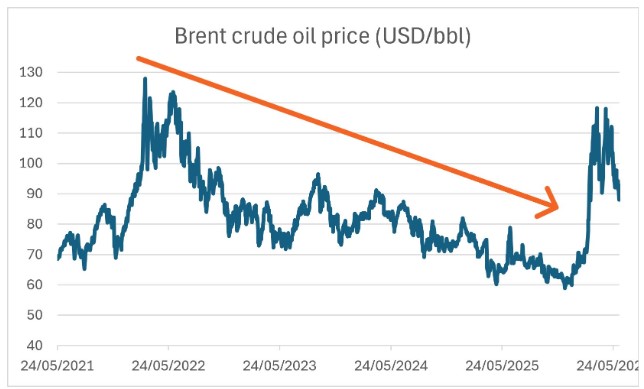
Last night, the price of Brent crude had fallen to just over $87 per barrel amid new statements by President Trump that the U.S. agreement with Iran could be signed as early as tonight. This was followed by the Pakistani prime minister’s announcement of an agreement to end the war. The price decline reflects the reduced geopolitical risk.
However, the prevailing narrative does not support a significant and rapid decline in the international price of oil over the coming quarters. And this is for various reasons. First, countries will rush to gradually replenish the strategic oil reserves they released onto the market to keep prices in check starting in March and thereafter. Second, because demand from Asian and African countries will continue to rise, and third, there may be disruptions in the global supply chain while shale oil production will begin to decline in about three years.
The market shares this prevailing narrative. The price of crude oil futures does not fall below $70 per barrel before September 2028.
However, this does not mean that the prevailing narrative is correct. A small minority of analysts and oil market executives do not share this view and believe that the oil market is structurally bearish. For them, the first strong support level will be $67 per barrel, followed by $50, as shown in the chart below by Robert Marshall Lee. Oil’s inability to maintain levels of $120–$130 per barrel during the Iran-U.S. conflict demonstrates precisely this.
According to this view, all countries have learned their lesson and will try to reduce their energy dependence on conflict-prone regions, such as the Middle East and Russia, by redirecting their supply chains elsewhere, e.g., the U.S. Furthermore, this means more renewable energy and batteries, nuclear power plants, and electrification, with a reduction in fossil fuel imports. China is considered a pioneer.
They note that the United Arab Emirates’ (UAE) exit from OPEC weakens the organization and favors increased production by the UAE. Furthermore, they point out that the price of oil would have been significantly lower last year if China had not purchased significant quantities to increase its strategic reserves, as was recently revealed. Consequently, the oil market has been in a steady decline since 2025.
The prevailing view seems to have the upper hand. However, the minority view of a significant drop in oil prices in the coming months cannot be ignored. It will be the surprise.