The main topic of economic discussion in Switzerland recently has been neither the strong Swiss franc, nor interest rates, nor U.S. tariffs.It was the proposal to impose a population cap of 10 million—up from approximately 9.1 million today—which was put to a referendum. In the end, the Swiss rejected the proposal by a margin of 55% to 45%, with major urban centers such as Geneva, Zurich, etc., voting against it, while rural and German-speaking regions voted in favor.
Large multinational and other companies spearheaded the rejection of the referendum, arguing that they would not be able to find workers and many would be forced to leave Switzerland for this reason. Furthermore, limiting the population would lead to stagnation in consumption and public revenue.
Finally, Switzerland would have to terminate the agreement on the free movement of persons with the EU, jeopardizing the country’s access to the single European market. Some spoke of a Swiss “Brexit.”
On the other hand, supporters of the proposal pointed to the worsening housing crisis and the strain on various infrastructure systems—such as healthcare—due to immigration and the resulting population growth.
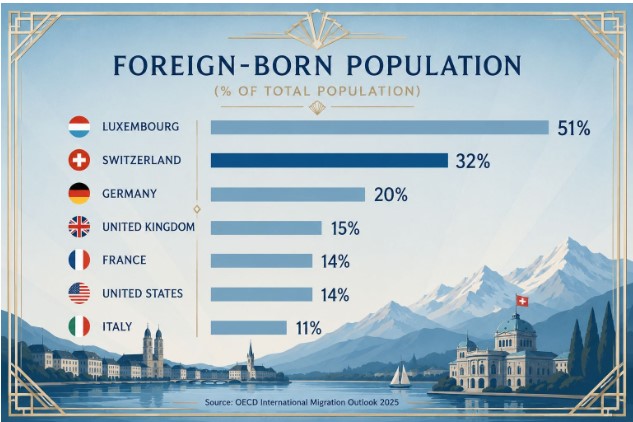
The issue is closed for now, but the high percentage—45%—of opponents is forcing the government to address the problems of housing and the strain on healthcare infrastructure, etc., caused by rapid population growth. Thirty-two percent of Switzerland’s population was born abroad, making it the second-highest after Luxembourg, which stands at 51%, as shown in the chart below.
It should be noted that the population of Greece born abroad amounts to 11.3% of the total, according to the OECD. Of these, 8 out of 10 were born outside the EU, with most coming from Albania, Georgia, and Russia.
This problem is well-known and common to all countries with aging populations, such as Greece. In the traditional economic model, growth is based on population growth and productivity. If you cannot or do not want to accept immigrants for labor-intensive jobs, e.g., in tourism, the restaurant industry, construction, etc., you will need to significantly increase productivity.
Japan is an example of a country whose population is aging and shrinking, and whose economy has been growing at a sluggish pace in recent decades, yet it maintains a high standard of living. In other words, while the nominal GDP growth rate may be low, there is prosperity reflected in a high per capita income.
It is true that a growing population translates into more workers and consumers and revenue for the state. It is also true that the issue has moved beyond its economic dimension.
However, the question remains. Can an economy grow and prosper with a stagnant or declining population?
Under certain conditions, this is feasible. If you try to increase employment by incentivizing underrepresented groups, such as women, if older adults work for more years, and at the same time the country adopts AI and automation and shifts from labor-intensive sectors to knowledge-intensive ones.
If this is not feasible, the country will have to decide what percentage of future growth will come from immigration and population growth and what percentage from productivity gains.