The bill submitted to Parliament by the Ministry of National Economy and Finance includes a social security and wage “package” with favorable provisions for thousands of civil servants and retired politicians.
These include pension increases as well as retroactive payments to thousands of civil servants who retired on or after January 1, 2017, so that their final benefits amount to 80% of the salaries of active civil servants and public officials. These are specific categories of public-sector insured persons who were exempted from the provisions of the “Katrougalos” law and retained the same pension calculation regime that was in effect for the public sector.
Overall, the social security and wage “package” of provisions included in the bill provides for a multitude of improvements to the method of calculating pensions and wages for specific categories of public sector insured persons, disability benefits, and a number of pending pension-related issues.
It is telling that the social security package alone has a budget of 50 million euros, of which 39 million euros are for retroactive payments to those who retired under the previous system between 2017 and 2025. As for salaries, the provision that stands out concerns increases ranging from 60% to 95% in the monthly gross earnings of the Archbishop of Athens and All Greece and the Metropolitans of the Church of Greece, at an annual cost of 3.6 million euros, according to the report by the General Accounting Office. There is, of course, also a provision to address wage disparities in the public sector, with the issue of the “personal difference” affecting approximately 1,500 employees being the main focus.
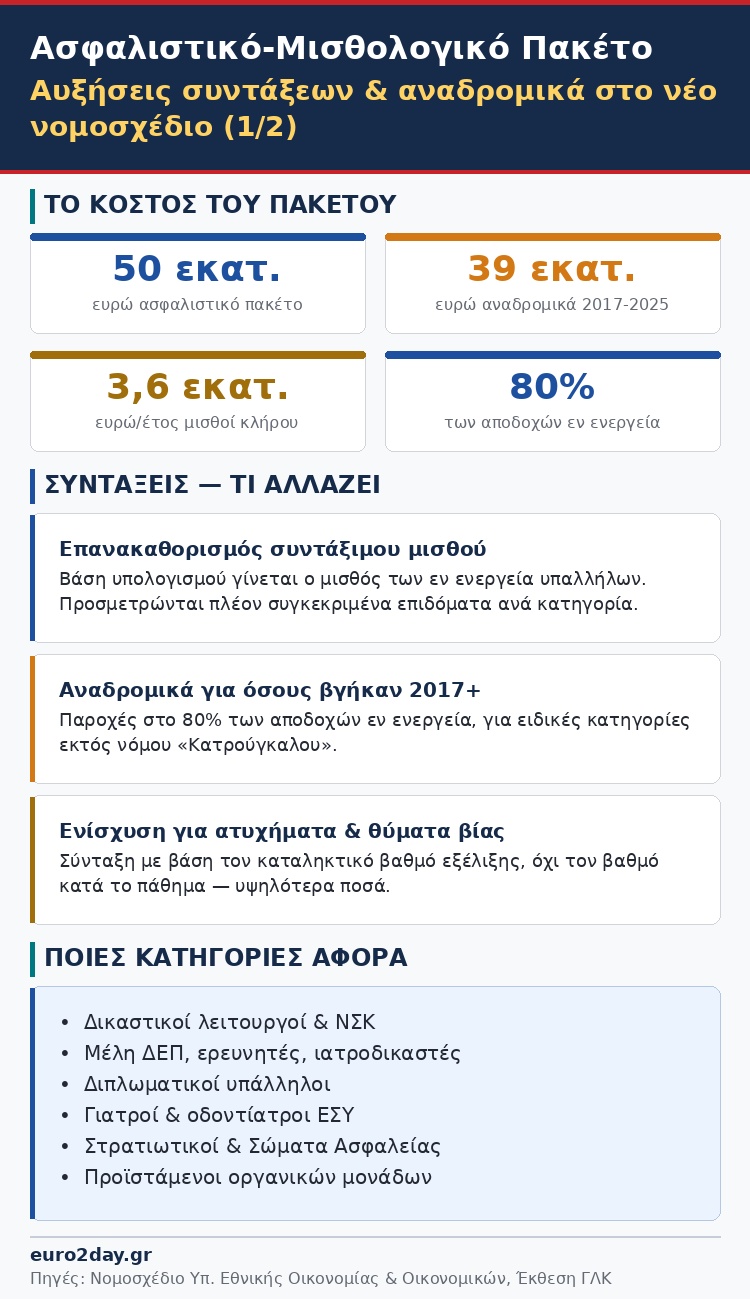
Specifically, a central element of the pension reforms is the recalculation of the pensionable salary for civil servants and public officials subject to the public sector’s special pension scheme. Henceforth, the monthly salary of active employees, as determined by the salary provisions in effect at the time, will serve as the basis for calculating the pension. The pensionable salary is defined as the base salary of the pay scale in which the employee is classified at the time of retirement, and it is stipulated that certain allowances will be included in this calculation—allowances for which it was not entirely clear until now whether they were taken into account when calculating the pension.
These categories include judicial officers, the core staff of the State Legal Council, medical examiners, members of the teaching and research staff at universities, researchers, diplomatic staff, doctors and dentists in the National Health System (ESY), as well as civil servants who have served as heads of organizational units. For each category, it is precisely specified which allowances are included in the pensionable salary, creating a clearer and more uniform framework.
A special provision applies to employees who suffered a serious accident or became completely disabled while performing high-risk duties. In such cases, the pension will not be calculated based on the rank they held at the time of the incident, but rather on the final salary grade they would have reached had they continued their career path. This provision results in significantly higher pensionable earnings and, consequently, higher pension amounts.
Similar measures are also planned for military personnel and law enforcement officers. The new framework now links the pensionable salary to the special pay scales applied to the Armed Forces and the Security Forces, while the calculation takes into account the base salary, the allowance for special working conditions, the hazard allowance, and the allowance for positions of responsibility. At the same time, a new calculation method is established for those who become fully disabled due to injury or accident while performing high-risk duties.
The new provisions also provide for improvements to the pensions awarded to the families of civil servants and military personnel who lose their lives while on duty. Effective January 1, 2024, the basis for calculating these pensions will increase, as higher pay scales will be used compared to those in effect until now. This change will result in higher payments for recipients of survivor’s pensions.
Significant provisions are also included for victims of terrorist acts or other violent crimes. For civil servants, public officials, and military personnel who become fully incapacitated due to such incidents and have a disability rating of at least 67%, a pension is provided regardless of their years of service. The pension is now calculated based on the final rank to which they would have advanced in the civil service, significantly strengthening the protection of these specific categories.
At the same time, the method for calculating disability benefits is being reformed. As of January 1, 2023, the amount of these benefits will be linked to the base salary of the corresponding pay scale, depending on the beneficiary’s educational category and rank at the time of retirement or at the time the disability occurred. This change aims to align the allowances with current public sector salary conditions.
The bill also includes a particularly important provision for thousands of civil service retirees, as it stipulates that amounts paid in error due to administrative mistakes during the computerized processing of retroactive payments or the recalculation of pensions will not be recovered. This, of course, applies to specific categories of public sector employees who received pension increases due to procedural errors.
The special provisions also include the expansion of eligibility for the special pension established for the victims of the Tembi railway accident. Beneficiaries now also include the parents of unmarried, divorced, or widowed victims who left no children, thereby filling a gap that had been identified following the implementation of the original provision.
In addition, the age limit up to which a pension is paid to children receiving benefits due to the death of a parent in specific categories of pensioners is being raised, thereby extending the period of financial protection for families.
Finally, a new social safety net is provided for older adults who are unable to establish pension eligibility through the recognition or buyout of prior service. If the relevant applications are rejected, the files will be automatically forwarded for consideration of eligibility for the Social Solidarity Allowance for Uninsured Elderly Persons, effective as of the date of the initial application.
With regard to wages, the provisions call for increases ranging from 60% to 95% in the monthly gross earnings of the Archbishop of Athens and All Greece and the Metropolitans of the Church of Greece, according to a draft law from the Ministry of Finance. Specifically, the total gross monthly compensation for the Metropolitans is set at 4,671.90 euros, compared to current compensation ranging between 2,400 and 2,475 euros. This represents an increase of between 88.8% and 94.65%, while for the Archbishop of Athens and All Greece, remuneration will rise from the current levels of 2,840–2,915 euros by approximately 60.27% to 64.5%.
It also includes a provision to address wage disparities in the public sector, with a particular focus on the issue of “personal differentials.” The provision, which takes effect on July 1, 2026, provides that in agencies where the majority of employees received a personal differential—due to the successive extensions granted in 2018 and 2023—up to the amount of 300 euros, this will be replaced by corresponding regular pay.