Greece was among the exceptions in the European short-term rental market in May, outperforming the European average, with demand, prices, and revenue all on the rise.
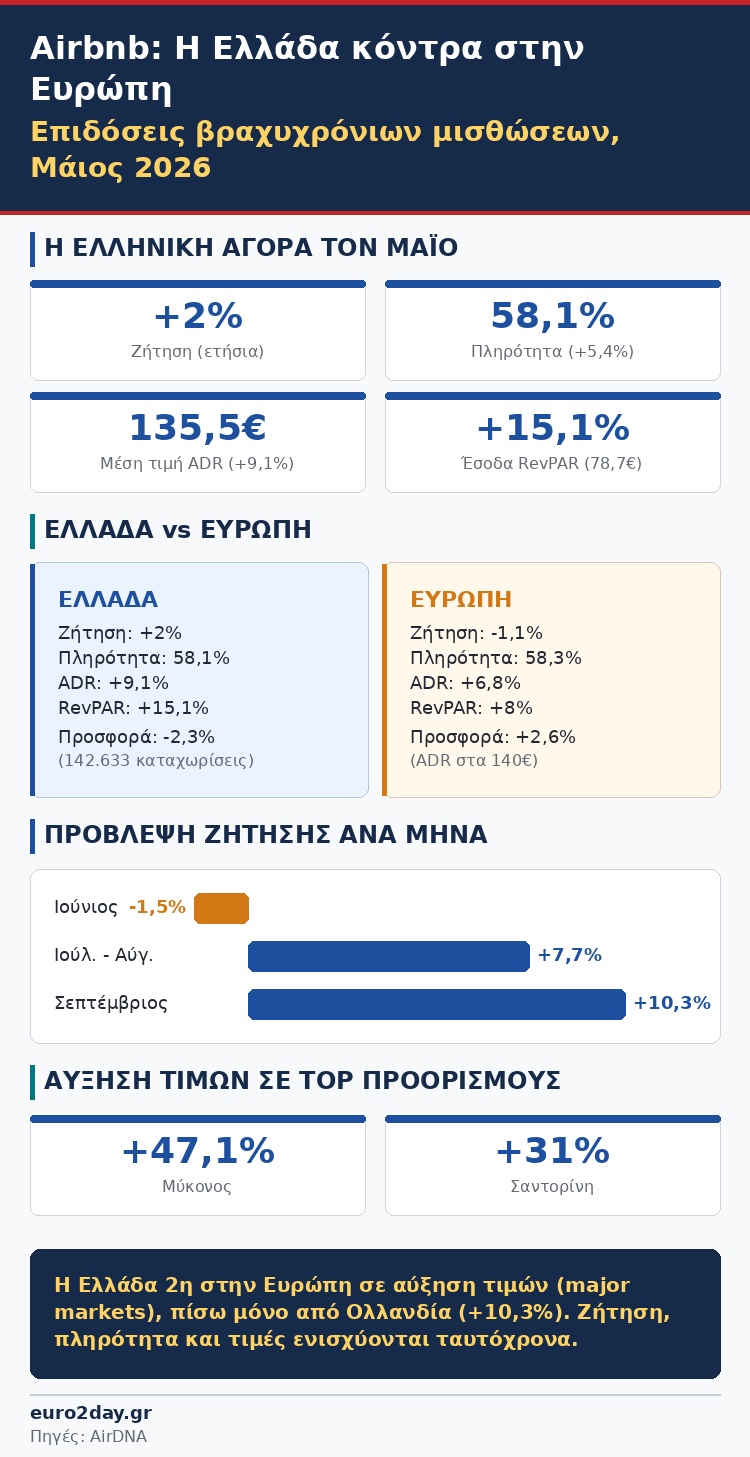
In contrast to the European market, where demand for short-term rentals declined in May, Greece posted positive results with an increase in bookings, higher occupancy rates, and rising prices. According to AirDNA data, the Greek short-term rental market diverged from the overall European trend. More specifically, while the European market recorded a 1.1% year-over-year decline in demand, Greece saw an upward trend, with demand rising by 2%, a fact that confirms the country’s momentum.
However, the supply of Airbnb-style accommodations in Greece saw a slight decline. The number of available listings decreased by 2.3% to 142,633, a trend that, combined with the increase in demand, created a more balanced market environment.
According to AirDNA, the reduction in available inventory may also be linked to regulations that took effect in October 2025, which were aimed at improving the quality of services in this market. The implementation of stricter requirements appears to have driven some listings off the market, limiting the number of available properties.
Consequently, the increase in demand, combined with the reduced supply, had a direct impact on occupancy rates. According to AirDNA data, accommodation occupancy rose by 5.4% year-over-year, reaching 58.1%.
The rise in occupancy rates is one of the most important indicators of market performance, as it shows that the improvement in performance is not driven solely by higher prices, but by a genuine increase in demand.
Regarding the pricing policy of Airbnb-style accommodation owners, the data show that the average daily rate (ADR) increased by 9.1%, reaching 135.5 euros. This trend indicates that owners in Greece were able to maintain a strong pricing strategy by capitalizing on travelers’ increased interest.
The combination of higher occupancy rates and increased prices led to a significant boost in revenue. RevPAR, or revenue per available room, rose by 15.1% year-over-year to 78.7 euros.
“The latest data overturn an initial, more cautious assessment of market trends, as they reflect stronger momentum: the increase in revenue is not solely the result of rising prices, but reflects an improvement across all metrics. “The simultaneous rise in demand, occupancy rates, and prices indicates that the short-term rental market in Greece is strengthening in terms of both volume and returns,” the report notably points out.
Indicative of the momentum of the domestic short-term rental market is the fact that Greece ranks second among Europe’s “major markets” (i.e., those recording more than 600,000 overnight stays) in terms of price growth, trailing only the Netherlands (+10.3%) and marginally ahead of Croatia (+9.5%).
Summer Demand
The positive outlook for the Greek short-term rental market does not appear to be limited to the start of the summer season, as forecasts for the coming months indicate that demand will remain strong, with variations between peak periods and off-season months.
Specifically, demand for June shows a marginal decrease of 1.5%, following the corresponding trend observed across Europe as a whole. The picture, however, changes significantly for the coming months, as demand in July and August is up by 7.7% year-over-year.
The off-peak period also shows strong momentum, with demand continuing to rise even after the summer peak. September saw a 10.3% increase, indicating a shift in travel patterns toward periods with milder weather and more competitive prices.
The growth of the so-called shoulder season is attributed to a combination of factors, such as the search for more affordable prices, the desire to avoid high temperatures, and the preference for periods with less tourist traffic.
In terms of destinations, the country’s popular destinations continue to see price increases during the summer season, with Mykonos and Santorini standing out. Santorini shows a 31% increase year-over-year, while Mykonos records a 47.1% increase, mainly during the off-peak months, in line with stronger demand.
At the same time, Athens has seen a steady rise in prices throughout the season, reinforcing its role as a destination with consistent, non-seasonal demand. In contrast, Thessaloniki shows more limited momentum after August, with the rate of price growth slowing down.
As for accommodations, there has been a shift toward more economical options, as the increased cost of travel is influencing consumer choices. The strongest growth in July was seen in economy and midscale accommodations, which served as the primary drivers of rising demand.
“This trend continues in the following months, with August and September showing a similar pattern. However, demand for upper-tier and luxury accommodations remains strong, particularly during the off-peak season, confirming the multi-tiered nature of the market,” the report notes.
The Picture in Europe
Overall, the European short-term rental market in May 2026 showed signs of stabilization, with supply increasing by 2.6% and demand declining marginally by 1.1%. Despite the slight dip in demand, occupancy rose to 58.3%, while the average daily rate (ADR) increased by 6.8% to 140 euros, leading to an 8% rise in RevPAR.
For the summer, bookings for June through August are up 4.9% from 2025 levels, with the high-end accommodation segment outperforming the rest.