Greece once again has the lowest wholesale price in Europe today—excluding, of course, the Nordic countries—due to the overproduction of solar power, which on a monthly basis is marginally below the May figure, with all that this may imply for July’s green electricity bills.
With the summer month—traditionally the most critical for electricity prices—approaching, market signals suggest that the rates to be announced by providers in ten days will not see significant changes, since the surplus production from renewable energy sources—which account for 60–65% of the daily energy mix— is keeping natural gas-fired units below 30%.
Unless something changes dramatically in the coming days, more than 80% of residential consumers will continue for another month to pay an average of around 15 leptes per green kilowatt-hour—or even less—just as they did in May and June.
In fact, if the country’s international leadership in renewable energy were combined with a large number of installed batteries—an area where we lag behind the rest of Europe—we wouldn’t have to “waste” huge amounts of cheap green energy—and instead meet our nighttime needs with expensive natural gas—then the wholesale price would be even lower, a fact that would be further reflected in end-user electricity prices.
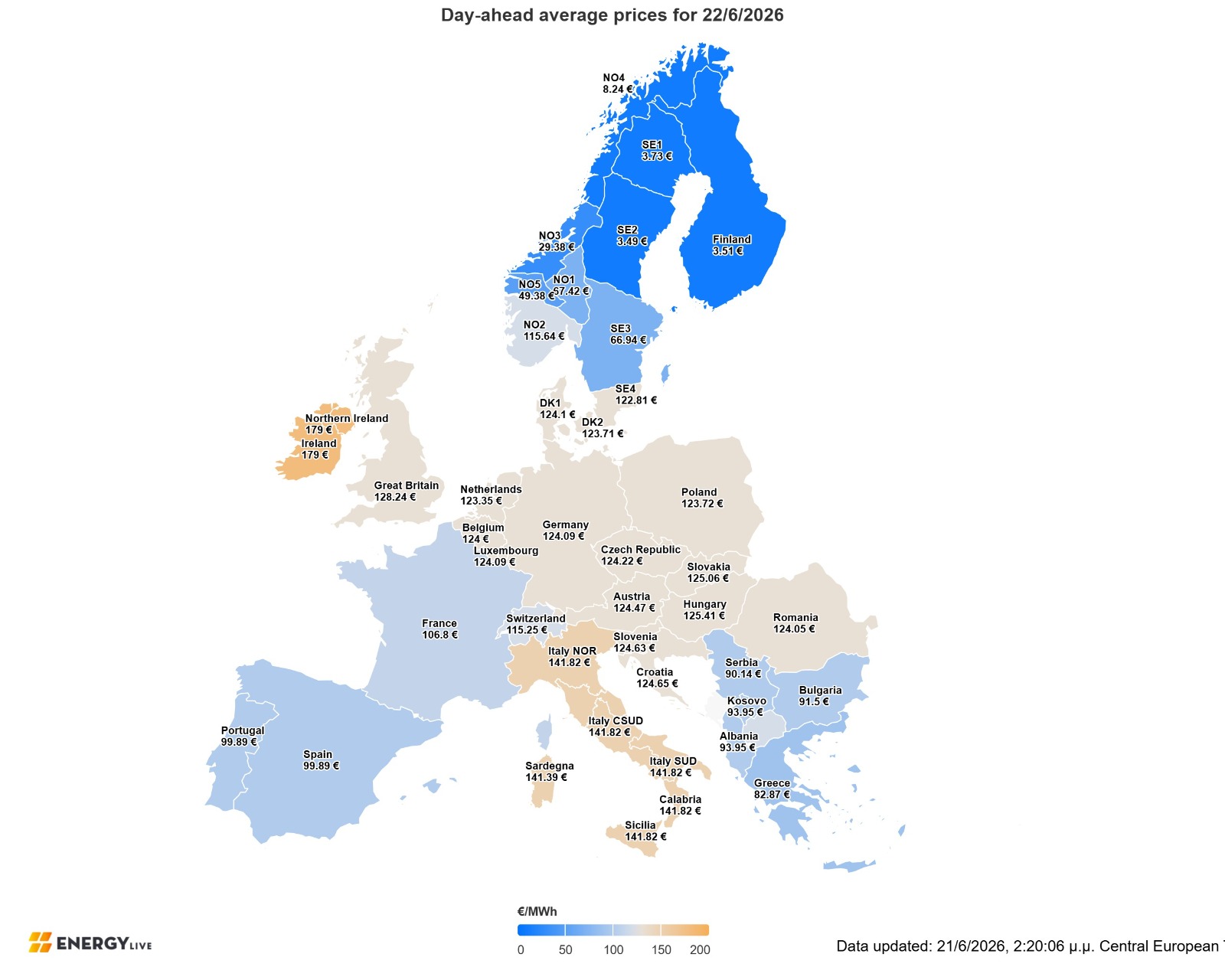
On the pan-European price map, today’s average wholesale price in Greece stands at 82.87 euros/ megawatt-hour, meaning we have the second-cheapest market (as we did on Friday) behind the perennial champions—the Scandinavians, thanks to their abundant hydropower—while the Iberian Peninsula, rich in renewable energy (Spain, Portugal) is “trading” at 99.89 euros and Central Europe (e.g., Austria, Hungary, Slovakia) at 124–125 euros/MWh.
Our neighbor Bulgaria, with which we once followed parallel paths, is currently at 91.5 euros, as—due to the high volume of Greek exports— the capacity of our interconnector has been fully utilized—as has consistently been the case in recent months—resulting in market decoupling and prices being set separately in each country.
In summary, there are three factors that support the view that green electricity prices will remain unchanged in July as well.
- The average wholesale price in Greece for the first 22 days of June stands at 88.49 euros/megawatt-hour, the same as the price at which May closed (89 euros/MWh).
- According to meteorologists, Western and Central Europe will experience intense heat waves this week, while Greece will maintain normal and rather cool summer conditions, with the meltemi winds setting the tone. Barring any sudden changes, the month will end with similar wholesale price levels.
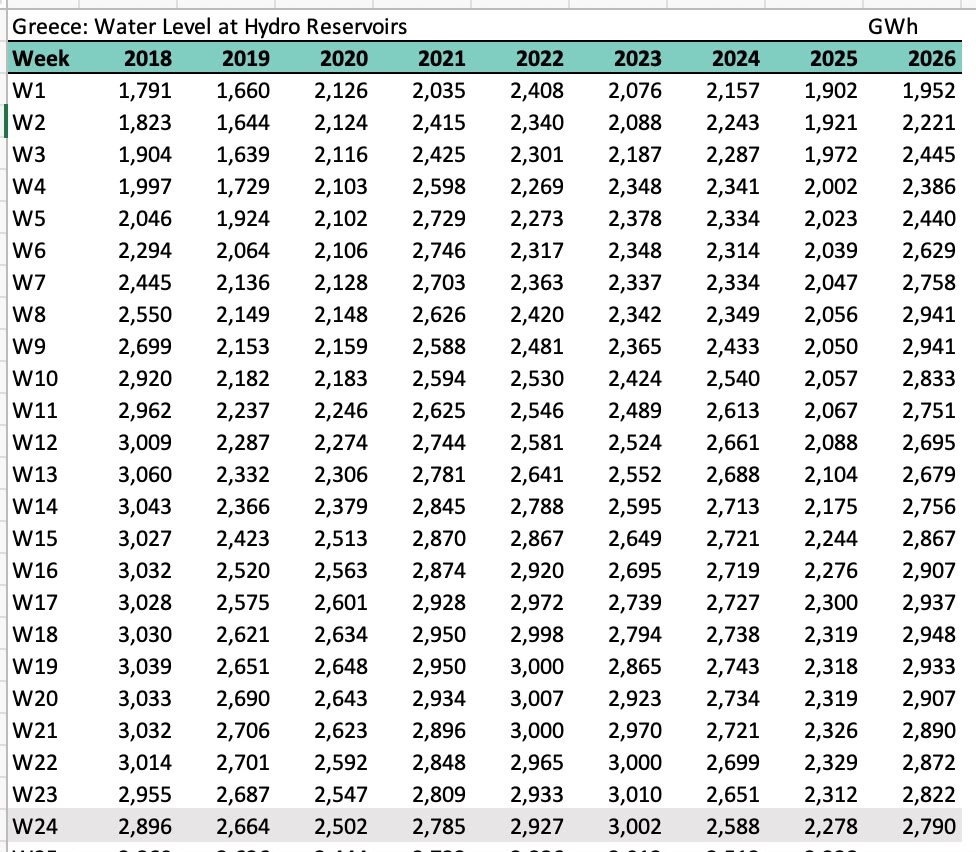
- Water reserves in the PPC reservoirs, which have been used sparingly throughout the previous months, stand at 2,790 gigawatt-hours. As the table shows, they are at very satisfactory levels—close to those of March—whereas a year ago they stood at 2,250 gigawatt-hours. Having increased by 22% since last year, they provide some breathing room for the system this summer.
Electricity Exports at 75% of Hours
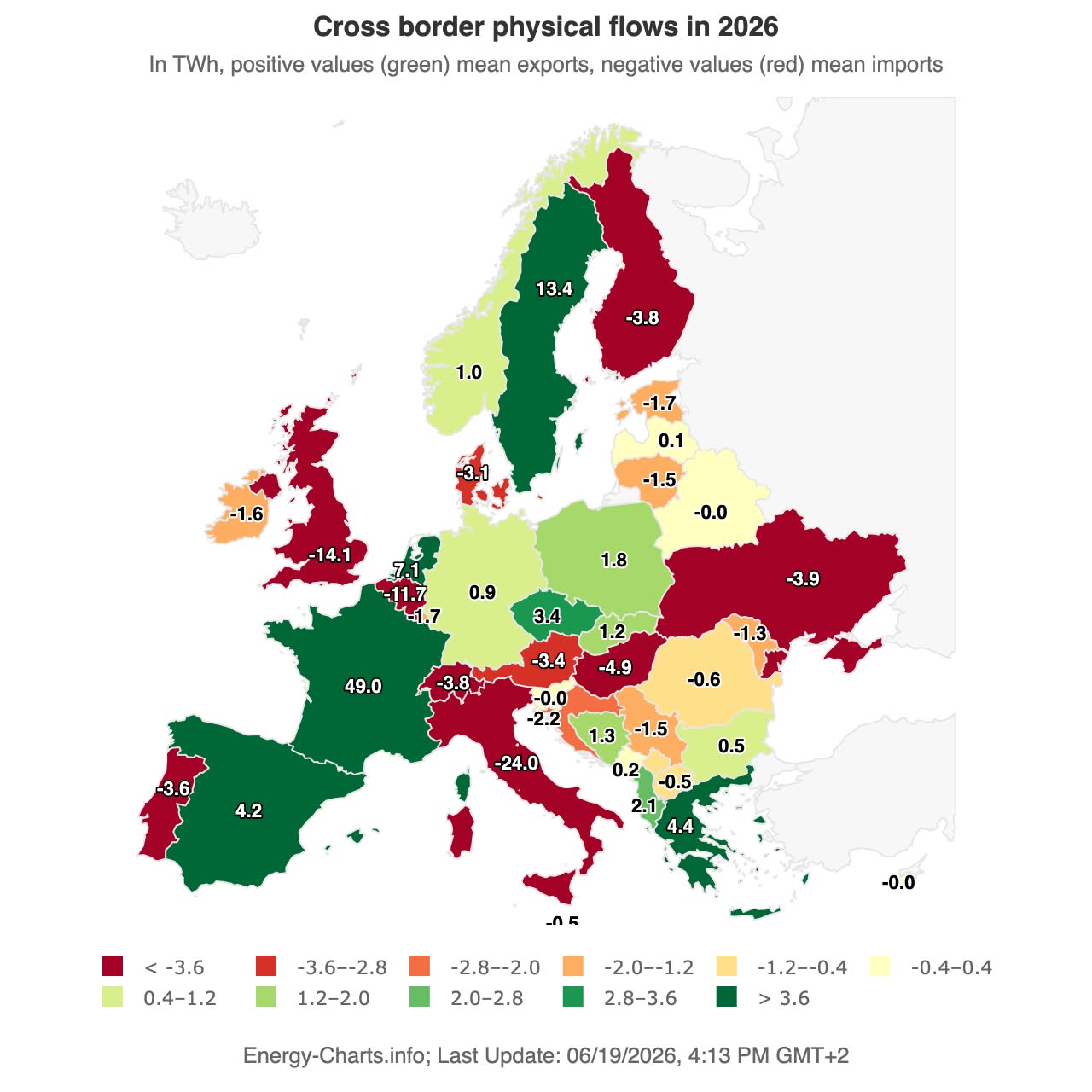
In terms of exports, the trend of the previous months continues unabated. The data show that during the first 20 days of June, we exported electricity during 75% of the total hours. Out of a total of 480 hours (20 days × 24 hours), we were net exporters for 358 hours and net importers for only 122 hours. In May, our performance with Bulgaria was even higher, as we exported electricity to our neighbors during 96% of the month’s hours.
This is how we’ve managed to remain, for yet another month, the 4th largest net electricity exporter in Europe in absolute terms, trailing only France (with its many nuclear plants), Sweden, and the Netherlands, and narrowly surpassing even Spain. In the first twenty days of the month, we exported a total of 4.4 terawatt-hours, compared to 49 terawatt-hours from France, 13.4 TWh from Sweden, and 7.1 TWh from the Netherlands, but 4.2 TWh from Spain.
Of course, if the pace of battery installation had been faster and we weren’t among the laggards across Europe with a storage capacity of just 220 MW—compared to the 3.5 GW that neighboring Bulgaria is said to have installed — the amounts of cheap green energy that are currently “curtailed”—that is, cut back to avert the risk of a blackout—would be used to meet our needs at night, reducing the use of expensive natural gas-fired power plants.
And the fewer hours natural gas-fired units operate, the less they influence the System Marginal Price (average wholesale price), according to the still-distorted European model.
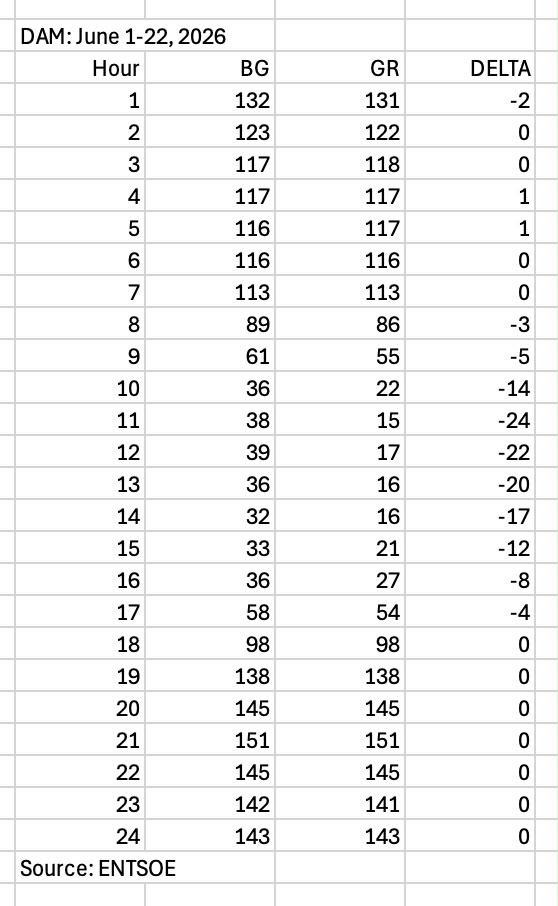
The paradox, of course, is that although the massive installation of batteries in Bulgaria should logically have led to lower wholesale prices than those in Greece —thanks to the use of cheap, stored green solar energy during the evening hours—this does not appear to be the case.
Comparing the fluctuations in wholesale prices between the two countries, it appears that prices are lower in Greece at midday, while they remain the same in the evenings. The comparison shown in the table below refers to today, but the picture was similar in previous weeks as well.
According to one interpretation, the massive investments in battery storage—in which Bulgaria appears to be taking the lead—may not yet be complete and are likely still under construction, a fact that, of course, does not negate the bigger picture. Greece has fallen significantly behind in this sector, and we need to accelerate our efforts to stop losing such a large surplus of green energy production.
The Ministry of Environment and Energy’s optimistic outlook is that Greece’s performance will improve by summer and that the installation of 500–600 MW of batteries (a milestone of the Recovery Fund) will become feasible, so that, combined with the operation of hydroelectric plants, there will be little need to call on natural gas plants this year—a development that will, of course, become clear over the course of the coming months.