The Bank of Greece has classified 10 billion euros in funds from the Recovery Fund as at risk of being lost, emphasizing that if the program’s tight deadlines are not met, the projects will have to be carried out using funds from the state budget, which would result in an extraordinary and severe fiscal burden.
In its new Monetary Policy Report, the Bank of Greece sounds the alarm regarding the timely absorption of the remaining funds from the Recovery Fund. As it emphasizes, absorbing the remaining 10 billion euros by the end of December 2026 (the program’s deadline) is an undertaking deemed extremely ambitious.
This absorption requires the full completion of the relevant milestones and targets by August 31, 2026, at the latest.
Failure to secure the relevant European funds for the completion of the contracted projects (under the grant component) could lead to their inclusion in the national Public Investment Program (PIP), as emphasized by the Bank of Greece.
Such a development would create the need to finance the projects from national funds, which would have a negative impact on fiscal aggregates, pushing up the growth rate of nationally funded net primary expenditures.
The Bank of Greece notes that, to expedite the procedures, in May 2026, Greece submitted its fourth revised National Plan, maintaining the overall budget while adjusting targets and replacing projects based on their stage of implementation.
Progress on Fund Absorption
Although meeting the deadlines will require a difficult race against time in the coming months, the Bank of Greece’s report acknowledges that Greece has made satisfactory progress so far compared to other EU countries.
Specifically, following the disbursement of the 7th tranche of grants and the 6th tranche of loans in April 2026,
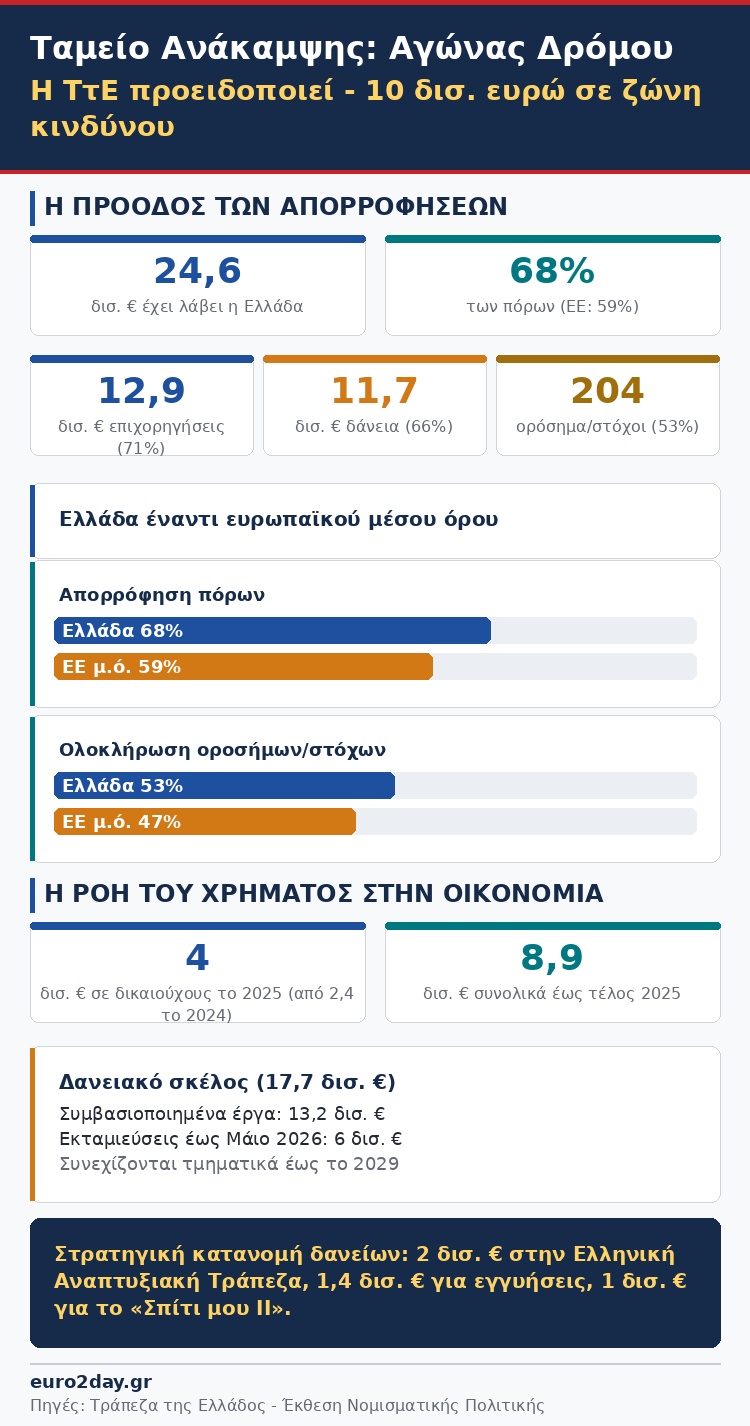
- the country has received 24.6 billion euros (68% of available funds, compared to the European average of 59%).
- • Of this amount, 12.9 billion euros are grants (71% of the approved amount) and 11.7 billion euros are loans (66% of the approved amount).
- • In addition, 204 milestones and targets have been successfully completed (53% of those agreed upon, compared to 47% in the EU).
In May 2026, the penultimate requests (the 8th and 7th, respectively) were submitted, totaling 1.63 billion euros, covering 34 milestones in health, employment, and digital transformation, notes the Bank of Greece.
The Flow of Funds into the Real Economy
Funds from the Recovery Fund began flowing into the real economy in 2025 at an ever-increasing pace, the central bank emphasizes. Disbursements to final beneficiaries accelerated dramatically in 2025, reaching 4 billion euros (compared to 2.4 billion in 2024).
By the end of 2025, a total of 8.9 billion euros had been paid to beneficiaries. Furthermore, by May 2026, 6.3 billion euros (including VAT) had been transferred from the State Budget to the relevant agencies.
On the loan side, the deadline for signing contracts expired at the end of May 2026, with contracted projects totaling 13.2 billion euros. However, disbursements to businesses are being made in installments (reaching 6 billion euros by May 2026) and are expected to continue through 2029.
Of the total €17.7 billion in the loan component, resources are strategically allocated for specific purposes:
- 2 billion euros are transferred to the Hellenic Development Bank to support the market.
- 1.4 billion euros are earmarked for providing guarantees and capital injections.
- 1 billion euros are allocated to the “My Home II” social housing program.
The European Commission’s draconian rules for closing the RRF
The Bank of Greece’s report refers to the strict rules set by the European Commission in April in a related announcement, making it clear to member states that the final phase of the Recovery Fund allows for no exceptions.
Specifically, all milestones and targets for the implementation of reforms and investments must be completed by August 31, 2026. Any actions taken by Member States to meet the targets after August 31, 2026, will not be taken into account in the assessment.
All final payment requests, along with management declarations and audit summaries, must be submitted by September 30, 2026. Furthermore, all payments from Brussels must be made no later than December 31, 2026.
If a milestone is assessed as not having been satisfactorily met after August 31, 2026, the Commission will not initiate the well-known “suspension” procedure, which previously allowed a 6-month grace period for compliance.
Instead, the reduction procedure will be triggered immediately, leading to a proportional reduction in financial contributions and loans to the Member State. Furthermore, meeting the targets requires that member states have not “rolled back” (reversed) measures and reforms that had previously been implemented.
If the Commission determines that a reversal has occurred after August 31, 2026, it will also initiate a procedure to reduce funding. The amount affected by the reversal will be deducted directly from the final payment decision.
Any unused amount of the European grant that has not been paid by December 31, 2026, will be definitively decommitted by the Commission and will be permanently lost to the country.