Despite the significant increase in visitors in recent years, Athens is not yet facing the effects of overtourism.
This is one of the key findings of an analysis included in the Bank of Greece’s Monetary Policy Report, which examines the pressures created by the rapid growth of tourism, as well as the risks that climate change poses to the sustainability of the Greek tourism model.
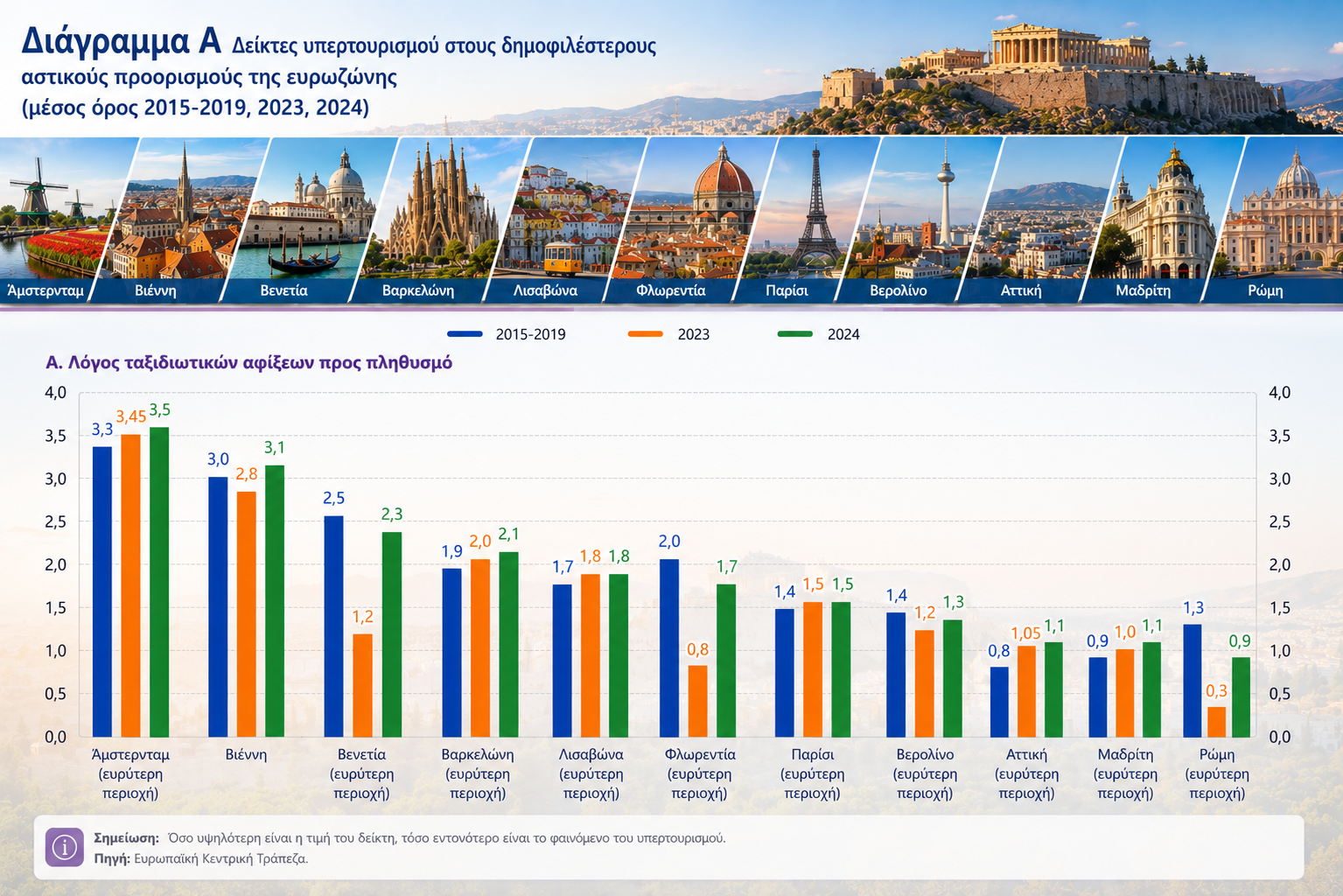
Based on indicators that compare international arrivals to the permanent population, the greater Athens area ranks significantly lower than cities that are already facing severe problems of visitor overcrowding, such as Amsterdam, Vienna, Venice, and Barcelona.
According to available data, Attica ranks ninth among eleven major European urban destinations (Paris, Madrid, Barcelona, Rome, Venice, Florence, Berlin, Vienna, Amsterdam, and Lisbon) in terms of the burden caused by the increase in visitors.
At the top of the list is the greater Amsterdam area, followed by Vienna and Venice, where the ratio of tourist arrivals to the permanent population exceeds 2.
According to this specific index—which, in the case of the Greek capital, remains around one—the greater Athens area does not exhibit problems of overtourism.
Similar conclusions emerge from an analysis of the trend in the index of tourist arrivals relative to geographic area across the eleven selected popular tourist cities, with Attica ranking low at sixth place.
Among the indicators that point to the conclusion that the Greek capital and the wider Attica region do not face a problem of overtourism is bed occupancy. In this specific ranking, Attica is in second-to-last place with a 52% occupancy rate in 2024 and lags behind other cities that are already under pressure from significant visitor traffic.
However, the data show that seasonality in Attica is pronounced. Travelers tend to visit during the summer months, a fact that indicates that Athens and the wider region have significant room for growth in terms of increasing visitor numbers by extending the tourist season.
It should be noted that only Florence, Venice, and Barcelona show higher levels of concentration. “The already emerging slight shift toward increased revenue and visitor numbers during periods outside the traditional tourist season offers further room for growth,” the Bank of Greece report notably points out.
It should be noted that data for the period 2018–24 were used for the comparison, with the exception of the pandemic years 2020–2022.
Measures Taken
While Athens may not currently be facing overtourism, the report highlights the urgent need to upgrade infrastructure in the energy, water supply, sewage, and waste management networks, as well as public transportation.
As noted, “the negative examples of cities that have already experienced heavy strain from tourist influxes dictate that Greece must promptly adopt appropriate policies aimed at mitigating the burden on permanent residents and infrastructure.”
It should be noted, in fact, that overtourism is not only related to the number of visitors but also to geographical, temporal, and management imbalances.
The Impact of Climate Change
Among the challenges facing Greek tourism is climate change, which in the medium term poses a burden on the sector’s sustainability, affecting both demand and the operations of hospitality businesses.
Especially for a country like Greece, where a significant portion of the tourism product is based on the “sun and sea” model, rising temperatures, extreme weather events, and pressure on natural resources are creating a new environment that requires adaptation.
As noted in the relevant Bank of Greece report, Greece is among the countries expected to be severely affected by the climate crisis, despite the fact that it has a well-developed tourism infrastructure and a strong product with international recognition.
In Greece, the effects of climate change are primarily reflected in rising temperatures, more frequent and intense heat waves, as well as extreme weather events such as “Ianos” and “Daniel.” These phenomena create new risks for tourist destinations, affecting both supply and demand.
As far as demand is concerned, the most significant change lies in travel habits. Excessive heat during the summer months is gradually leading to a shift toward different vacation periods, with an increase in travel during the spring and fall.
At the same time, younger generations of travelers appear to be more environmentally conscious, choosing smaller, less impacted destinations, sustainable accommodations, and experiences linked to the protection of nature and cultural heritage.
On the supply side, adapting to the new conditions is now a necessity for the tourism industry. Businesses are called upon to invest in infrastructure with a low environmental footprint, with an emphasis on renewable energy sources, conservation of natural resources, waste management, and the use of more eco-friendly materials.
Finally, as noted in the report, the protection of natural and cultural resources, improved spatial planning, and the development of alternative forms of tourism—such as cultural, hiking, spa tourism, and ecotourism, are the key tools for a more resilient development model.