The upcoming tender for seismic surveys in areas reportedly of interest to foreign players in the hydrocarbons sector paves the way for a new round of concessions in the future.
The decision signed by Minister Stavros Papastavrou gives the green light to the Hellenic Hydrocarbons and Energy Resources Management Company (EDEYEP) to launch an international tender for seismic companies to “scan” areas in Western and Southern Greece where there is potential interest from their clients and players who have approached them.
They will then sell the seismic data (non-exclusive seismic data), which anyone can purchase, following the same model used by the government during the first round of concessions (2012–2013).
At that time, the Norwegian company PGS (now TGS), following the “multiclient data” model, financed the mapping of a vast offshore area and subsequently sold the seismic data (2D or 3D) to hydrocarbon companies, many of which are currently concessionaires in Greek blocks.
This is exactly what will happen now with those seismic companies that respond to the call from EDEYEP.
Expression of interest from a major player
In fact, according to some reports, one reason for yesterday’s ministerial decision by the Ministry of Environment and Energy is that the state-owned company has received an official expression of interest from one of the world’s largest seismic survey companies.
In addition to TGS, the “very large” category includes the French company Viridien (CGG), which has the world’s largest fleet of geological survey vessels, the multinational Schlumberger (SLB/WesternGeco), one of the leading providers of services to the oil industry, as well as the Norwegian company Shearwater GeoService.
This is not a new issue; EDEYEP has been receiving informal inquiries for some time now. “We have already received interest from one of the two largest seismic companies in the world to begin the process. We’ve told them that we want to finalize our collaboration with Chevron on a broader plan, but this shows that the goal is very specific, and we’re already preparing for the day after the contracts are signed,” Aris Stefatos, the head of the company, had announced in February while speaking at a Capital-Forbes event.
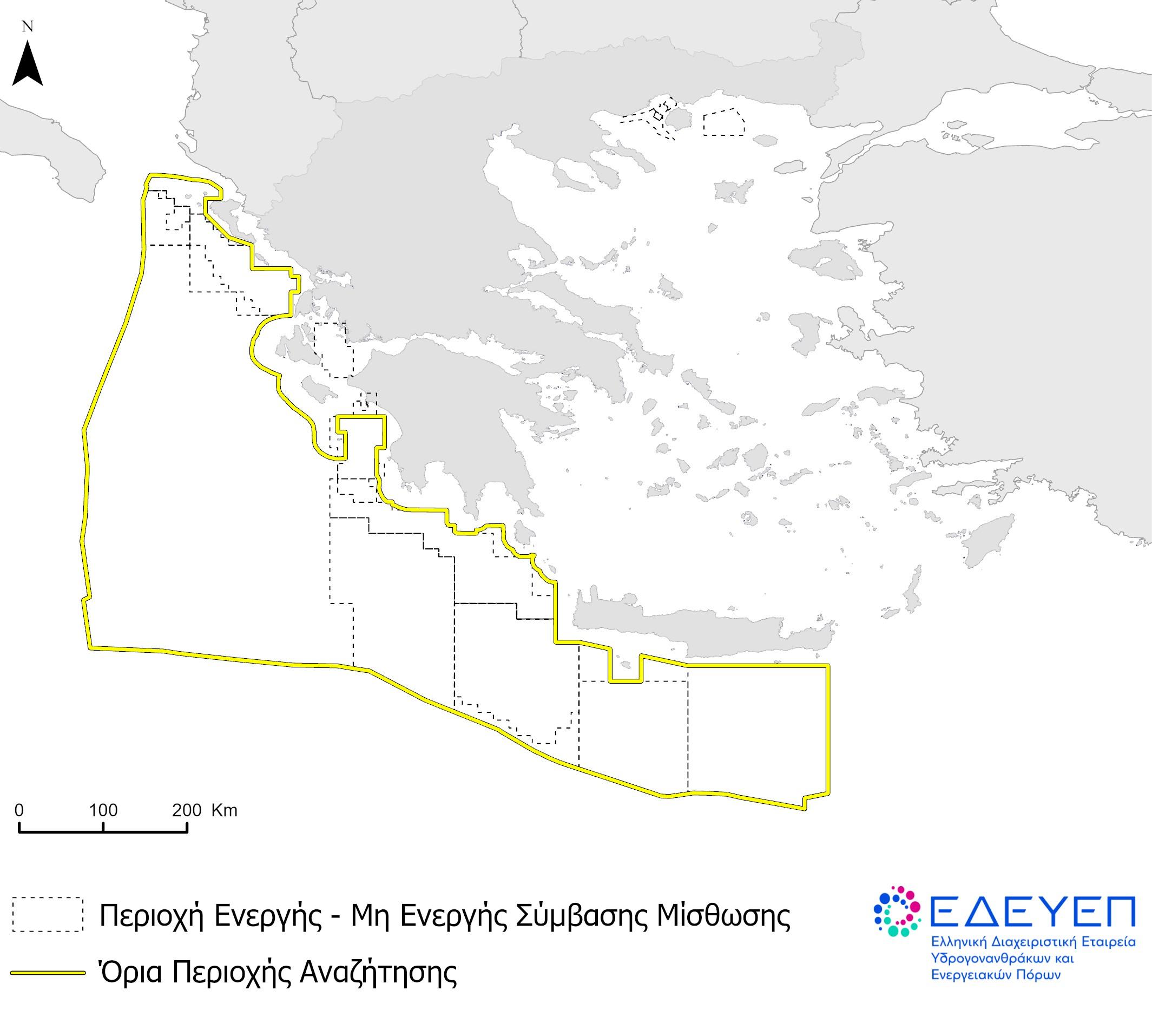
An area of 190,000 square kilometers
Although the map accompanying the Ministry of Environment and Energy’s announcement covers a vast area to be mapped—encompassing more than half of Greece’s maritime territory and estimated by experts to be 180,000–190,000 square kilometers— obviously, the companies that respond to the call will not survey the entire area. They will propose research programs covering parts of the region.
To put 180,000–190,000 square kilometers into perspective, the total area of Greece is 131,957 square kilometers.
In practice, the area to be included in the tender comprises all the plots that were demarcated under the Maniatis Law (Law 4001/2011), of which far fewer were ultimately put up for tender.
It remains, of course, to be clarified why the Ministry of Environment and Energy’s map also includes the plots licensed to Chevron and ExxonMobil. Unless, in some of the blocks where no seismic surveys have been conducted or where they are very sparse, the two companies—instead of issuing tenders for survey vessels—are waiting for the seismic data to be collected so they can purchase the data afterward.
After all, a common factor behind the interest that seismic companies are said to be showing in Greece is the extensive drilling program worth over 1 billion euros that is being planned for the coming years in the country’s nine offshore blocks, as well as the fact that the country would ideally like to have research vessels in the area south of Crete before the end of 2026.
The catalyst for new concessions
This is implied indirectly but clearly in the Ministry of Environment and Energy’s announcement itself, according to which “the goal is to respond to the market’s interest in financing new seismic surveys that will provide, in accordance with the most up-to-date standards followed in the hydrocarbons sector, data for non-exclusive use. This interest is directly related to significant developments in the growth of the hydrocarbons sector and the recent energy agreements involving Chevron and ExxonMobil.”
The above could trigger a new round of concessions or an expression of interest in a particular area by a player looking to purchase the latest seismic data, or even a new “open door” round, that is, an open call for expressions of interest, meaning that the area is available on a permanent basis to any investor who knocks on the government’s door.
This applies both to areas that have been returned to EDEYEP for some reason—as recently happened with the “West of Crete” block—and to the delineation of new blocks that have never been put out to tender, judging by the vast area yet to be mapped.
Moreover, yesterday’s announcement by the Ministry of Environment and Energy states that a database of two-dimensional and three-dimensional data for non-exclusive use is to be created, which will make these areas attractive to hydrocarbon companies, as it will ensure easier access and improved data accuracy while simultaneously reducing investment risk.
It should be noted that Mr. Stefatos himself recently addressed the issue of the “open-door” policy.
“We have already proposed (to the Ministry of Environment and Energy) the launch of a new international tender for the acquisition of seismic data, and we are also evaluating the launch of an ‘open-door’ process for areas that will be available on a permanent basis. In this context, we will also evaluate the possibility of contributing to solutions that reduce investment risk and make the plots more attractive. “I hope that we will be in a position to make specific announcements relatively soon,” he had stated a few weeks ago in an interview with “VIMA.”