From investments in renewables and batteries to the potential acquisition of an electricity provider and new LNG deals that will be accompanied by ship charters, AKTOR’s business plan aims to reshuffle the deck in the domestic energy market.
Examining the key elements of its business plan—from expanding into renewable energy generation to entering the retail electricity market and expanding into LNG trading— everything points to intensified competition in the energy sector, as well as potential partnerships.
In the retail electricity market, for example, where the group currently has no presence, the plan unveiled by Alexandros Exarchou to acquire a Greek electricity provider will inevitably bring about upheavals and shifts in the balance of power. The goal is to create a new, powerful player, with all that this entails for the battle for market share.
In contrast, in the FSRU sector—that is, floating LNG storage and regasification units—where the venture is inherently difficult and very expensive, with costs of 500–600 million per unit and fierce competition from Germany to the Baltic states, everything points to partnerships emerging.
Reports persist that AKTOR is in advanced discussions with a major domestic player, a fact confirmed by the group itself. The presentation to analysts mentions an investment in the range of 190 million euros, emphasizing that a “joint venture with a strategic partner for the FSRU is being planned to help mitigate the project’s risk,” with the base-case scenario calling for capacity commitments at a new terminal without assuming operational responsibility.
It is clear that the group does not intend to be involved in its construction and operation.
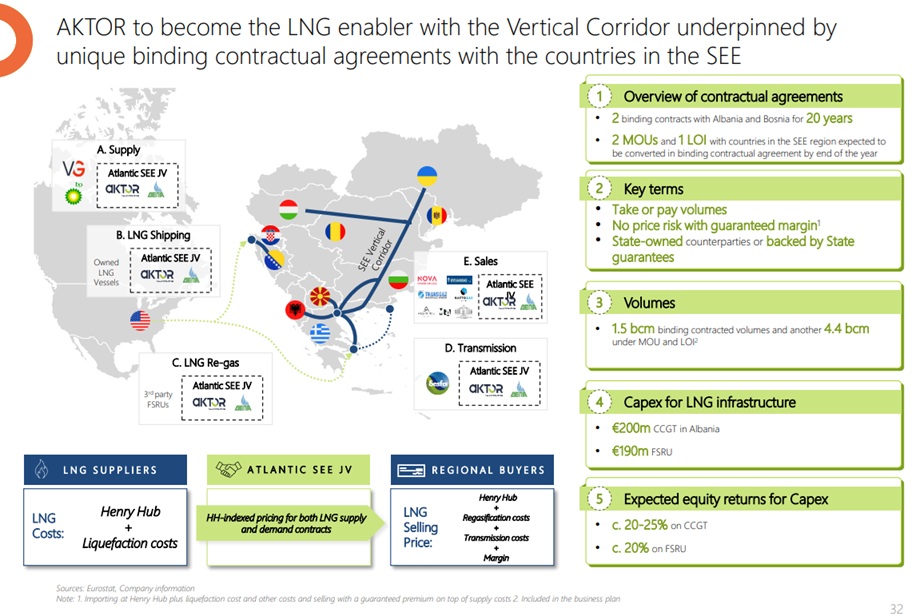
It is an open secret in the market that the group is in talks with one of the three players (or even more than one) currently developing FSRU projects. Namely, Gastrade of the Kopelouzos Group, which is promoting a second project in the Thracian Sea; Gas Canal of the Vardinoyannis Group in Agioi Theodoroi; and Helleniq Energy, which has always had a project for a terminal in Thermaikos in its portfolio.
In fact, the group’s new business plan, totaling 3 billion euros—of which energy accounts for 43%, or 1.3–1.4 billion—includes only a portion of what the group’s CEO has announced over the past week.
These funds are earmarked for new investments in renewables and batteries, with an estimated budget of 1.1 billion euros over the coming years, and the 200–300 million euros to be allocated to the LNG sector, as well as for participation in a new FSRU.
This figure does not include the chartering of ships to transport liquefied natural gas—which Mr. Exarchou discussed yesterday during his presentation to analysts—nor the acquisition of an electricity provider, nor any other potential moves the group may make.
Taking into account the new business plan, the remarks made by the CEO himself during Thursday’s interview, as well as what he said yesterday during the presentation to analysts, the group’s energy strategy envisions at least four key areas of focus.
Expansion of LNG agreements beyond 4.5 bcm per year
The group estimates that by the end of the year it will have contracted LNG volumes equal to 4.5 billion cubic meters. This figure includes existing memorandums of understanding (MoUs) with Bulgaria, Romania, and Ukraine—which it aims to convert into binding agreements by 2026—as well as plans to expand into Hungary and North Macedonia, as well as the short-term contracts on the Vertical Corridor, which Atlantic SEE’s management had discussed on Wednesday.
However, as Mr. Exarchou told analysts yesterday, the figure of 4.5 bcm is conservative, and he predicted that these volumes will increase significantly as new opportunities arise and new commercial agreements are finalized.
Chartering of two LNG carriers
If the group secures gas volumes exceeding 4.5 billion cubic meters, it will proceed with the chartering of two LNG carriers. The vessels will remain permanently in Greece and will operate as floating natural gas storage units, enhancing the flexibility and security of supply for the new business. At this stage, the plan involves only chartering the vessels, not purchasing them.
Expansion into the renewable energy sector and batteries
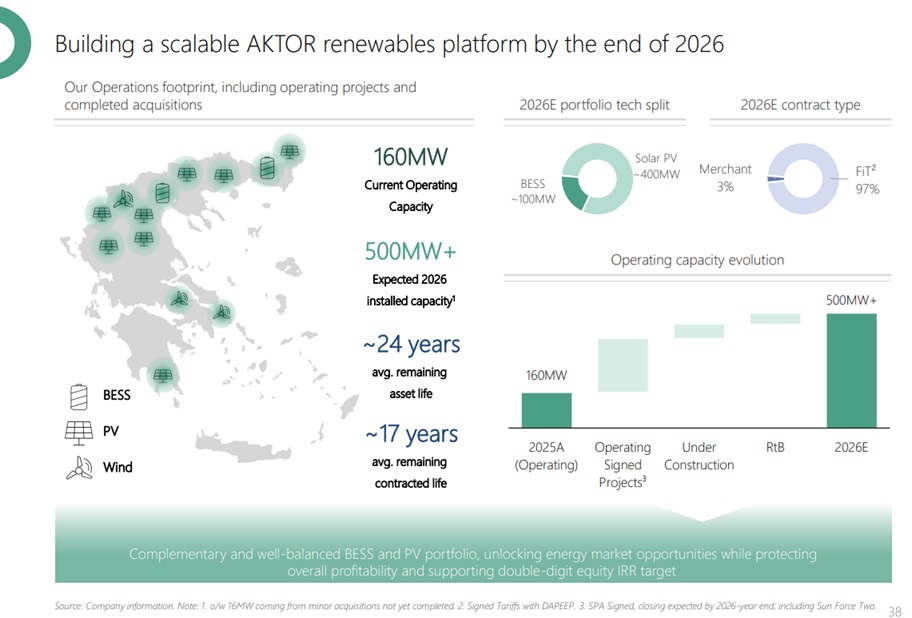
Within the year, the company plans to acquire power plants with a total capacity of 550 MW, with guaranteed feed-in tariffs, which will ensure predictable cash flows.
The next goal is to expand the portfolio to 1.2 GW, with management making it clear that every new acquisition must offer double-digit internal rates of return (IRR).
In Bulgaria, the company will acquire battery storage facilities, thereby offsetting the ever-increasing curtailments faced by domestic renewable energy projects—a risk that Mr. Exarchou (and others) is increasingly warning of the risk of a new wave of non-performing loans.
Acquisition of an electricity supply company
Currently, the company has no presence in the retail sector. The group plans to acquire a Greek electricity supply company in order to cover the entire chain, from production and storage to the trading of electricity.
No further details have been disclosed; however, the company’s CEO had made broader remarks last December at an event at the Athens Stock Exchange, on the occasion of the start of trading in the company’s €104 million bond issue.
The implementation of the above will be financed through two measures totaling 1 billion euros: the 300 million euros from the bond and the 650 million euros from the capital increase, in which U.S. capital is expected to play a significant role.
Through the upcoming capital increase—which will be approved by the AKTOR Group’s General Meeting on July 16 and is expected to be completed by the end of next month—it is reported that two prominent international funds, likely American, will acquire a stake in the company.
Two major players, acting as cornerstone investors, are said to be joining the international offering, a move that appears to have been under discussion for some time now. Speculation that the U.S. development bank DFC is among them has neither been confirmed nor denied.